September 18, 2023

Welcome back, Pro readers. Ready for another week?
- Axios Pro's latest policy whitepaper just dropped, and it's all about AI. Get the rundown on the legislation, lawmakers and companies to watch right now by downloading it here.
1 big thing: Cohere CEO: Good regulation will make for better business
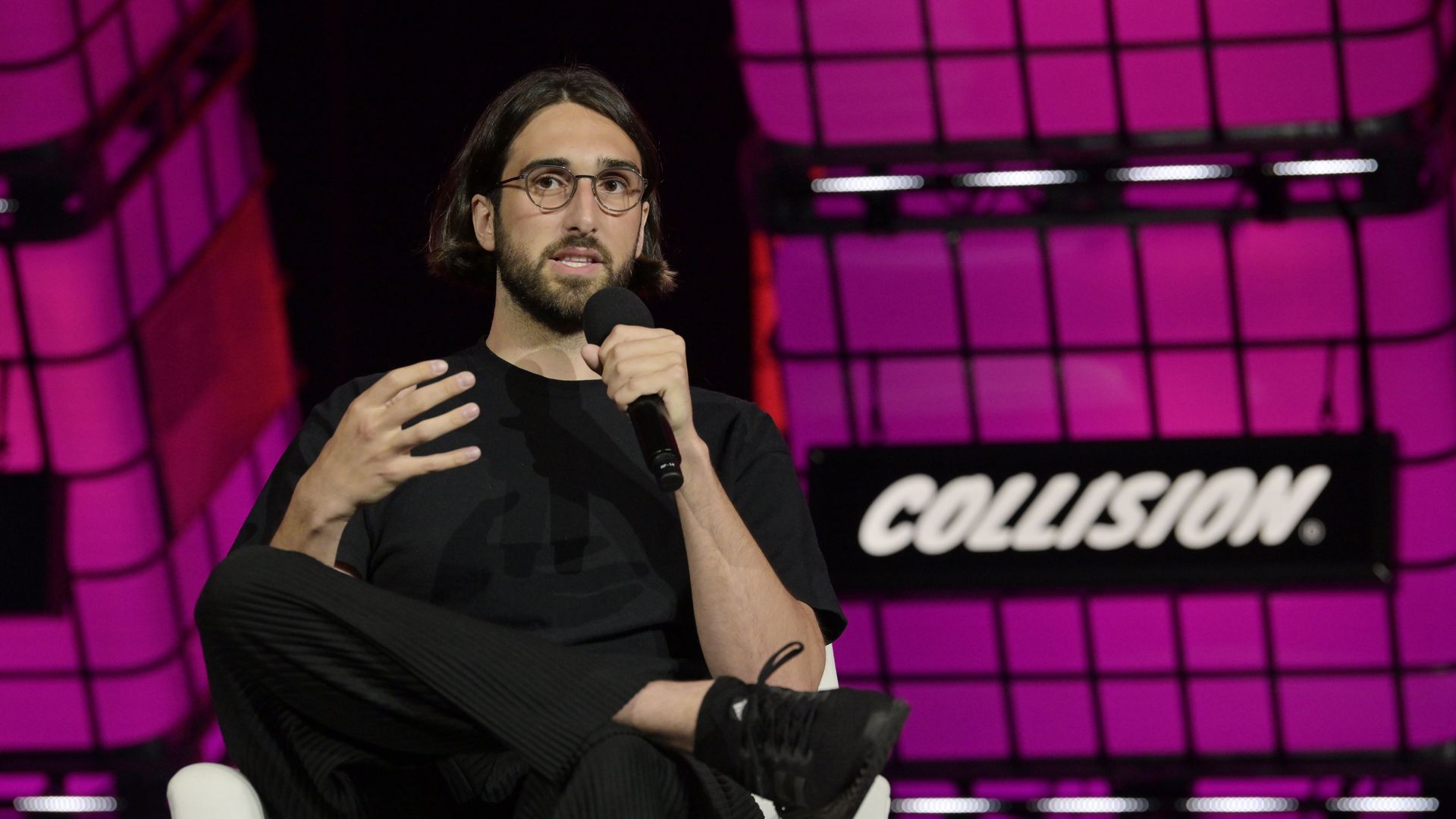
Aidan Gomez in Toronto in June. Photo: Piaras Ó Mídheach/Sportsfile for Collision via Getty Images
For enterprise AI companies like Cohere, it's a welcome development that government is thinking about regulation now as opposed to years into generative AI's boom, CEO Aidan Gomez told Axios in an interview last week.
What's happening: After pledging to voluntary "responsible AI" commitments at the White House, Gomez chatted with Ashley about the U.S. vs. Canada and the United Kingdom when it comes to tech regulation, why enterprise AI companies need different rules from consumer-facing ones, and more.
This interview has been edited and condensed for clarity.
What is your take on the voluntary commitments the White House is leading for "responsible AI"? What do they really mean?
I think this time we are early, and before wide deployment we're getting these commitments and we're all really thinking through how to make this stuff go well and ensure that both consumers and enterprises are protected.
- I'm excited to see that there's such close engagement from the government with experts like the folks who have been in research for decades on this stuff.
How should people be thinking about the key differences between consumer and enterprise generative AI?
In one case, you're putting it directly in the hands of the general public, which might not necessarily have the expertise or familiarity with this technology to properly understand it.
- When you have organizations that are already deploying this tech, they have some degree of expertise inside them with AI, so they might be more familiar with the technology. But they require a certain set of protections in order to adopt it.
What sort of protections are you talking about?
Data privacy is a big one. We can't have new risks in terms of data leakage, or these models picking up proprietary data to organizations and leaking it to the outside world. There's a lot of unique concerns on the enterprise side.
- I think this administration and this group at the White House really cares about protecting that, as well as the broader consumer-focused efforts.
Cohere has offices in Toronto, NYC, California and the U.K. Is that complicated for the company when it comes to conversations around policy?
It's three parties, so it's not overwhelming. They're quite tightly knit and coordinated among the three of them. Everyone is speaking to each other, trying to wrap their heads around this and trying to come up with some consistent set of guidelines.
Are doomsday scenarios that have been laid out for AI overblown?
A lot of what bad actors could do with open source models is very real ... but a lot of it is a distraction from the actual stuff that could go wrong, which is a little more banal or less extreme.
- I don't want to see this extreme vision of the future dominate our discourse when what we should be protecting against is much more well known and understood, such as misinformation and very scalable phishing campaigns and data privacy.
- It's not new risk, it's very amplified existing risk.
- When we talk about concrete regulation, we have to stay focused on the risks that are most likely.
What would be the most useful type of regulation for a company like Cohere?
Guidelines on the sorts of safeguards that are required for particular use cases; for instance, deployment of these models into medical or legal scenarios. That would make it a lot easier for us and our customers to feel comfortable actually pressing the button on deployment and moving ahead.
- We don't have a certain safety around clearly moving forward [in some industries]; having those guidelines, that is what good regulation does.
Ashley's thought bubble: Governments are going to have to shift out of the regulatory mindset that developed around social media and remember businesses and individual people have different needs and uses for laws around generative AI.
- The biggest companies, often serving consumers, tend to dominate discourse around regulation while generative AI is already being used daily by businesses without incident.
2. Hill hearing watch

Illustration: Tiffany Herring/Axios
It's another action-packed week on the Hill — here's what to watch.
1. Intel and AI: The Senate Intel Committee holds an unusual open hearing tomorrow at 2:30pm ET. Senators will discuss the national security implications of AI with academics and Yann LeCun, Meta's chief AI scientist.
2. CHIPS: Commerce Secretary Gina Raimondo heads to the Hill tomorrow at 10am ET to look back at one year of the CHIPS and Science Act with the House Science Committee.
3. Rural broadband: The House Energy and Commerce communications and technology panel gathers Thursday at 9am ET to discuss rural broadband and broadband funding.
4. IP and China: The House Judiciary Subcommittee on courts, intellectual property, and the internet meets Wednesday at 3pm ET for the third hearing in its series on IP and strategic competition with China.
- This one will focus on IP theft, cybersecurity and (what else?) AI.
5. AI in financial services: The Senate Banking Committee dives into AI and the finance sector Wednesday at 10am ET.
6. FTC noms: The Senate Commerce Committee convenes a nominations hearing for Republicans Andrew Ferguson and Melissa Holyoak, and the renomination of Democratic commissioner Rebecca Kelly Slaughter, Wednesday at 10am ET.
- Ferguson currently serves as Virginia solicitor general and previously was chief counsel to Senate Republican leader Mitch McConnell.
- Utah solicitor general Holyoak was president and general counsel of the public interest law firm Hamilton Lincoln Law Institute.
7. FCC approps: The Senate Appropriations panel on financial services and general government meets tomorrow at 2:30pm ET to hear from FCC Chair Jessica Rosenworcel as it reviews the agency's FY2024 budget.
8. E&C member day: E&C holds a member day hearing tomorrow at 2pm ET so lawmakers can share their relevant priorities with the committee.
9. Advanced tech meets natsec: The Homeland Security & Governmental Affairs subcommittee on emerging threats and spending oversight also meets tomorrow, at 2:30pm ET.
- Senators will hear from outside experts on advanced technology's threats to national security.
10. Supply chains: E&C's innovation, data and commerce subcommittee gathers Wednesday at 10:30am ET for a legislative hearing to review bills focused on securing America's supply chains and combating China.
✅ Thank you for reading Axios Pro Policy, and thanks to editors Mackenzie Weinger and David Nather and copy editor Brad Bonhall.
- Do you know someone who needs this newsletter? Have them sign up here.
View archive