
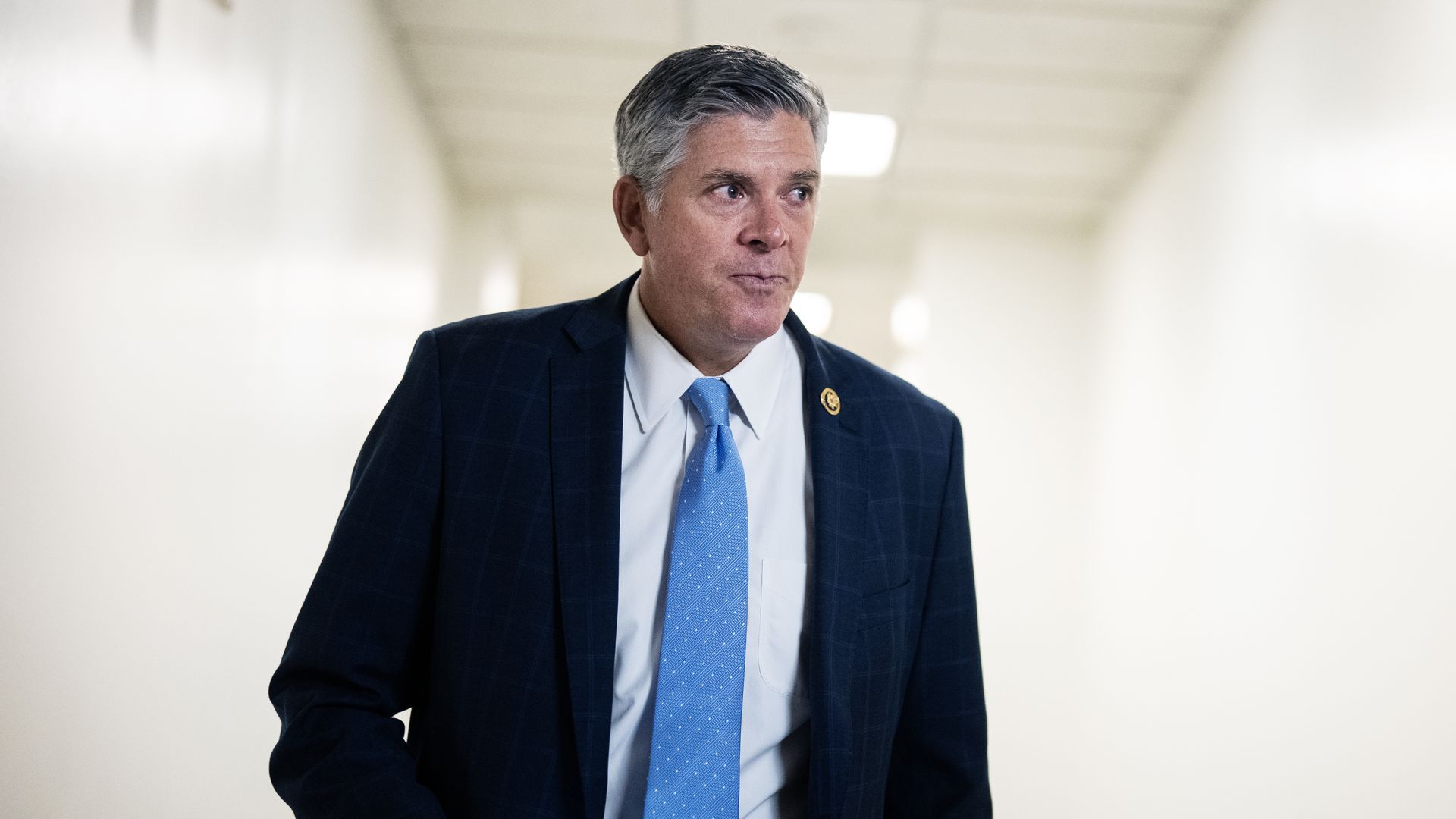
Rep. Darin LaHood on Sept. 24, 2024. Photo: Tom Williams/CQ-Roll Call, Inc via Getty Images
Rep. Darin LaHood is positioning himself as a liaison between two committees at the center of AI and national security.
Why it matters: The Illinois lawmaker is the only Republican who sits on both the Intelligence and China Select committees, among the few bastions of bipartisanship remaining on the Hill.
- We sat down with LaHood in his office shortly after he introduced legislation to help thwart China's access to advanced U.S. tech.
- He's also behind a bipartisan bill to ban DeepSeek on government devices.
This conversation has been edited and condensed for clarity.
Have you talked to House leaders about your bill to ban DeepSeek? Is there a strong appetite for it?
The answer is yes.
- I think we're going to have some type of series of China bills at some point, and I anticipate this will be part of that.
Why should Congress pursue a new ban on an app when the TikTok ban is not being enforced?
I've been very frustrated with the Trump administration — that TikTok has not gone dark.
- Those fears and those vulnerabilities and what we raised are still there. They haven't gone away. I would argue they've almost become more enhanced in many ways.
- And remember, JD Vance, Marco Rubio, Mike Waltz — all these people voted for the bill that are part of the administration now and are playing a role.
What's your response to the argument that export controls actually hurt U.S. competitiveness because you're shutting off China's massive market and incentivizing innovation within China?
There is clear evidence that we've seen on the China Select Committee and on the Intelligence Committee that shows that there is a direct coordination, collaboration and partnership between the CCP and these entities.
- You're feeding the hand that's hurting us from a national security standpoint and from a technology standpoint.
- You couple that with the theft of intellectual property that we've seen in many different sectors, and there's a lot of concern there.
In the president's FY26 budget request, Commerce's Bureau of Industry and Security is poised to get more money while NSF, NIST and DOE are facing steep cuts. Do they need more resources, too, for the U.S. to be competitive?
I think within the intel space, you'll see consistent and robust funding in these areas that relate to China.
- There may be areas that have been trimmed or cut back or made more efficient, but when it comes to China, I think it remains a priority and an emphasis in the administration.
Did you know there was an AI moratorium in the reconciliation bill when you voted for it and are you supportive of it?
I did. I voted for it.
- I do think 10 years may be a little too long.
- Having 50 states all passing individual laws — that creates lots of confusion and a patchwork of different regulations.
- I'm real concerned about slowing down the innovation that we need in AI. If it was five years, I'd probably be happier with that, but I think some type of moratorium is a good thing.
Why are you leaning into AI policymaking?
Between the Intel Committee and our focus on the China Select Committee, there's a recognition that China has a plan to replace the United States and they're working at it every single day.
- When you think about AI, we need to win that, and China is on our heels. So we got to be thinking proactively. We got to be passing laws.
