
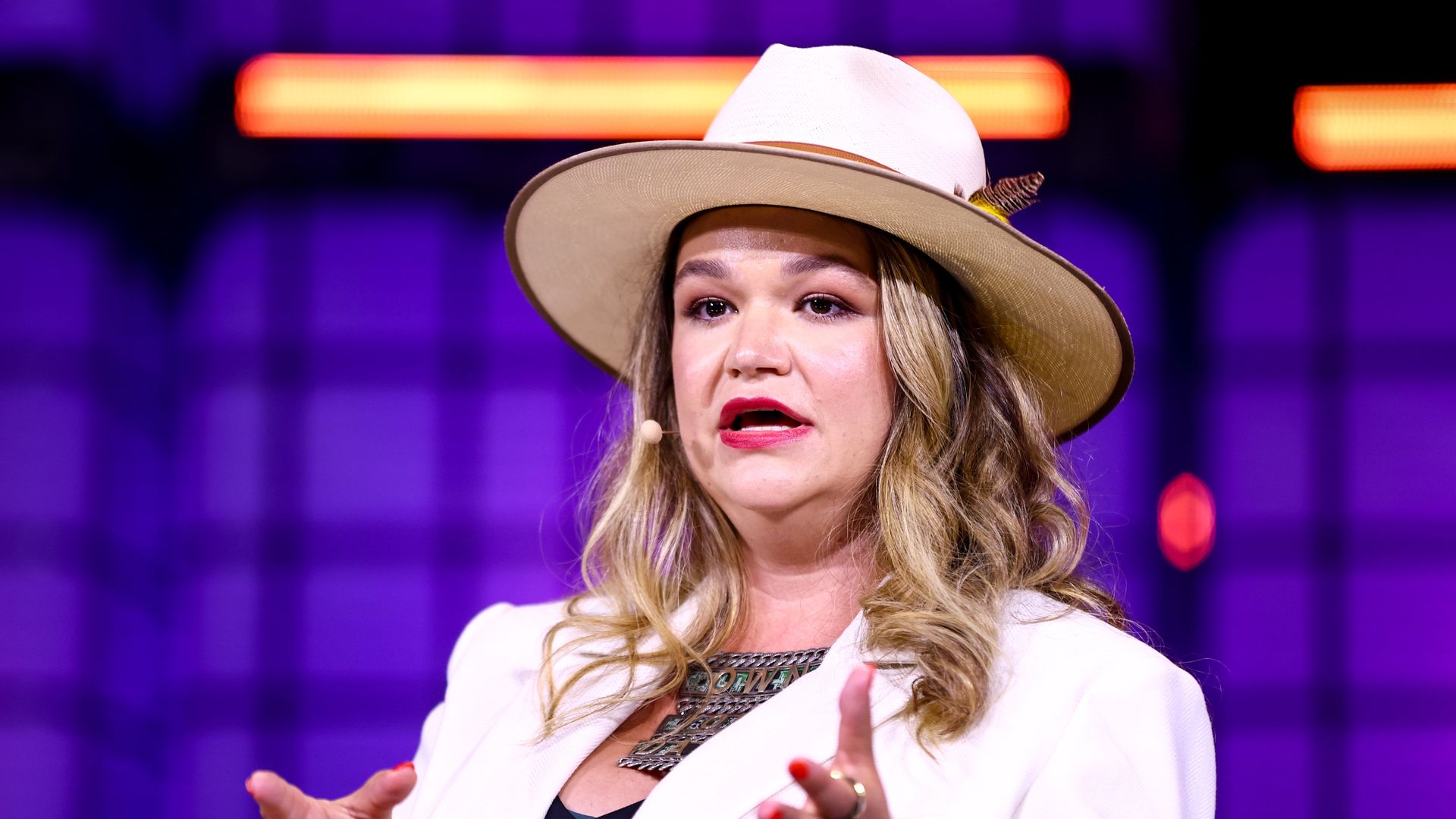
Brittany Kaiser at Web Summit Rio 2025 at Riocentro in Rio de Janeiro, Brazil. Photo: Vaughn Ridley/Web Summit via Sportsfile via Getty Images
Open Source AI Foundation co-founder and chair Brittany Kaiser chatted with Axios during the Web Summit in Rio last week on open source AI systems and prospects for a data privacy law.
Why it matters: Kaiser was a Cambridge Analytica whistleblower and served at the Commerce Department.
- She's also president of the Own Your Data Foundation and chief strategy officer for Eliza Systems, a new initiative to lobby the Trump administration around upcoming AI legislation that would mandate all government technology be open source.
- It's a subsidiary of Eliza Labs, which provides decentralized AI technology.
This conversation has been edited and condensed for clarity.
Eliza Systems is your latest venture — what problem are you solving that wasn't already being addressed?
So for Eliza Systems, our huge opportunity is to offer ethical, transparent, open source AI systems as governments are starting to adopt it right now.
- There are a lot of different companies that are competing for these contracts.
- Right now, most of them that are winning the contracts are closed source companies where we have no idea how the technology functions or how the data is being used.
- Usually when open source systems are built out, they're built in order to keep all of the data where it is, which would be a much better way for the government to actually function right now.
How are you thinking of this in relation to DOGE and its handling of data?
I think a lot of people are worried that with ... DOGE accessing loads of people's information, how is that being used? Is it safe?
- What you can do with a proprietary, open source system, is you can see exactly what is being done, because all the code is published so it can be publicly audited.
- I think there's definitely a zeitgeist for that right now, for the public to actually know how the tech is functioning and where their data is going.
What's an example of how a federal agency can benefit from this?
HHS — this is a very human-focused government service.
- You can provide human-like services to tons of citizens at once without actually going to hire tens of thousands of people.
- It really streamlines the amount of personal care and attention that individuals can get.
- And AI can help streamline data collection processes that help with things like vital records or getting appointments.
What are the prospects for a federal privacy law passing in the U.S.?
I don't think there's going to specifically be a federal privacy law. I think there's going to be federal AI law and federal digital asset law, or crypto, that will address data ownership and traceability of data.
- I think it's going to be a lot faster to see a federal specific AI bill that has a lot of different components and addresses data.
- We haven't been able to get a federal data law through the entire 10 years I've been working on it.
- It's always way too politicized, but I think everyone can agree that we definitely need legislation on digital assets, and we definitely need legislation on AI.
What's next for you?
Sen. Cynthia Lummis is the biggest digital asset advocate that we have in the government.
- We're looking at introducing a federal bill all about focusing government agencies that are civilian facing on using open-source AI for tracking and traceability of data
