
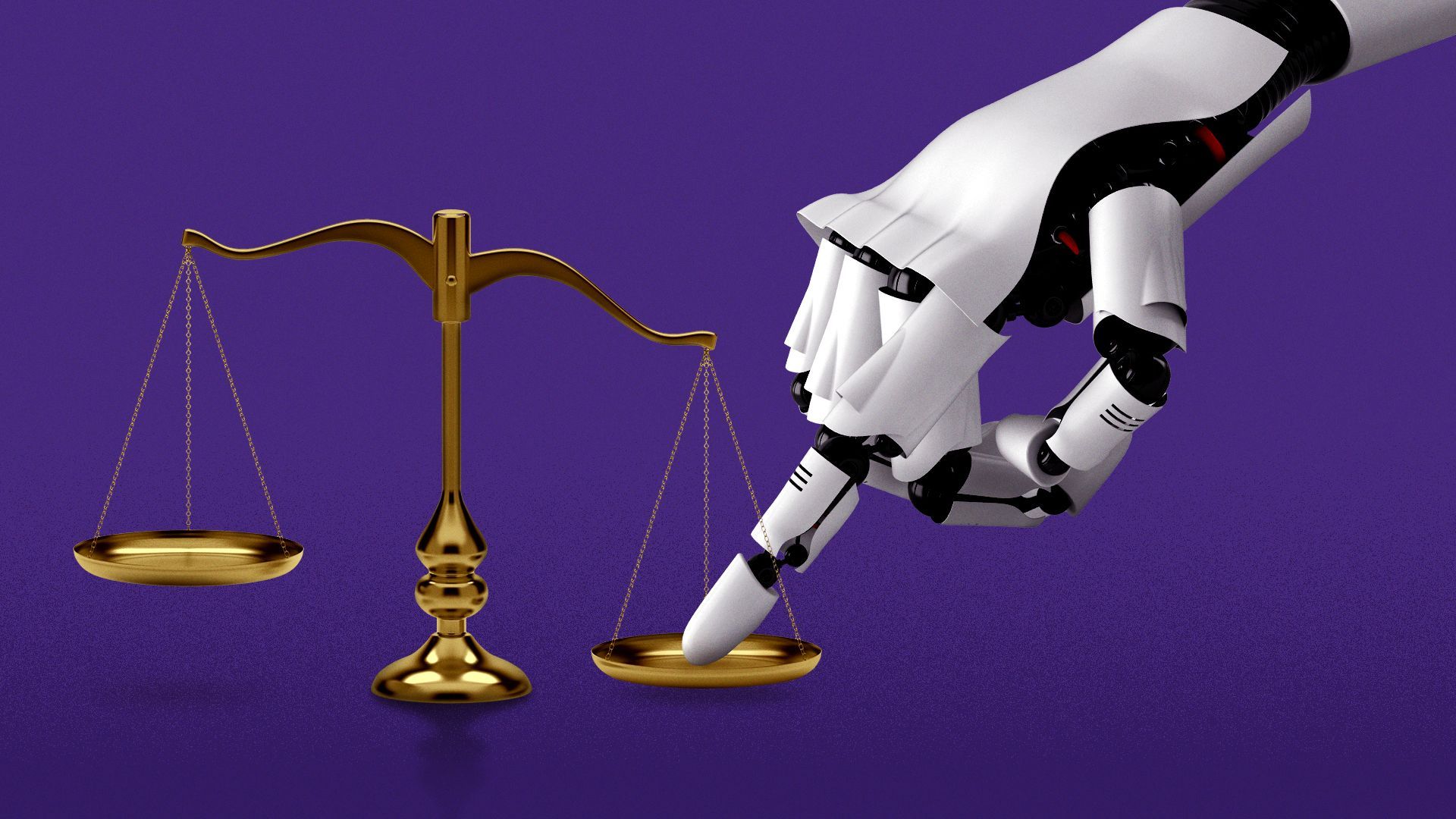
Illustration: Allie Carl/Axios
The Trump administration is telling agencies that protecting privacy is critical when using AI, but civil rights advocates say that isn't playing out in reality.
Why it matters: Office of Management and Budget director Russell Vought's updated guidance for federal agency use of AI previews the direction the Trump administration wants to take with the technology — and its own words suggest that privacy should be protected.
What's inside: Vought in the memo directs agencies to maintain "strong safeguards for civil rights, civil liberties, and privacy" as they provide improved services to the public.
- Vought categorizes AI use in immigration and asylum decisions as high-impact, meaning that in these cases agencies have to minimize risks and prioritize safety.
- That involves pre-deployment testing; assessing whether data is being used appropriately; human reviews of civil rights and privacy violations; and giving people a chance to appeal when they've been negatively impacted by an AI-enabled decision.
Friction point: DHS recently struck a data-sharing agreement with the IRS related to people suspected of being in the U.S. without documentation.
- The agreement says tax information used for AI purposes must be disclosed to the IRS Office of Safeguards to make sure it's in compliance with safeguard requirements, without elaborating.
What they're saying: Center for Democracy and Technology's Quinn Anex-Ries in a statement to Axios noted OMB's memo includes heightened protections for AI use in immigration contexts.
- "Yet these protections are largely missing from this [IRS] agreement, which appears to be out of alignment with the overarching goals and obligations imposed by OMB's guidance," Anex-Ries said.
- Advocates also say the agreement violates a privacy law stating the IRS is forbidden from sharing tax return information with other parties.
- "If you have a John Smith that DHS is looking for, IRS has a difficult job to figure out who that is, and this where AI will probably play a role, not only in processing the records, but matching them," ACLU's Cody Venzke said.
The other side: The IRS-DHS MOU is meant "to establish a clear and secure process to support law enforcement's efforts to combat illegal immigration," a Treasury spokesperson said, pointing to statutory authorities to do so.
- The privacy law that advocates point to has an exemption that obligates the IRS to assist law enforcement in the pursuit of criminals.
- OMB and DHS did not respond to requests for comment.
DHS plans to screen the social media accounts of people suspected of being in the U.S. without documentation also involve automated tools that advocates say are error prone.
- "If people are being caught up and falsely deported thanks to artificial intelligence, that's going to undermine the entire AI enterprise," Venzke said.
- "So if the administration is serious about its commitment to trustworthy innovation, it will ensure that these technologies meet the requirements of the OMB memo," he added, noting he has not seen testing or reporting of the technologies being deployed.
Flashback: The Biden administration's DHS was eager to adopt AI, and said chief AI officers could waive civil rights and privacy risk assessments when they impede on law enforcement and national security operations.
- UnidosUS senior policy director Laura MacCleery had pushed for then-President Biden to close that loophole because it could lead to misuse in immigration enforcement.
- "When you combine powerful technological tools for social monitoring with an approach to government that uses the resources of government to pursue nakedly political objectives, and to punish those who would oppose your agenda, then we are moving very close to scenarios in which guardrails on paper mean very little," she said.
- The updated OMB guidance allows for waivers for critical agency operations.
The big picture: DHS is one of many agencies that is supposed to square away its practices with OMB's stated privacy and civil rights priorities, especially as DOGE taps into AI and mishandles data.
- House Oversight Committee Democrats have asked 24 federal agencies to provide documentation that any potential AI use complies with federal laws, protects data, and does not financially benefit Elon Musk.
- "If the Administration is using AI to monitor social media and scrape IRS data to carry out their abductions and anti-immigrant agenda, this is a massive violation of civil liberties and federal privacy laws and is counter to the Administration's stated guidance on the government's use of AI," House Oversight Committee Ranking Member Gerry Connolly said in a statement.
