
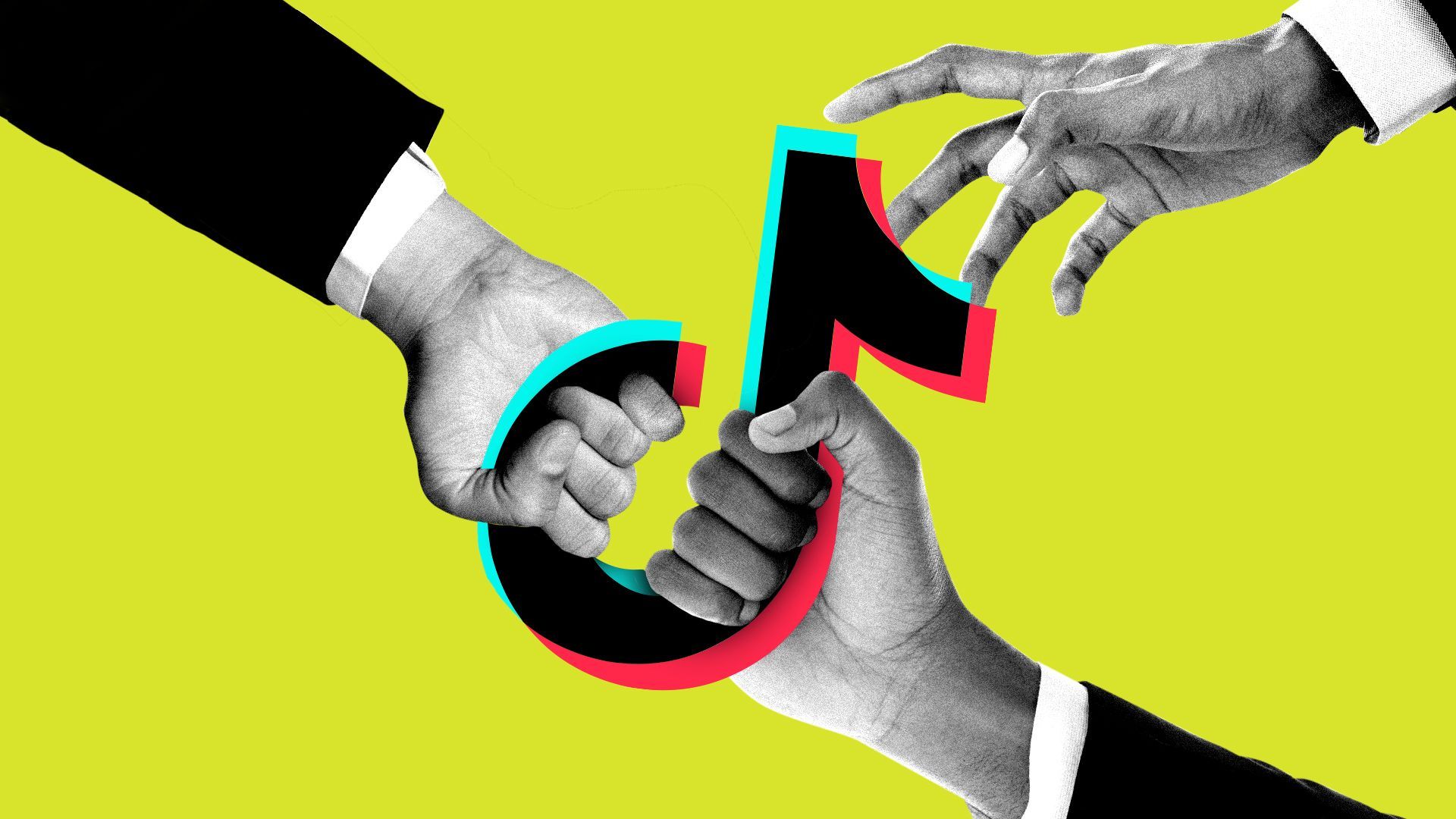
Illustration: Aïda Amer/Axios
The Supreme Court on Friday could decide to pause a looming TikTok ban after hearing oral arguments that day.
Why it matters: TikTok and President-elect Trump are both asking for a pause to give the incoming administration time to make its own assessment of the issue.
- TikTok and its Chinese parent company ByteDance also argue that even a temporary ban would cause irreparable harm to the platform.
The question at the heart of Friday's proceeding is whether or not the ban violates the First Amendment.
- TikTok says it does because 170 million people use the app for speech.
- Further, TikTok says the government made the ban about content when lawmakers publicly took issue with pro-Palestine TikToks or harms to children.
- Concerns over foreign influence campaigns also relate to content, TikTok said.
DOJ says the law has two main objectives that are unrelated to the First Amendment and should be decided on national security grounds.
- One is to protect Americans' sensitive information and data from China, which "has nothing to do with expression at all," the brief states.
- The law's other objective is to prevent covert manipulation from the Chinese government, which does not have First Amendment rights.
If TikTok can convince SCOTUS that this is about freedom of speech, it will be harder to impose a ban based on national security concerns because any potential infringement on that constitutional right is scrutinized much more strictly than other matters.
- When the D.C. Circuit Court of Appeals ruled to uphold the law, it focused on the First Amendment, saying the government acted to protect freedom of speech in the U.S. from a foreign adversary and limit that adversary's ability to gather people's data.
For Trump, who is sensitive to perceived conservative censorship, this issue is also about speech.
- In a SCOTUS filing, Trump's lawyer emphasizes the incoming president "is one of the most powerful, prolific, and influential users of social media in history" with 14.7 million TikTok followers.
- And as the founder of Truth Social, Trump has "an in-depth perspective" on "the power of the federal government to effectively shut down a social-media platform favored by tens of millions of Americans, based in large part on concerns about disfavored content on that platform."
Our thought bubble: A pause could signal greater willingness from the court to punt the issue back to Trump and Congress.
- Trump could secure a qualified divestiture under the law, but he would have to somehow overcome ByteDance's adamant refusal to sell the most important part of TikTok — its algorithm.
- If SCOTUS decides to strike down the law, justices would be going against the overwhelming majority of Republicans and Democrats who voted to pass it, the D.C. Circuit Court of Appeals, and the Biden administration.
Members of Congress are lining up on both sides of the TikTok fight in filings to the Supreme Court.
- Sens. Ed Markey and Rand Paul, as well as Rep. Ro Khanna, say Congress did not consider whether "less drastic" measures could protect people's data from China and the ban should be overturned.
- Sen. Mitch McConnell urged SCOTUS to deny a pause, saying "TikTok clearly hopes that the next administration will be more sympathetic to its plight than the incumbent administration."
Former national security government officials who served at the highest levels of government and for leaders of different political parties reminded SCOTUS that China's national intelligence law requires ByteDance and TikTok to assist with intelligence gathering and providing massive troves of American data.
- "The government's compelling national security interests overcome any applicable level of First Amendment scrutiny," the brief states.
Advocacy groups are also weighing in on the case.
- Asian Americans Advancing Justice say the TikTok ban and other measures popping up across the country "are unfortunate and potentially dangerous modern analogues to the long history of racial discrimination against Asian Americans generally and those of Chinese descent specifically."
- The ACLU, Electronic Frontier Foundation, and The Knight First Amendment Institute called the law "a sweeping ban on free expression."
What's next: SCOTUS took on the TikTok case in an expedited manner and allocated two hours for oral arguments, which will begin Friday at 10am.
- That same day, judges could decide whether to grant a pause on the ban set to take effect Jan. 19.
