

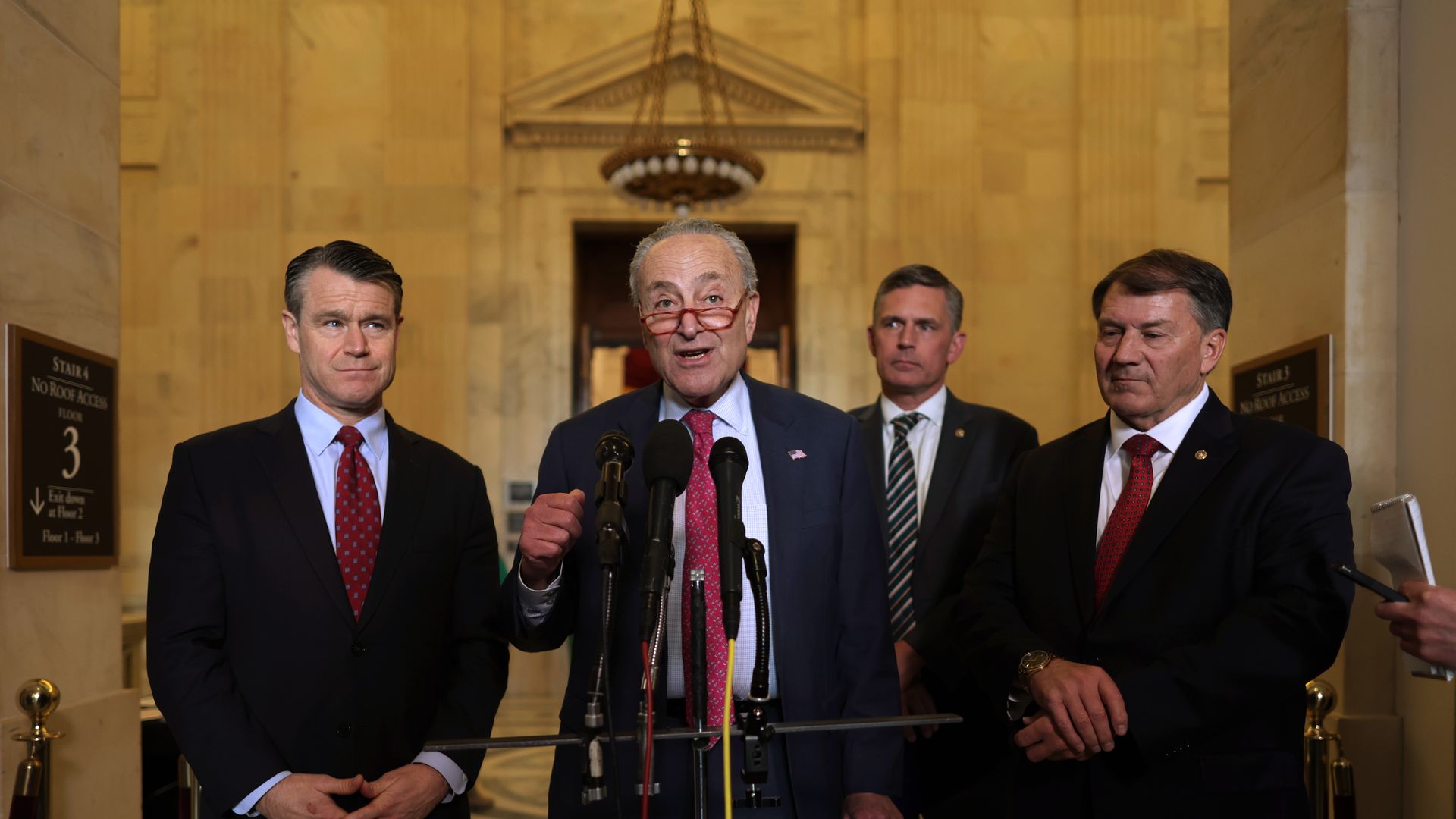
Schumer speaks as Young, Heinrich and Rounds listen after the Nov. 1 AI insight forum. Photo: Alex Wong/Getty Images)
The Senate will wrap up its insight forums on AI for the year this week, with industry and other policymakers hoping the closed-door sessions held since the fall will lead to significant legislative groundwork in 2024.
Driving the news: Senate Majority Leader Chuck Schumer will lead two AI insight forums Wednesday, one on "doomsday scenarios" and another on national security.
Details: Some featured participants for the "Risk, Alignment & Guarding Against Doomsday Scenarios" forum will include:
- Amanda Ballantyne – AFL-CIO, Technology Institute director
- Malo Bourgon – Machine Intelligence Research Institute, CEO
- Martin Casado – Andreessen Horowitz, general partner
- Jared Kaplan – Anthropic, co-founder
- Aleksander Madry – OpenAI, head of preparedness
National security participants will include, among others:
- Alexandr Wang – ScaleAI CEO and founder
- Alex Karp – Palantir CEO
- Faiza Patel – Brennan Center for Justice, senior director of the Liberty and National Security Program
- Former Sen. Rob Portman
Reality check: A common thread we've been hearing in our reporting is that focusing on the aforementioned "doomsday scenarios" of AI is a distraction from more common or short-term risks, or a fear tactic meant to entrench bigger players.
What they're saying: "One point I want to get across is that policymakers should remain clear-eyed in discussions around doomsday scenarios," ITIF's Hodan Omaar told Axios.
- "There are enough proponents of the idea that 'God-like AI' is on the horizon that policymakers feel compelled to act ... [but] policymakers should not let dogmatic narratives drown out [and] prevent good-faith efforts to address potential risk scenarios."
The other side: In written remarks for the forum shared in advance with Axios, Malo Bourgon tells lawmakers that "developers will soon be able to build AI systems that surpass human performance at most tasks."
- He writes that "loss-of-control scenarios" will result if "smarter-than-human AI" is developed without greater technical understanding, and calls advanced deep learning-based AI systems "akin to black boxes."
In the national security space, AI can optimize military logistics and improve intelligence analysis, but workforce shortages, infrastructure issues and a lack of funding are barriers to taking full advantage of the technology, proponents say.
- Michèle Flournoy, WestExec Advisors managing partner and former undersecretary for policy at DOD, will advocate for building a "common digital infrastructure system," which means ensuring defense system interoperability by using the cloud, establishing data standards and sharing secure software.
Attendees will stress adopting AI responsibly but quickly as not remaining technologically competitive in the national security space — namely against China — can imply more existential threats.
- ScaleAI's Wang will say the speed of AI innovation is outpacing the government's ability to acquire it.
- "Congress must work within the annual appropriations process to provide money closely tied to technological realities of today, not 18 months ago," Wang will say.
- Wang will also call on lawmakers to set a target of all DOD data to be "AI-ready" no later than 10 years from now.
What they're saying: Microsoft's Bill Chappell, chief technology officer of strategic missions and technologies, will emphasize the importance of responsible experimentation with AI as a way to get "quick and effective" AI integration into military operations.
- "To use this amazing new technology properly and responsibly, our national security community needs a stronger culture of experimentation and innovation, led from the top and properly funded.
Our thought bubble: While AI is developing at breakneck speed, difficult-to-reverse regulation needs to be developed thoughtfully — and that takes time.
- In the national security space, moving too fast may hamper innovation in more consequential defense applications rather than just the next best chatbot.
What's next: Expect more AI forums next year, though the format and topics will likely shift.
