
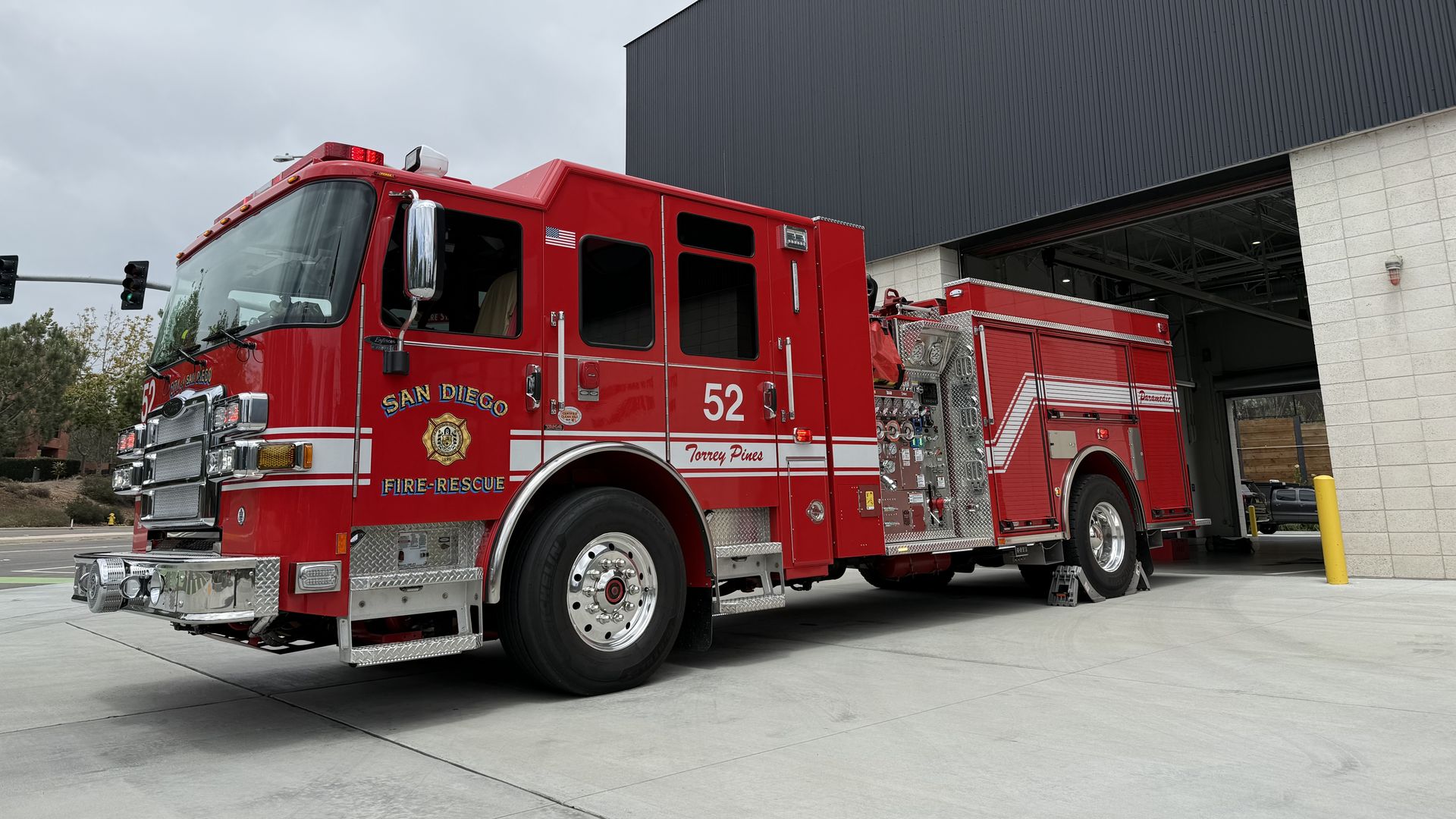
I was excited to see an electric firetruck firsthand earlier this year, but I didn't fully understand the rationale for one. After all, even the crunchiest climate advocate can tolerate diesel when it's saving lives.
The big picture: Firefighters argue that employee health concerns are an essential driver — including fumes in the firehouse and ear-splitting engine noise.
Zoom in: Upon visiting San Diego's Torrey Pines Fire Station, I saw a box next to the passenger door of a Pierce Volterra fire engine.
- "That for me?" I asked, assuming the crew had put it there as a climbing courtesy into the tall cab.
- "They're for us," Capt. Cameron Snyder responded — pointing out the boxes in front of every other door to the engine. Taking that big step through the decades wears on the body.
The intrigue: That crystallized for me why American towns and cities are buying — and manufacturers like Pierce are building — battery-powered fire trucks.
Follow the money: During a $22 million makeover of the San Diego fire department's Station 52, the department paid $2.1 million for the engine, plus another $600,000 for a pair of charging systems.
- That's about twice the price of a standard fire engine.
- Close to two dozen agencies have bought or ordered an electrified fire engine from Pierce or competitors Rosenbauer and E-One.
Zoom in: The Pierce Volterra, made by an Oshkosh Corp. subsidiary, produces zero air pollution and is whisper-quiet.
- "We live here; a third of my life is spent in a firehouse," engineer Kevin Taddonio tells Axios Pro. "It's pulling into your own house and not having those particulates."
- The near-silent operation meanwhile reduces the risk of long-term hearing loss and makes for safer roadside emergency scenes. "I can hear traffic coming," Taddonio adds.
How it works: The Volterra has a backup diesel engine that kicks in as soon as the battery is depleted — after roughly 90 minutes of continuous water-pumping at a fire.
- The hybrid approach enables the Volterra and its crew to stay on-scene. But the diesel engine is roughly half the size of a normal engine, limiting driving power.
What's next: San Diego plans to replace one engine at each new station it builds with an e-powered fire truck.
