June 09, 2025


Hello Monday. Here's a look at what health provisions could get knocked out of reconciliation by budget rule challenges.
1 big thing: Health provisions that could be axed by Byrd Rule
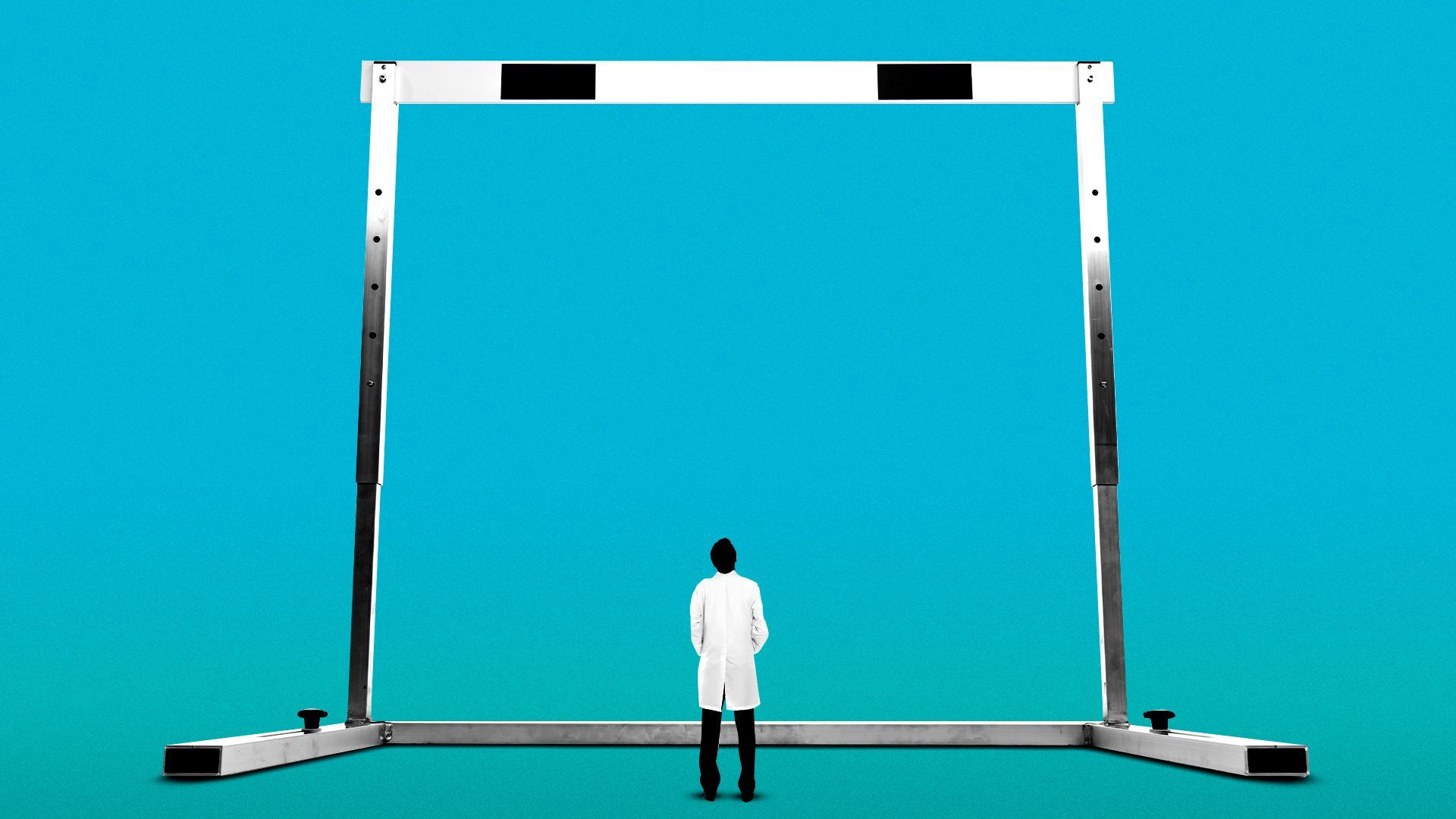
There's an extra hurdle in the Senate for Republicans' megabill: Each provision has to have an intentional budget impact under reconciliation rules — otherwise, it could get thrown out by the parliamentarian.
Why it matters: Some key stipulations, including abortion measures and penalties for states covering undocumented immigrants, could be scrapped.
We talked to sources in both parties about which health provisions from the House-passed bill could be eliminated by the so-called Byrd Rule, which requires that provisions have a sufficient effect on the budget.
- Although the parliamentarian rulings haven't happened yet and the text could be tweaked in the Senate, here are provisions most likely to be axed.
1. FMAP cut for states covering undocumented immigrants
The House-passed text would cut from 90% to 80% the federal share of Medicaid costs (FMAP) for states that cover undocumented immigrants with state funds.
- Cutting the FMAP has a budgetary impact but could still run afoul of the Byrd Rule by being viewed as "merely incidental" to the true intent of the provision: pressuring states to change which groups they cover with their own funds.
- "I feel pretty darn confident that the FMAP decrease is going to fall out," said Bobby Kogan, a former Democratic Senate Budget Committee staffer now at the Center for American Progress.
- He described it as "shoehorning a budgetary effect into trying to get a state to do something with its own dollars."
2. Abortion restrictions on CSR funding
The bill would fund cost-sharing reduction (CSR) payments to insurers in the ACA marketplaces but would prevent those payments from going to plans that cover abortion (other than in certain exceptions, including for the life of the mother).
- Those abortion restrictions could conflict with the Byrd Rule's budgetary effect requirements, sources say.
- If the abortion restrictions are struck, it is possible Republicans would remove the CSR funding altogether, given that some GOP senators do not want to vote for the funding if it lacks abortion restrictions.
3. Defunding abortion providers
The bill would cut off certain abortion providers from Medicaid funding. Although the text does not include Planned Parenthood by name, Democrats argue that the provision is aimed at the organization.
- If the provision is viewed as targeting a specific organization, it could conflict with the rule, so whether it stays could depend on whether Republicans can argue that the provision would have a broader impact.
4. Gender-affirming care funding ban
The bill would block federal Medicaid funds for gender-affirming care.
- It's possible that provision would be viewed as primarily a policy change on gender-affirming care rather than being sufficiently intended to have a budget impact, and it could be struck.
What we're watching: None of these scenarios are certain to happen, but Democrats can at least make their case before the parliamentarian on a range of measures.
- "Dems will go through everything with a fine-tooth comb," Kogan said.
2. Trump turns focus to state-directed payments

President Trump threw a wrinkle into the reconciliation debate with a Friday memo characterizing state-directed payments in Medicaid as an example of "waste, fraud and abuse."
Why it matters: It's another instance of the Trump administration portraying its policy priorities as a way to root out mismanagement and wrongdoing within federal health care programs.
What's inside: The memo directs HHS Secretary Robert F. Kennedy Jr. to ensure that Medicaid provider payments are not higher than Medicare's and notes that an imbalance "threatens to jeopardize access to care for our seniors."
- Trump said that under the Biden administration, states and providers were allowed to "game the system" through a process in which states taxed providers, then used the money as supplemental payments to hospitals and other entities.
- The extra payments also meant the federal government had to provide an additional "burden-sharing payment" that left providers receiving much more than the Medicare payment rate.
By the numbers: The White House cited a statistic from MACPAC that state-directed payments have rapidly accelerated over the last four years and reached $110 billion in 2024.
- MACPAC said that $110 billion was nearly a 60% increase over the $69 billion in expected projected spending.
Between the lines: The fact that Trump signed a memo on the issue at this point is significant, since the reconciliation bill contains provisions that would cap Medicaid state-directed payments at the rate that Medicare pays providers.
- A provision was also added in the House manager's amendment that would allow state-directed payments to be higher in states that have not expanded their Medicaid programs, which could serve as a deterrent for any states considering expansion.
What's next: Senators could still make changes to the Medicaid portion of the reconciliation bill, and the memo made clear where Trump's line is for now.
3. Catch me up: NIH hearing, Newsom's Medicaid plan
/2025/06/09/1749471105149.gif?w=3840)
- NIH hearing: Director Jay Bhattacharya will face a grilling over Trump administration cuts to the agency's budget and other changes at a Senate Appropriations Labor-HHS subcommittee hearing tomorrow at 10am ET.
- Newsom's choice: California Gov. Gavin Newsom is getting heat for considering Medicaid cuts to undocumented immigrants, Shawna Chen reports.
- ACIP cuts: Four of the 19 members on the expert panel that advises CDC on immunization practices received termination notices, and Kennedy gets final say on who would fill the positions, STAT reports.
- Academic grants: Williams College in Massachusetts appears to be the first college or university to decline NIH or NSF grants because of new Trump administration DEI requirements, Science reports.
4. Document watch: Drug pricing, HHS watchdog

- Drug pricing: CRS outlined legal issues around Trump's "most favored nation" order and how it could interact with laws including the Inflation Reduction Act.
- Watchdog report: HHS' inspector general's office released a semiannual report identifying more than $16 billion in overpayments, fraudulent billings and possible cost savings in health programs.
- Diagnostic tests: GAO made recommendations for HHS to a create a national testing strategy for infectious diseases with pandemic potential, such as avian influenza.
✅ Thank you for reading Axios Pro Policy, and thanks to editors Adriel Bettelheim and David Nather and copy editor Brad Bonhall.
- Do you know someone who needs this newsletter? Have them sign up here.
View archive