

April 22, 2025
Welcome back. We have a first look at the latest Q1 lobbying disclosures and how health influence is playing out under the GOP trifecta.
- If you have tips on people changing jobs in the health world, send them here for our next installment of people moves.
1 big thing: Medicaid debate drives Q1 lobbying
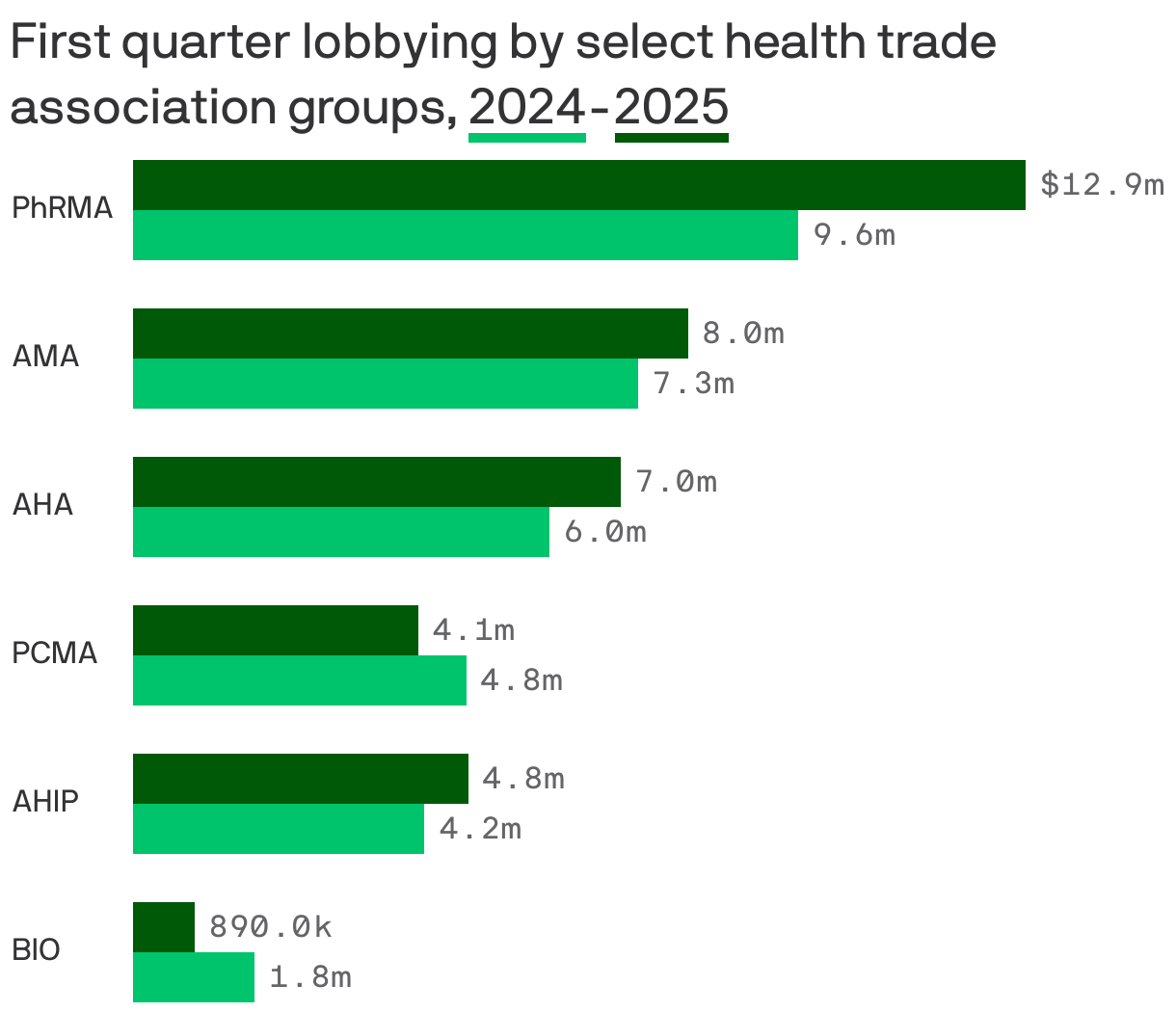
The specter of Medicaid cuts and expiring Affordable Care Act tax credits stoked first-quarter lobbying by hospital and insurer trade groups, a review of new 2025 disclosure forms shows.
Why it matters: The numbers offer the first glimpse at how health care industries are aligning and trying to shape policy in the second Trump administration and with a GOP trifecta in charge, Victoria reports.
By the numbers: The American Hospital Association boosted year-over-year Q1 lobbying spending by more than $1 million.
- Insurers also ramped up activity, with AHIP putting up $4.8 million in 2025, compared with $4.2 million in the first quarter of 2024.
Many hospital groups are warning that reduced Medicaid payments and a phaseout of ACA subsidies could be ruinous, especially to rural facilities.
- The Federation of American Hospitals, which represents for-profit hospitals, increased its spending to $1 million from $650,000 a year ago.
- America's Essential Hospitals, which represents safety-net hospitals, upped its spending by $230,000.
The big picture: Republican lawmakers have been weighing a variety of Medicaid cuts as they try to offset the cost of their massive tax cut package.
- The policies with the best odds of being considered when lawmakers return from recess are work requirements, more frequent state eligibility checks, and reducing the federal share of costs for the expansion population, with incomes up to 138% of the federal poverty level.
- The prospect of Congress allowing ACA tax credits to expire at the end of the year is also a concern.
- Hospitals and insurers are worried the policy changes will not only reduce provider payments but also drive up the uninsured rate, which could hit both industries' bottom lines.
- Some hospital and insurer advocacy groups have recently launched seven-figure ad campaigns advocating for both Medicaid and the ACA subsidies, targeting their pitches at swing-district Republicans.
Follow the money: The threat of pharmaceutical tariffs has also caused drug companies to ramp up their lobbying, hoping to stem the severity and extent of the levies.
- PhRMA spent over $3 million more in the first quarter of 2025 than in the first quarter of 2024. That brought the trade association's total Q1 spending this year to almost $13 million.
- Eli Lilly, a big GLP-1 manufacturer, almost doubled spending from the year before, to $3.4 million in Q1 2025, as policymakers debated whether to expand Medicare coverage to anti-obesity treatments.
Between the lines: Another focus of lobbying is efforts to remedy an almost 3% Medicare payment rate cut for physicians that took effect in January. A "doc fix" could be included in the GOP reconciliation package.
- The American Medical Association increased its lobbying by more than $700,000 from Q1 2024 to Q1 2025.
2. D.C. hospitals see unique threat from Medicaid cuts

A House Republican proposal to cut the District of Columbia's federal Medicaid reimbursement to generate savings for reconciliation is sending shudders through the city's hospitals, Peter reports.
Why it matters: The proposal has largely flown under the radar in the Medicaid debate, but the D.C. Hospital Association is warning it would have "devastating" effects, including longer wait times and even the possible closure of a hospital.
Driving the news: The proposal under consideration would cut D.C.'s federal Medicaid reimbursement, or FMAP, from 70% to 50%.
- DCHA — which represents 13 facilities — warns that would result in a roughly $400 million annual cut to hospital revenues at a time when some are operating on thin margins.
- "It would send our short-term acute care hospitals from a positive margin to a negative margin almost immediately," said Justin Palmer, a vice president at DCHA. "The results are devastating from a care delivery perspective."
- "Given the severity of the cuts it is likely one if not more hospitals would close," he added, warning of layoffs and longer wait times for emergency care and specialty appointments.
Yes, but: D.C.'s FMAP is currently set at a higher level by statute, and this proposal would instead use the standard formula that states use to calculate the federal share of payments, which would result in a drop to a 50% FMAP.
- D.C. hospitals argue there's good reason they get a higher share.
- Much of the land in the district is owned by the federal government and not subject to property taxes, which would otherwise generate revenue to offset the loss of federal funds.
Between the lines: It's not guaranteed that this proposal will make it into the reconciliation bill. It was included in a menu of options circulated in January, which found it would save $8 billion over 10 years.
- "We are still in the process of drafting legislation, so we are not yet ready to speak to any policy-specific questions or items regarding reconciliation," said Matt VanHyfte, a spokesperson for House Energy and Commerce Republicans, when asked about the proposal.
- But D.C. hospitals are trying to fight a perception among Hill Republicans that the proposal is low-hanging fruit. Even moderate House Republicans who generally worry about cutting Medicaid do not have much at stake politically if D.C. has its federal share reduced.
- One argument by the hospitals is that the move would hurt President Trump's stated goal of making D.C. "better, safer, and more beautiful than ever before" by, for example, cutting funds for ambulances to respond to emergencies.
- The White House did not respond to requests for comment on the proposal.
3. Catch me up: Food dyes, Walgreens settles

- Food dyes: HHS Secretary Robert F. Kennedy Jr. is moving to phase out the remaining eight artificial food dyes from the U.S. food supply within two years and is expected to announce the approval of natural dyes today, per ABC News.
- Walgreens settlement: The pharmacy chain agreed to pay $300 million to settle charges that its pharmacists dispensed millions of illegal opioid prescriptions, then billed Medicare and other federal health programs, Tina Reed reports.
- Autism study: NIH is amassing private medical records from federal and commercial databases to give to Kennedy's new effort to study autism, NIH director Jay Bhattacharya said, per CBS News.
- Physician shortage: Sens. Roger Wicker and Jackie Rosen are reintroducing the SPARC Act, which would create a student loan repayment program as an incentive for medical specialists who practice in rural areas.
✅ Thank you for reading Axios Pro Policy, and thanks to editors Adriel Bettelheim and David Nather and copy editor Brad Bonhall. Do you know someone who needs this newsletter? Have them sign up here.
View archive


