
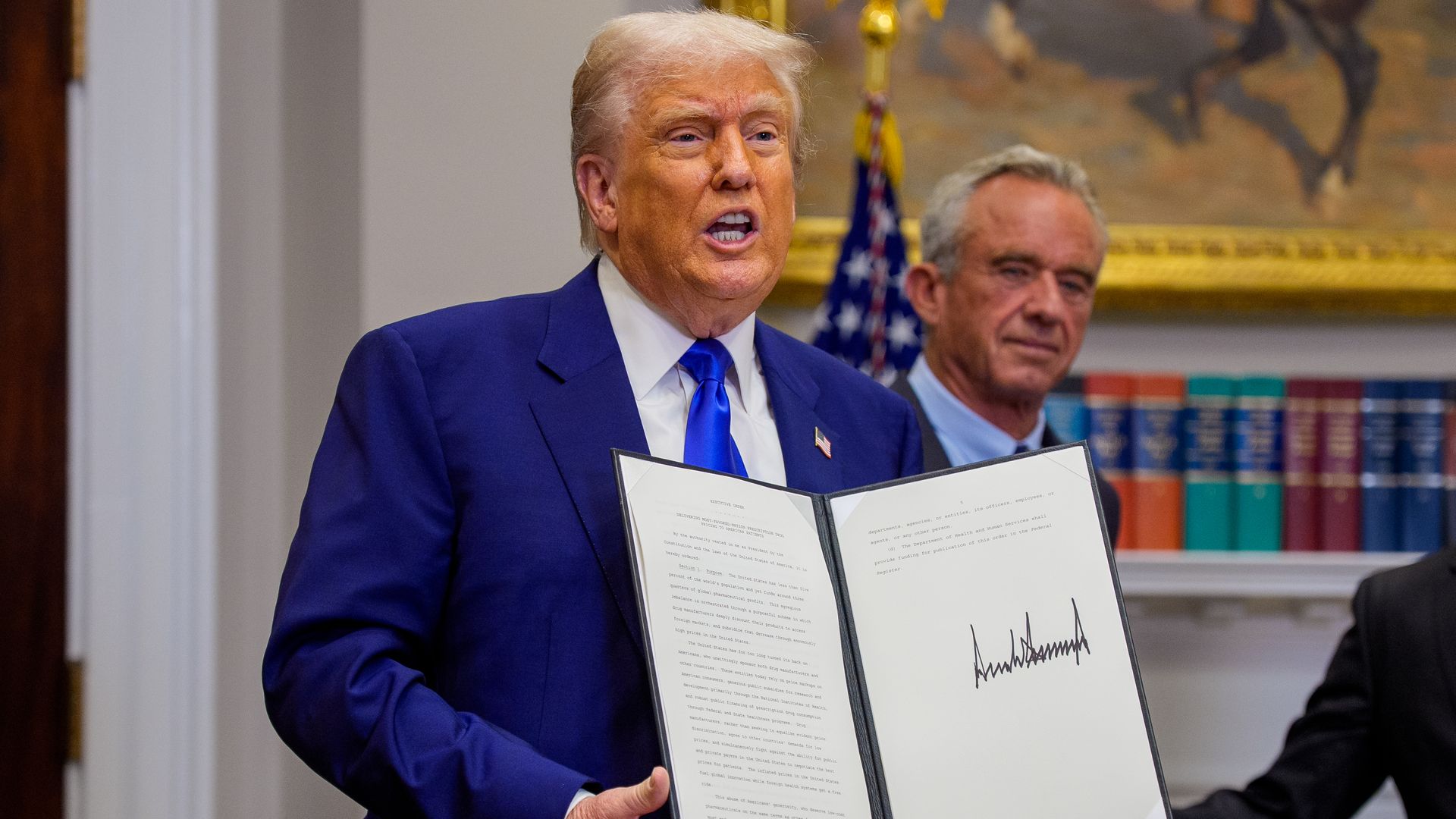
Trump and HHS Secretary Robert F. Kennedy Jr. in May with an executive order aimed at reducing the cost of prescription drugs. Photo: Andrew Harnik / Getty Images
President Trump's demands for drug price cuts are forcing pharmaceutical companies to walk a fine line as they look to mollify the president without taking a major financial hit.
Why it matters: Discussions over the coming weeks could show whether the 17 companies Trump is targeting are willing to deal and make concessions in the face of threatened tariffs on the sector.
Driving the news: Trump wrote the major manufacturers late last month, giving them 60 days to move toward what he calls "most-favored nation" pricing for certain drugs, or essentially to give the U.S. the lowest price in developed countries.
- The manufacturers aren't likely to agree to Trump's full demands. But they aren't publicly rebuffing him, and at least some are open to talks.
- Pfizer CEO Albert Bourla, for example, said on an earnings call this month that he had spoken with Trump since receiving one of the letters.
- He referred to the demands as a "base of what the president wants," indicating they are just a starting point for negotiations.
- "The letter asks a lot from us, but we are engaged in productive discussions with them," he said, declining to elaborate.
- Eli Lilly also last week gave a nod to Trump's push when it announced a higher list price for its weight-loss drug Mounjaro in the United Kingdom, as part of a "rebalancing" of global prices. But the company did not announce new steps to lower U.S. prices at the same time.
The big picture: Drug pricing advocates expect companies to come up with largely symbolic concessions without taking substantive steps to lower prices.
- "Unless they're forced to give up any power or ability to raise drug prices, it's highly unlikely that they will do it on their own," said Merith Basey, executive director of Patients for Affordable Drugs.
- Part of the industry strategy could be to delay the most significant changes on the table.
- "Companies are looking at any potential action that they can propose or agree to, [to] show that some progress is being made, while attempting to delay and avoid the biggest worries they have, which is the idea that Americans should get to pay what other countries pay," said Chris Meekins, an analyst at Raymond James.
Between the lines: The identical letters Trump sent threaten that "if you refuse to step up, we will deploy every tool in our arsenal" to lower drug prices.
- It does not specify what those tools would be, and Trump's power to lower prices through executive action is limited.
- The White House did not respond to requests for comment on any discussions since the letters were sent or what actions the administration could take after 60 days if it is not satisfied.
- Trump proposed a version of most-favored nation in his first term, but it got tied up in legal challenges from the drug industry and never took effect. Drug companies are also certain to sue to stop any similar moves this time.
Yes, but: The administration still has options if the companies' offers don't pass muster.
- One is using the Center for Medicare and Medicaid Innovation as a back-door way to lower prices, using it to test new pricing approaches in Medicare.
- Another is seeking to incorporate most-favored nation pricing into the existing Medicare drug price negotiations from the Inflation Reduction Act.
- The administration still could levy tariffs on pharmaceuticals. Trump has indicated they would start small but could reach 250% depending on what offers industry may make.
The bottom line: Most-favored nation would be on much firmer legal footing if Congress acted to implement it, but Republicans in Congress have so far pushed back on Trump's efforts to pass it legislatively.
