
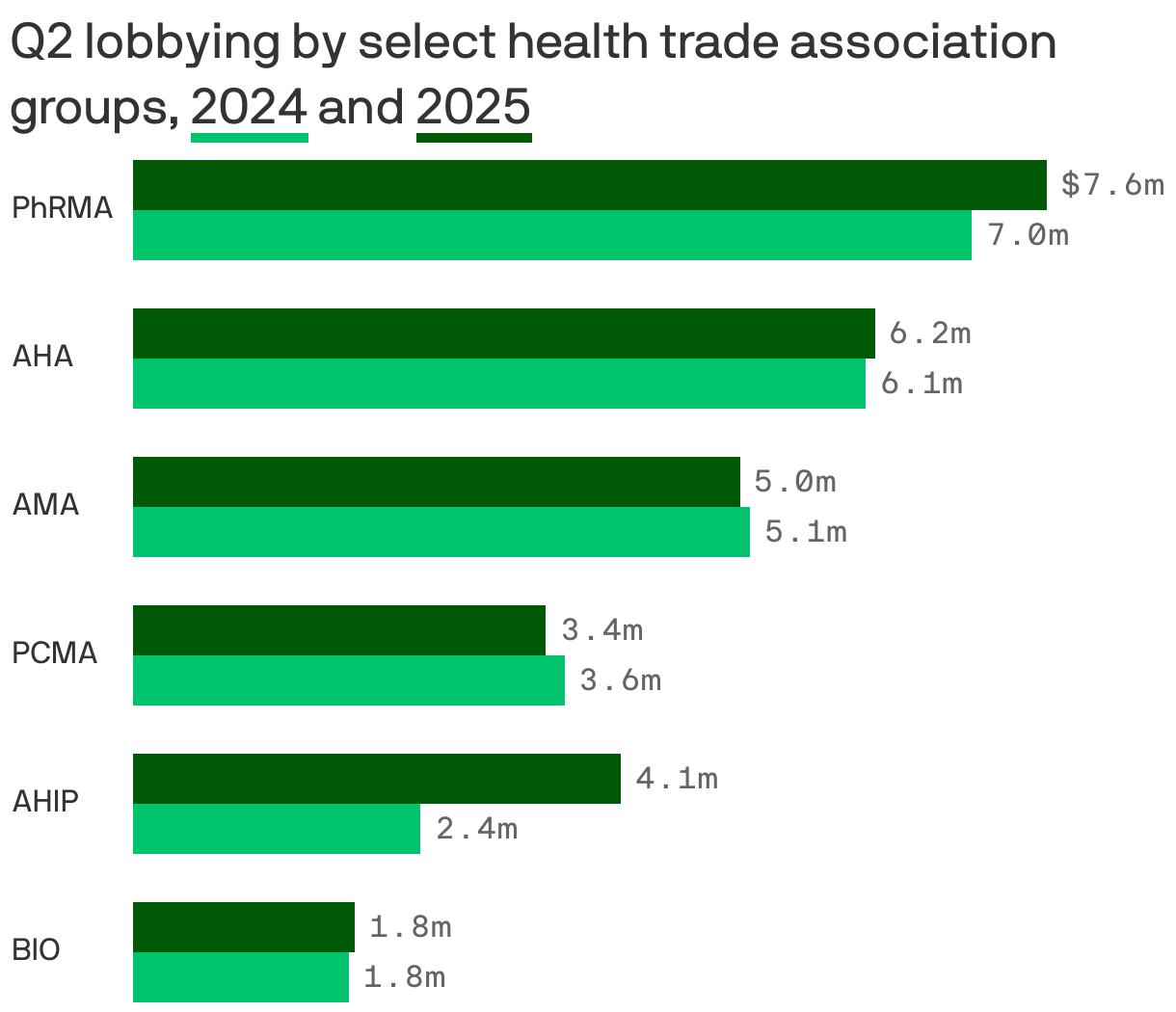
Health industries spent heavily on lobbying in the run-up to reconciliation, as hospitals and insurers tried to stave off sweeping changes to Medicaid and Affordable Care Act markets.
- The pharmaceutical industry was busy in Q2 as it faced the threat of sector-specific tariffs and President Trump's "most favored nation" drug pricing plan, an Axios review of the latest lobbying disclosures shows.
Why it matters: Most of the efforts to shape the GOP megabill failed, leaving providers and payers facing an uncertain landscape with millions more uninsured and caps on provider taxes and state-directed payments.
- Lawmakers did authorize $50 billion over five years for states to spend on rural health.
By the numbers: The Federation of American Hospitals almost doubled its second-quarter lobbying spend with outlays of $1.1 million, compared with $480,000 last year.
- AHIP similarly nearly doubled its outlays, spending $4.1 million in Q2, up from $2.4 million a year earlier.
Other hospital interests slightly hiked their spending.
- AHA spent $6.2 million in Q2 2025, compared with $6.1 million in Q2 2024.
- America's Essential Hospitals spent $520,000 in Q2 2025, up from $450,000 a year earlier.
Between the lines: The AMA and PCMA each spent slightly less in Q2 than at the same time last year.
- The AMA won a partial "doc fix" in reconciliation to recoup some Medicare physician fee cuts, while PCMA tried to ensure that changes to PBM business practices wouldn't be wrapped into the tax and spending package (they weren't).
Threat level: PhRMA and drugmakers upped their spending amid Trump's repeated threats that he's planning to implement pharmaceutical tariffs of up to 200%.
- PhRMA spent $7.58 million in Q2 2025, compared with $6.96 million in Q2 2024.
- The pharmaceutical industry managed to keep the "most favored nation" policy out of the GOP package, though the Trump administration could still implement aspects of it administratively.
The big picture: For all the millions spent, some of the most powerful health interests weren't able to get their way, potentially signaling a realignment in the influence game.
- Hill Republicans largely shrugged off a drumbeat of warnings about dire consequences to hospitals and patients from the Medicaid changes.
- It was another example of how Trump's Washington has in some ways defied the customary rules of the game.
