
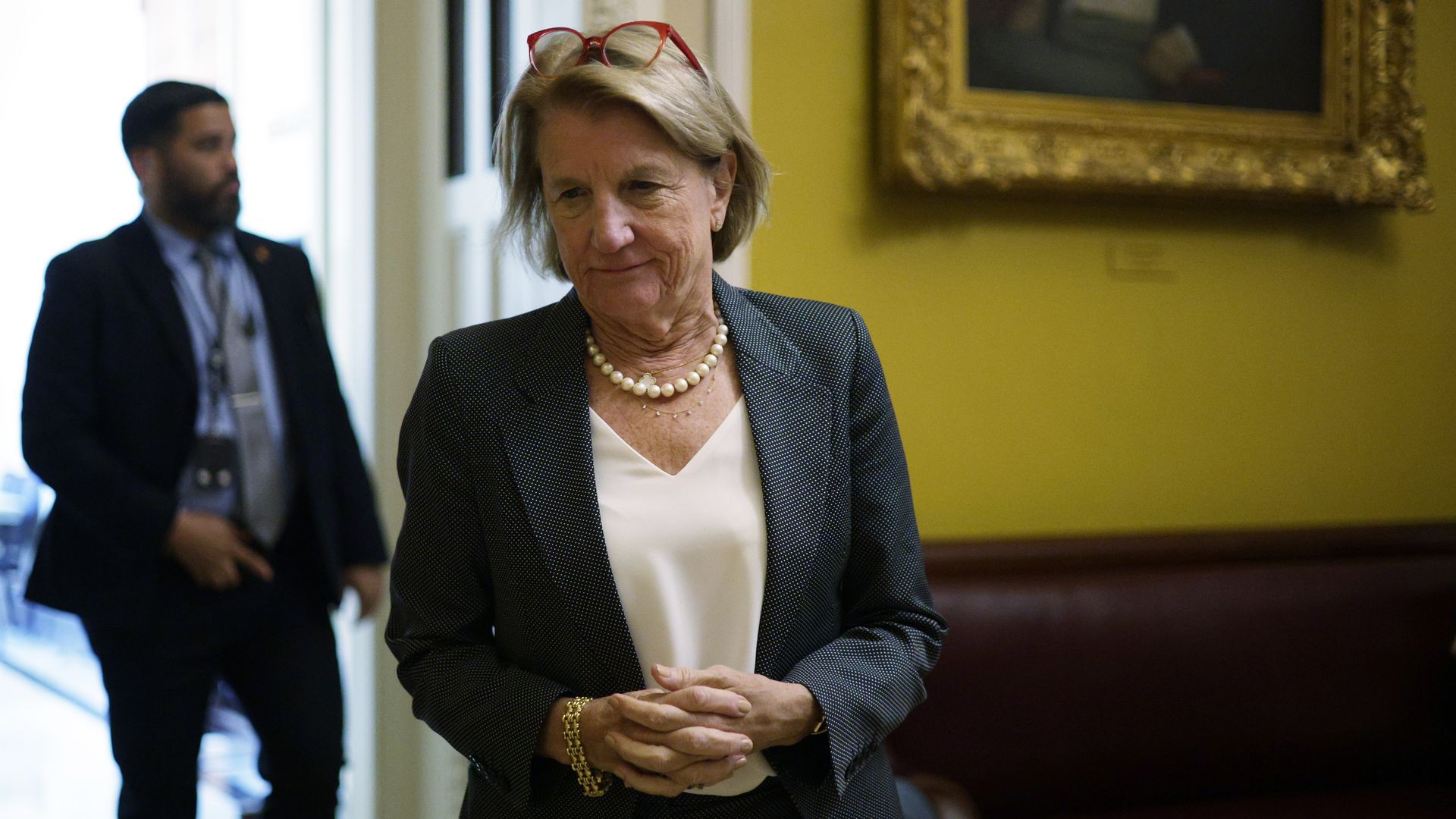
Capito during the reconciliation debate. Photo: Alex Wong / Getty Images
Top Republican appropriators are pushing back on President Trump's proposed $18 billion cut to the NIH's discretionary budget amid growing signs that the government may limp through the rest of this year on a series of short-term funding deals.
Why it matters: The likelihood of a series of CRs instead of an omnibus package increases the chance that federal health agencies will be flat-funded past Sept. 30.
What they're saying: House Appropriations Chair Tom Cole said last week that FY26 spending bills including Labor-HHS wouldn't contain cuts as deep as what Trump's 2026 budget outlined.
- Sen. Shelley Moore Capito, the Appropriations Labor-HHS subcommittee chair, also pushed back on the idea of NIH cuts in the upper chamber, saying that funding the agency was a "high priority" for her.
- "I'm a strong supporter of NIH research, biomedical research.… We're going to be working with the administration on this.… I'm hopeful that we can continue to be the world leader in biomedical research through the NIH when this is all laid to rest," Capito told Axios.
- "Let me just put it this way. There's a lot of support for NIH," said Robert Aderholt, House Appropriations Labor-HHS subcommittee chair. "We want to do whatever we can to support NIH.… Generally speaking, Congress likes NIH."
By the numbers: House Appropriations has set its topline number for the total Labor-HHS title at $184.5 billion.
- That's a drop from last year's $185.8 billion.
- The yearlong CR for 2025 set the Labor-HHS funding at $198.2 billion, with about $48.6 billion alloted to the NIH.
- The Trump administration proposal translates to an NIH funding cut of about 40% for FY26.
What's next: With reconciliation consuming much of the oxygen on the Hill, the Appropriations Committees have been relatively slow getting individual bills marked up and to the chamber floors.
- Aderholt has already signaled that House appropriators' Labor-HHS markup will be pushed into September.
- Capito said that the goal is "hopefully" for Senate Appropriations to mark up a bipartisan Labor-HHS bill by the end of this month.
Reality check: Even if the funding bills do make it out of their respective appropriations committees, they may not all get floor votes.
- Democrats are in no mood to collaborate with Republicans on a full-year deal after the fractious debate over the rescissions package and GOP tax and spending package. They might even be willing to risk a shutdown.
- That likely translates to the status quo for health agencies, including NIH.
