
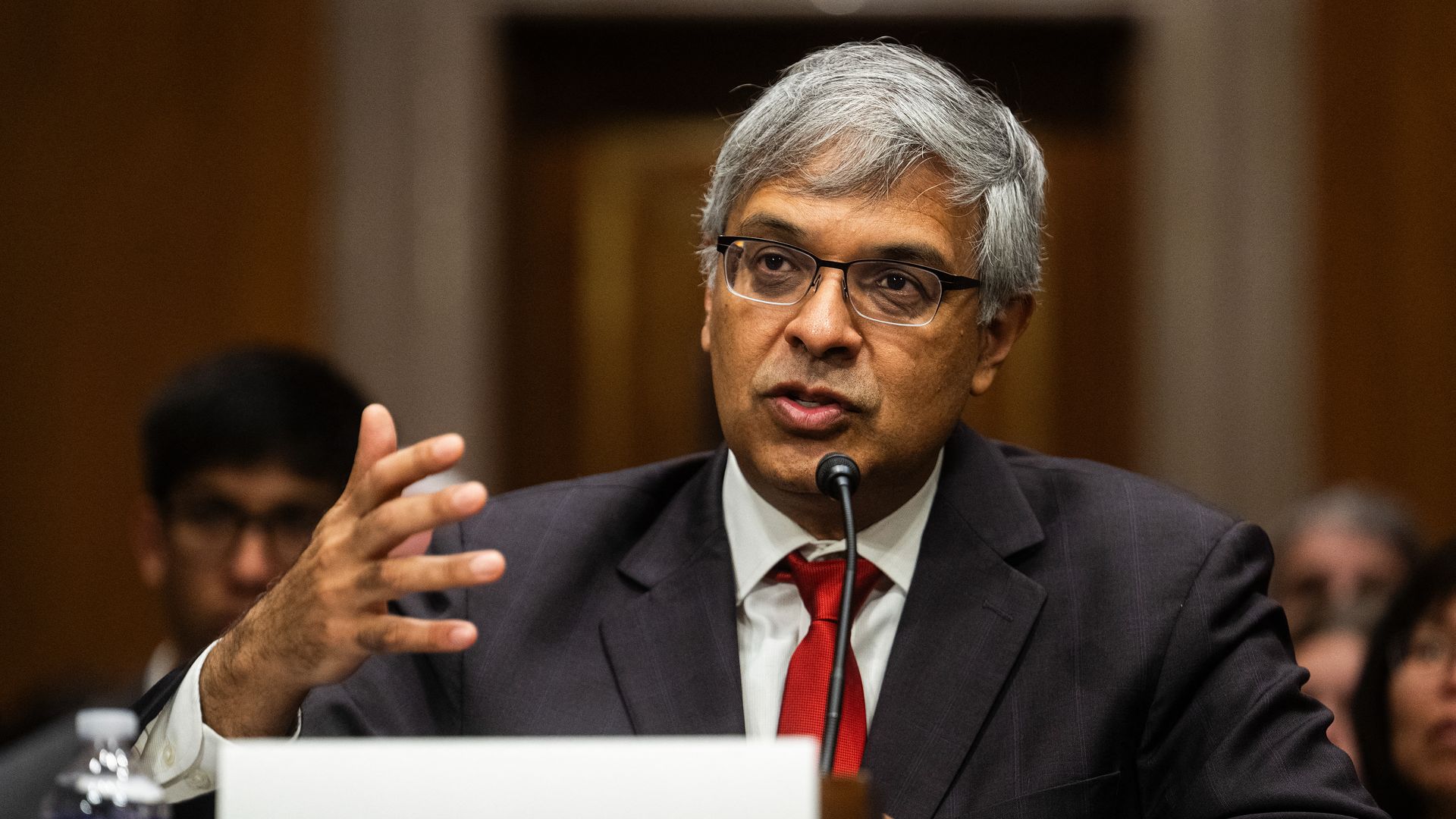
Bhattacharya at the Senate HELP confirmation hearing. Photo: Jim Watson/AFP via Getty Images
NIH director-designate Jay Bhattacharya appears headed for confirmation after a Senate HELP hearing Wednesday at which he portrayed the nearly $48 billion biomedical research institution as being at a crossroads.
Why it matters: The Stanford professor, whose views on the COVID-19 response and herd immunity rattled the scientific establishment, is expected to satisfy skeptics' calls for a reexamination of how NIH works.
Driving the news: Bhattacharya outlined five steps to revamp the agency he would take if confirmed.
- They include focusing research on chronic diseases and establishing what he termed a culture of respect for free speech in science and scientific dissent.
- He pledged to fund the most innovative biomedical research possible and vigorously regulate high-risk research on pathogens that could cause another pandemic, and to make those efforts transparent. And he said he would make scientific data reliable and replicable.
What they're saying: HELP Chair Bill Cassidy used the deadly measles outbreak in western Texas to press Bhattacharya on whether he believed there was a link between measles vaccine and autism.
- Bhattacharya responded that he didn't generally believe so but added there is "tremendous distrust in medicine and science coming out of the pandemic."
- He said he would support "a broad scientific agenda based on data to get an answer" on why there is a sharp rise in the percentage of children that have been identified with autism spectrum disorder. Experts say the increase is likely due to increased awareness of the condition.
- Cassidy repeatedly pressed Bhattacharya on why he would spend limited federal dollars examining whether there is a connection between vaccines and autism when that link has been disproved. By the end of the hearing, the pair appeared to agree to limit the focus on the rise in autism diagnoses.
Top Senate appropriators Susan Collins and Patty Murray expressed concerns about NIH capping funding for indirect research costs, with Collins going so far as to reiterate that the recent policy change violated the law.
- "If confirmed will you work immediately to rectify and reverse course on having a one-size-fits-all 15% direct cap on indirect costs?" Collins asked.
- Bhattacharya responded that he was committed to following the law on the indirect costs policy.
Senate HELP Democrats also expressed concerns about the federal research freezes, NIH probationary staff cuts and the postponement of scientific advisory committee meetings.
- Bhattacharya said that he wasn't involved in any of the personnel decisions but would evaluate them closely if confirmed.
HELP Ranking Member Bernie Sanders asked Bhattacharya what NIH could do to lower drug prices.
- Bhattacharya responded that the NIH should fund research to look at off-patent, off-label uses of drugs.
Catch up quick: Bhattacharya is a health economist who rose to prominence in the Trump world as a vocal opponent of lockdowns.
- He cowrote the Great Barrington Declaration, a petition from a group of scientists that argued for allowing COVID to spread among young, healthy people to reach herd immunity faster.
- In his opening remarks, Bhattacharya said that he "loved the NIH" but that post-pandemic, "American biomedical sciences are at a crossroad."
