Breaking down health payfor options in budget bill


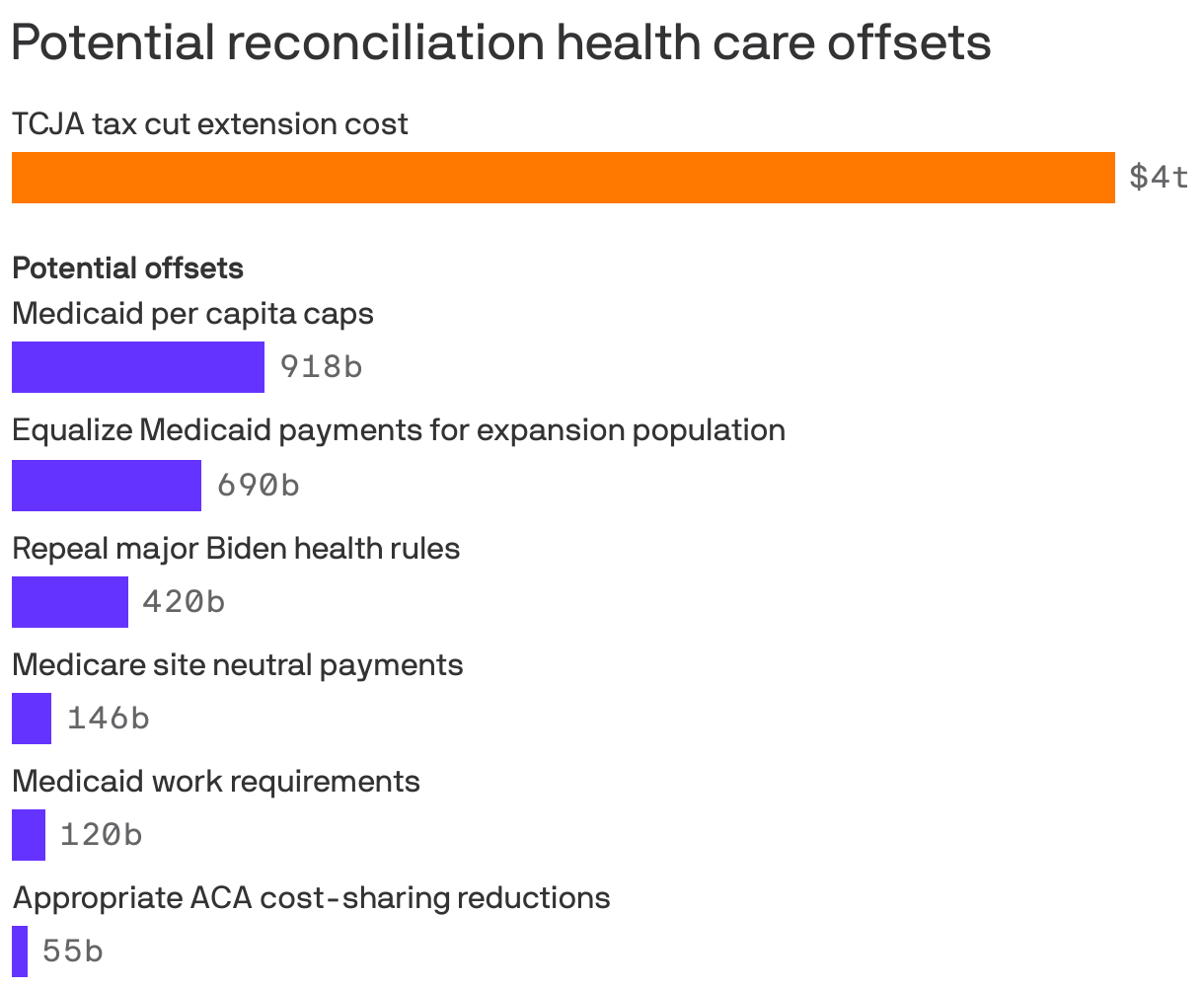
House Republicans are looking at a range of health care offsets in reconciliation to help cover the huge cost of extending the Trump tax cuts.
Why it matters: Many of these payfors would face major blowback, most notably caps on Medicaid spending, but Republicans still face pressure to make the math work and offset at least some of the tax cut extensions.
Between the lines: A menu of options circulated by the House Budget Committee and obtained by Axios shows at least some of the health policies in play.
- It is far from certain which, if any, could make it into the final bill. And the list is noteworthy for what's been left out.
- PBM reform, overhauling the 340B program and prospective changes to Medicare Advantage were all omitted but still could deliver moderate savings.
- Although most of the options would draw opposition from Democrats, Medicare site-neutral payment proposals have at least some bipartisan support, but they would prompt fierce blowback from hospitals.
By the numbers: The potential health care offsets would still help pay for only a small portion of a massive tax cut package that could cost more than $4 trillion.
- Medicaid per capita caps are the option on the Budget Committee list that generate the most projected savings — though the $918 billion offset is still well short of the full bill for extending the tax cuts.
- Another major Medicaid option would be dialing back the 90% federal matching rate for the expansion population, which is estimated to save up to $690 billion.
- But there are also concerns with loss of coverage from reducing Medicaid spending by these amounts.
- And Medicaid work requirements, which are actively being discussed as an option among GOP lawmakers, would save about $120 billion.
The bottom line: The reality is that fully offsetting the tax package, if the GOP goes that route, will be difficult and could involve Republicans having to include controversial policies, particularly in Medicaid, that could lead to people losing their insurance coverage.
