
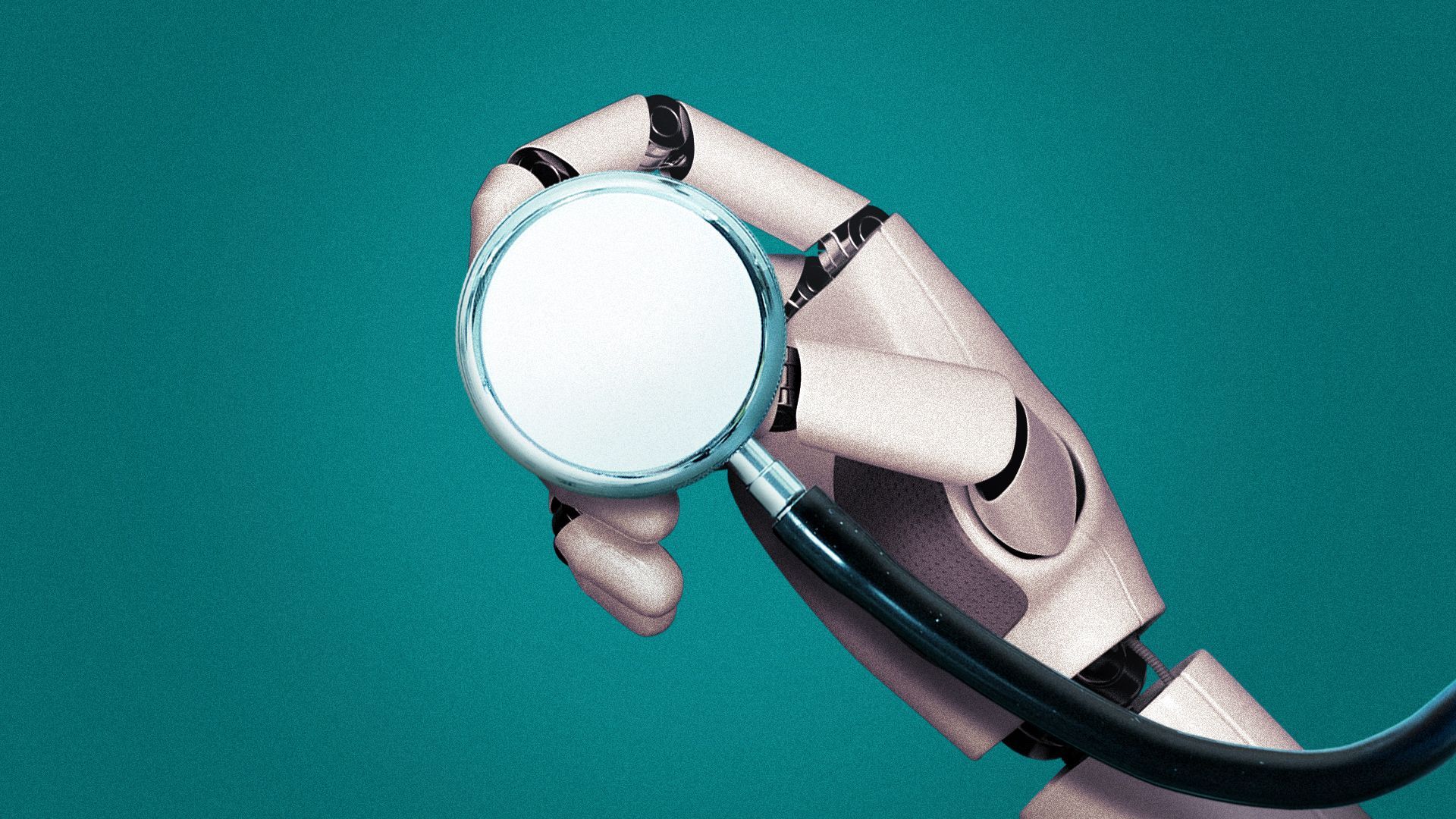
Illustration: Gabriella Turrisi/Axios
FDA officials this week vowed to be transparent and predictable in setting guardrails for artificial intelligence in drug development as they confront a slew of applications with AI components.
Why it matters: Congress is not showing signs of updating the regulatory framework for health care and AI, leaving it to the agency to fill a significant void.
- FDA officials at a daylong workshop Tuesday warned that innovation could languish if companies are uncertain how the agency will treat the use of AI. But the officials didn't offer a concrete timetable for any rules of the road.
The big picture: AI can be trained to use a vast array of data to help researchers discover new ways to target diseases. But the health industry has been slow to embrace big tech solutions, as was the case with electronic health records.
- Though lawmakers have set up a range of working groups to begin sussing out the issue, the FDA will have leeway in determining such questions as whether algorithms are medical devices, or even whether they have the authority to regulate them.
What they're saying: "In order to foster innovation, we also have to create some clarity and make sure that regulated entities operate in an environment of regulatory predictability and not having surprises," said Patrizia Cavazzoni, director of the FDA's Center for Drug Evaluation and Research.
- She said FDA is developing guidance on the issue that "is really aimed at guiding regulated entities on how to integrate AI and machine learning into the work that is regulated by FDA."
Between the lines: There is a broad range of potential uses for AI in drug development, some of which were detailed by outside experts at the workshop.
- One is using AI to predict the incidence of COVID-19 at potential sites for testing new vaccines and countermeasures, to allow for greater efficiencies in clinical trials.
- Charles Fisher, CEO of Unlearn.AI, said the technology can also be used to create "digital twins" — an AI model of a person or a part of a person — to help predict health outcomes and improve clinical trials.
- "For each one of those people as they show up, we can just say well, let's take information about that person and predict what would happen if they got a placebo," he said.
Cavazzoni said the agency has been getting interest from industry in using AI for monitoring drug safety.
- "We're very interested in sponsors coming to us with pilots and potential use cases" in that area, she said.
By the numbers: AI is already driving drug development to some degree, even without clear-cut rules.
- As of 2021, Cavazzoni said, CDER had received more than 300 submissions with "AI elements," adding that the number is surely much higher now.
The bottom line: FDA officials emphasized the need for predictability in a largely untested field.
- "We know you need consistency," said Jacqueline Corrigan-Curay, deputy director of CDER. "If you don't know the ground rules, you're not going to come to us with AI."
- "It's our role to try and give you some predictability in an area where we're all still learning together, and I hope we continue to learn together," she added.
