
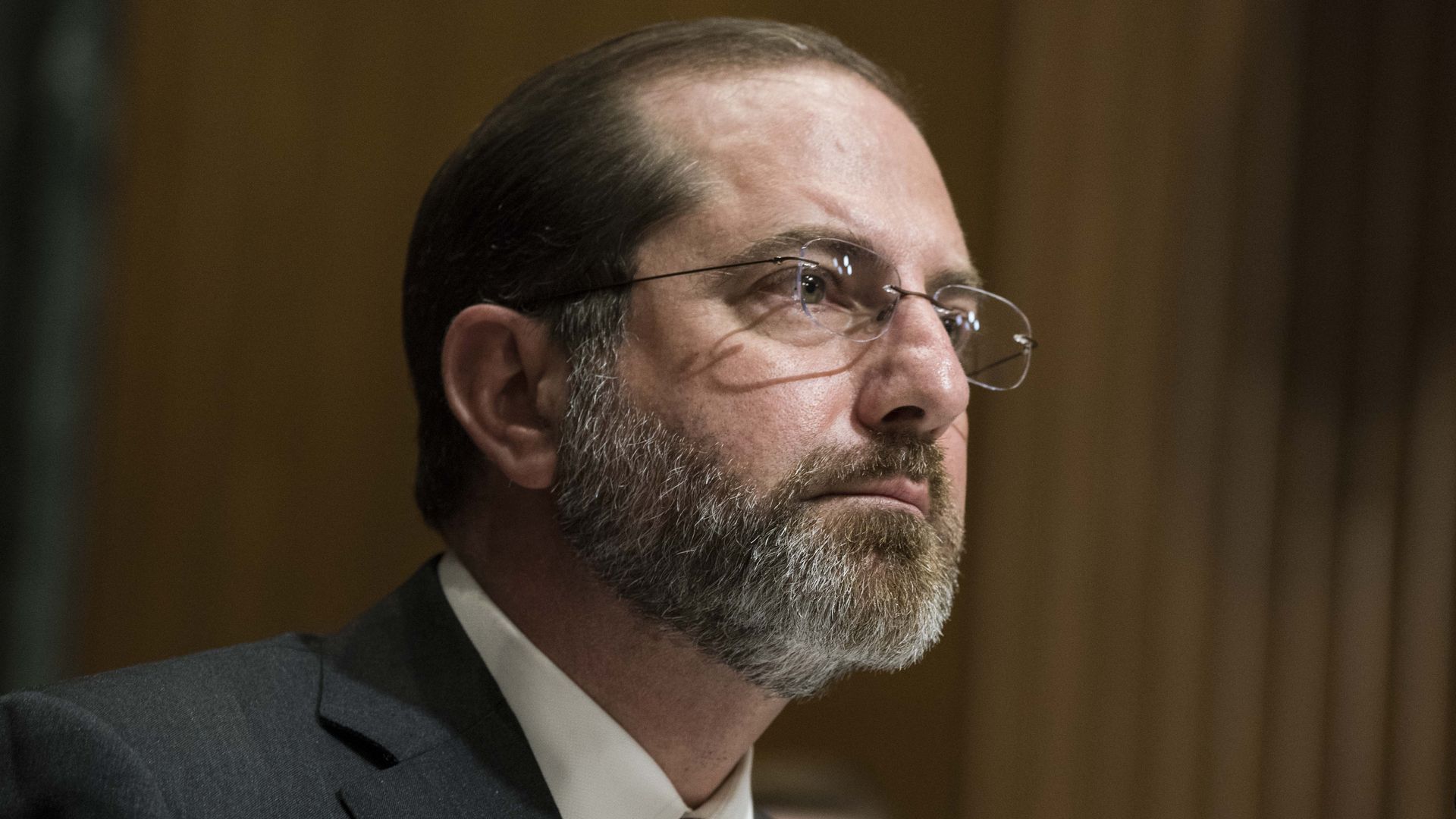
Former Trump health secretary Azar at a 2020 Senate hearing. Photo: Sarah Silbiger/Getty Images
Site-neutral Medicare payments are a question mark for a year-end health package, but if they don't make the cut, they could have a bigger role next year in a reconciliation package.
Why it matters: There's increasing discussion about how Republicans could use the reconciliation process to enact partisan legislation if they sweep the elections, with site-neutral being an alluring payfor.
What they're saying: Alex Azar, former HHS secretary in the Trump administation, raised the idea at an event Monday.
- "I think the way this happens by legislation is going to be when you have a must-pass vehicle like a reconciliation package," Azar said.
- "Let's say if there's a Republican sweep of Congress and the presidency, and you've got the Trump tax cuts that have to be renewed … site-neutral payments could easily be a payfor there."
Between the lines: If Republicans score big, they're sure to use the reconciliation process to bypass a filibuster in the Senate.
- The centerpiece of that effort is likely to be extending the portion of the 2017 Trump tax cuts that are expiring.
- Medicare overhauls that would pay the same amount for outpatient services regardless of whether they're delivered in a hospital-affiliated facility could deliver much-needed offsets.
- The proposal this year applies only to physician-administered drugs, though far more sweeping versions could save over $100 billion.
- Medicaid cuts are another health option that could serve as a payfor, though they'd be guaranteed to generate more partisan friction.
Yes, but: It is far from certain that Republicans will sweep the election, and even if they do, the payfors for reconciliation are still up in the air.
- Still, the idea is gaining currency among congressional Republicans, given the push this year from Energy and Commerce Chair Cathy McMorris Rodgers.
- House Budget Chair Jodey Arrington also praised the idea at a hearing in May, calling it "obvious" and a "consensus solution."
The other side: Hospitals fiercely oppose the idea, arguing it would lead to damaging cuts to their payments that would especially harm rural areas, a potent warning among members with rural constituencies.
- That opposition would remain a big hurdle in a new session.
The bottom line: A bipartisan group of experts spoke in support of the idea at Monday's forum and floated potential solutions to rural concerns.
- The event was hosted by Paragon Health Institute, the Center for American Progress, the American Enterprise Institute, and the Brookings Institution, groups you don't see together every day, and featured former HHS Secretary Kathleen Sebelius as well as Azar.
- Benedic Ippolito of AEI said some hospitals in outlying areas really need help, and could get targeted payments, rather than the inefficient status quo.
- "The idea that in order to solve that you should overpay all of the hospitals in America is so backwards," he said.
