
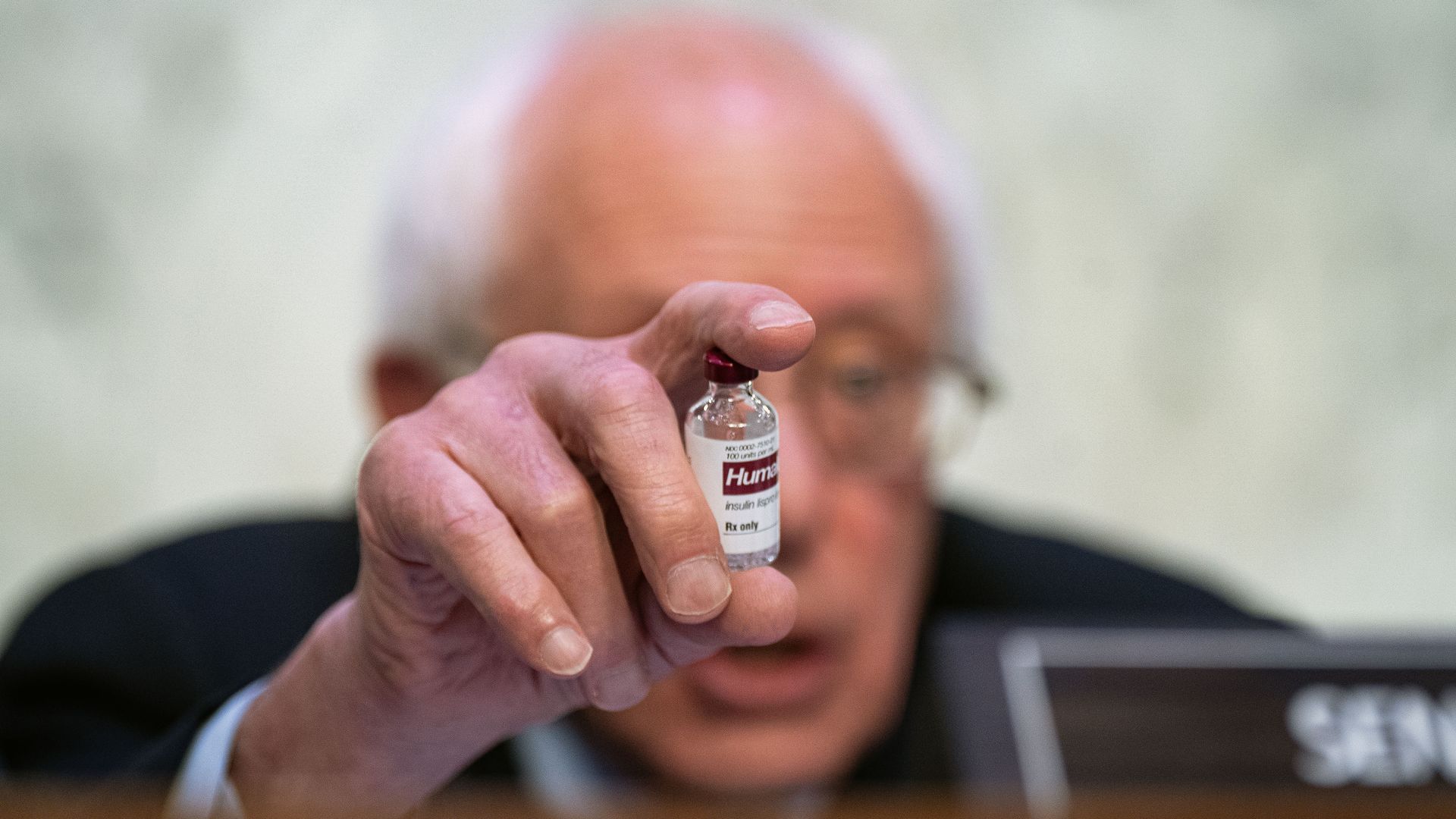
Sanders during a 2023 hearing on insulin costs. Photo: Al Drago/Bloomberg via Getty Images
Sen. Bernie Sanders is trying to use the bully pulpit to lower the price of blockbuster anti-obesity drugs the way he took on the costs of inhalers and insulin. But this bid could be much more of an uphill climb.
Why it matters: Surging demand for drugs like Novo Nordisk's Ozempic and Wegovy could severely strain Medicare and patients' wallets. But drug manufacturers are loath to concede on list prices.
Driving the news: Sanders will grill the Novo CEO Lars Fruergaard Jørgensen, which makes those drugs, at a Senate HELP hearing in early September.
- Sanders acknowledged in an interview that it will not be easy to get the company to go along, but said the "spotlight" can make a difference.
- "The people who run Novo Nordisk are not stupid," Sanders said. "They are in a very good position. They're charging 10 to 15 times more for the product than they charge people in Germany and elsewhere."
- "But they're also, I think, cognizant of public relations and to the degree that we can put a spotlight on them, I think the pressure will build for them to finally say, 'OK, we're not going to rip off the American people,'" he added.
Between the lines: Sanders has been able to claim some important drug cost victories after taking the chairmanship of the Senate HELP Committee last year.
- Public pressure likely played at least a role in makers of insulin and asthma inhalers announcing new $35 out-of-pocket caps (in the case of insulin expanding to the private market a cap in Medicare put in place by Democrats' Inflation Reduction Act).
- The Eli Lilly CEO Dave Ricks also pledged not to raise the price of insulin at a hearing Sanders held last year.
Yes, but: Many of those efforts surrounded capping patient costs, which drug manufacturers tend to support, rather than lowering overall prices, though that did occur to some degree.
- Anti-obesity drugs are also a new breakthrough, not decades-old like inhalers or insulin. And Novo says the net price of Ozempic and Wegovy has already declined 40% since the drugs' launch through rebates and fees paid to PBMs.
- The drugs could also soon be subject to Medicare price negotiations, congressional scorekeepers wrote in an analysis this spring. Sanders calls such drug pricing provisions arising from the Inflation Reduction Act "modest progress" that he wants to expand on.
What they're saying: In a letter to the HELP Committee last month, the company pointed to the billions of dollars it had already invested in research and in ramping up production capacity for the drugs.
- It also said the net price for the weight loss drugs (factoring in rebates paid to insurers), has been declining, and that 80% of U.S. patients with insurance are paying $25 or less per prescription of Ozempic or Wegovy.
- "Novo Nordisk takes patient access and affordability very seriously and we are committed to working with policymakers to develop meaningful solutions within the complex U.S. healthcare system," Allison Schneider, a Novo Nordisk spokesperson, said in a statement to Axios.
The other side: Sanders said even with rebates, the price of Ozempic is much higher than other countries, about $600 per month compared to $59 in Germany.
- And even if many patients are shielded from high direct costs by insurance, Sanders warns private insurance premiums will have to rise or Medicare will have to spend exorbitant amounts to cover the drugs.
What's next: Sanders acknowledged Novo and other drugmakers' point that pharmacy benefit managers and insurers play a major role in what patients pay.
- Asked if he would like to hold a committee markup on additional PBM legislation this year, Sanders said, "I would like to. ... I think our prescription drug system is dysfunctional and broken, and I want to do as much as I possibly can."
- Sanders also left the door open to calling in Novo's rival Eli Lilly to testify about its Zepbound and other GLP-1 drugs. "One at a time," he said. "Eli Lilly is also very big, but I think we focus on Novo Nordisk first and then we'll go to the others."
The bottom line: Gerard Anderson, professor of health policy and management at Johns Hopkins, said there are limits to what "shaming" can do to drug prices. "Changing the laws is absolutely the right answer," he said.
