
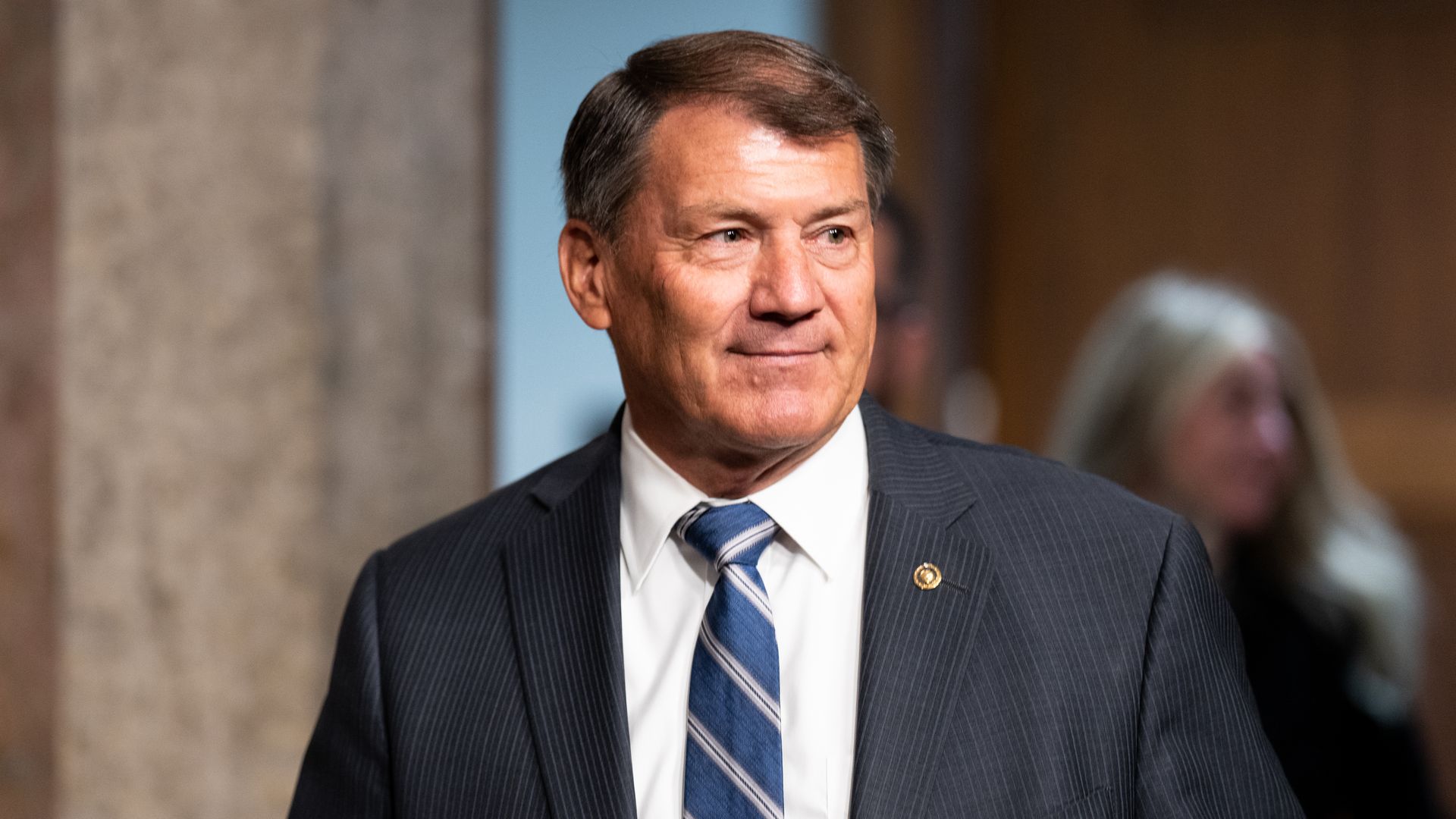
Sen. Mike Rounds. Photo: Getty Images
Sen. Mike Rounds is one of the four senators helming the Senate's artificial intelligence forums, and the lead for an AI panel Thursday focused on using the technology to develop cures for cancer.
- He previewed the closed-session meeting with Axios — the first Senate AI panel specifically focused on health care — and discussed why he's passionate about using AI to advance health outcomes.
Of note: Attendees at Thursday's cancer forum will include former National Cancer Institute director Ned Sharpless, Google's chief clinical officer Michael Howell, Harvard Medical School professor Eliezer Van Allen, Argonne National Laboratory associate director Rick Stevens, and Lauren Silvis, senior vice president of external affairs at Tempus.
- The gathering is hosted by the four Senate AI leads (the others are Majority Leader Chuck Schumer and Sens. Todd Young and Martin Heinrich) but is separate from the AI Insight forums.
On why Rounds is passionate about the issue: I lost my wife on Nov. 2, 2021. So we're coming up on two years now, but she had been diagnosed with a sarcoma several years earlier. Sarcoma is about 1% of all the cancers in the United States. There's not a lot of research that goes into it.
- What we found as we moved along was that while we were using some pretty traditional chemotherapies for the treatment, there came a point in July or in June of 2021 where she developed some tumors in her brain, which I thought meant the end was very, very close.
- Within two days she had started taking these new radiation scans.… Over a period of about a month she had regained the use of her arms. She had her handwriting back, the tumors were eliminated. That technology had not existed two years earlier. It gave us another another full four months with her.
On why more money is needed for cancer research: For me, it was a matter of the technologies that are developing, and it was also a matter of are we putting the right type of of research dollars into it? Are we investing in the right types? And is there a return on that?
- I see real opportunities, and I see more return on investment than a lot of people like to think there is, and when it comes to Parkinson's and Alzheimer's, I believe the same thing applies.
- We're going to spend trillions of dollars over the next decades on taking care of and providing nursing care to people with Alzheimer's and Parkinson's. I think we can delay those onsets for years and in some cases manage them to the point where they are not terminal in nature, using artificial intelligence.
On goals for tomorrow's AI panel: This is not a matter of us telling these leaders in health care what to do. This is a matter of where we're going to cut right to the chase.
- And we're going to have these folks talking about what we can do to help them develop this tool in a safe and efficient manner and in a timely manner as well.
On the next steps: A series of forums not necessarily focused on health care, but about AI in general.… But as this comes together, each of the separate committees that normally would have jurisdiction, we want them to be taking a look at what AI will do to address or create issues in their jurisdiction.
- And if we talk about this tool that can be utilized under HHS, then both the authorizing committee and the appropriating committee that have HHS jurisdiction, or NIH in their jurisdiction, is going to look at this and say, this is an area where we need to invest … and that way we get all the committee members involved.
- What this is about is trying to get the areas where the expertise currently exists to recognize AI as a tool that is going to be visible in their future.
