December 06, 2023

🐋 Happy hump(back) day! Whales may be less happy than you today.
🗓 Axios Pro Virtual Event: Get your questions answered live Dec. 13 at 1:30pm ET during "Ask the newsroom: General Catalyst's hospital ambitions" with Health Tech Deals reporter Erin Brodwin and editor Claire Rychlewski. Secure your spot today.
🚨 Situational Awareness: The House is expected to vote at 4:30pm ET on its bill targeting auto tailpipe standards.
🎻 Today's last tune is from Sen. Bill Cassidy, who crooned Fred Astaire's rendition of "Night and Day" by Cole Porter for Jael off the Senate floor. (Really.)
1 big thing: Year-end legislative logjam
Illustration: Annelise Capossela/Axios
Nothing motivates Congress like a holiday! House committees are moving a flurry of year-end bills that have a real chance of becoming law, Jael and Nick write.
Why it matters: The future of the Pipeline and Hazardous Materials Safety Administration, licensing at the Nuclear Regulatory Commission and a broader set of permitting policies will be up for grabs over the coming months.
Driving the news: The House Transportation & Infrastructure Committee today reported a bipartisan reauthorization of the pipeline safety bill.
- T&I leaders navigated the bill through the amendment process without any poison pills.
- That included a bipartisan effort from Reps. Jared Huffman and Scott Perry to add language scrutinizing CO2 pipelines, which could've upset the delicate bipartisan balance on the bill.
- The last bipartisan PHMSA reauthorization — the 2020 PIPES Act — expired in September.
Meanwhile, the Natural Resources Committee today approved a series of energy permitting bills to clarify right-of-way access, hasten geothermal leasing and automatically approve oil project permits in Alaska.
- This comes after the House Energy and Commerce yesterday advanced a huge slate of energy bills, including two industry-backed bipartisan nuclear bills and Chair Cathy McMorris Rodgers' hydropower permitting overhaul.
Between the lines: All this year-end legislative action feels a little like the Willy Wonka river scene — there's no earthly way of knowing where we're going.
- Getting almost anything onto the House floor is going to be extremely challenging after the departures of Kevin McCarthy, Bill Johnson and George Santos (rest in power).
- That's going to be the highest hurdle for bipartisan bills like the PHMSA reauthorization and E&C's nuclear permitting legislation.
- Partisan messaging efforts like the NatRes bills could have an easier shot on the floor. Of course, those are doomed in the Senate.
Zoom in: Procedural and partisan divides also could keep a lot of this stuff from getting done.
- E&C shares jurisdiction on the PHMSA reauthorization, and the panel hasn't moved on it yet.
- Democrats in September accused the GOP of politicking on a historically bipartisan issue after the E&C Republicans released their own draft pipeline proposal that would promote natural gas and go after local gas bans.
- In a statement, a Dem E&C aide slammed committee Republicans for not holding more hearings or addressing "our concerns with their disturbingly partisan bill."
- E&C spokesperson Sean Kelly said Republicans on the panel are "looking forward to reviewing T&I's legislation, much of which is addressed in our pipeline legislation."
Plus, E&C leadership has held up the Senate versions of their NRC overhaul and nuclear fuel supply bills from being added to the final defense bill.
- Instead, they're seeking a separate negotiation on nuclear issues, which would be laborious and have few guarantees of a legislative vehicle.
What we're watching: Must-pass bills are currently the only path for priority energy bills. But those are mostly done with (and approps is a mess). So … fingers crossed for next year's NDAA?
- Still, we expect a real discussion about moving the pipeline reauthorization and finding some vehicles for these nuclear bills.
2. Senate supplemental's nuclear money
Illustration: Tiffany Herring/Axios
The $110.5 billion national security supplemental that Democrats unveiled yesterday includes money for nuclear fuel supply, Nick writes.
Why it matters: The U.S. has very little domestic production of enriched uranium. It's a huge potential stumbling block for the nascent advanced nuclear industry.
Driving the news: The package would make $2.7 billion available for low-enriched uranium, used in conventional nuclear reactors, and high-assay low-enriched uranium, used in many advanced reactor designs.
- The money would go toward at least two competitive awards from the Energy Department for acquisition and distribution of LEU and HALEU.
- But Senate Republicans are expected to sink a procedural vote on the package this afternoon, amid intense divides over border policy.
What's next: That leaves the money in a precarious place. But it does have some bipartisan support.
- Sens. Joe Manchin and Jim Risch both expressed support for including nuclear fuel funds in the supplemental during a hearing last week.
Of note: This is a priority for the industry because Russia is currently a dominant supplier of HALEU.
- Both the House and Senate have been trying to move the Nuclear Fuel Security Act (see above). That bill would establish programs at DOE to firm up domestic supply of HALEU and LEU.
3. Rand Paul stalls the radio star
Paul in September. Photo: Anna Moneymaker/Getty Images
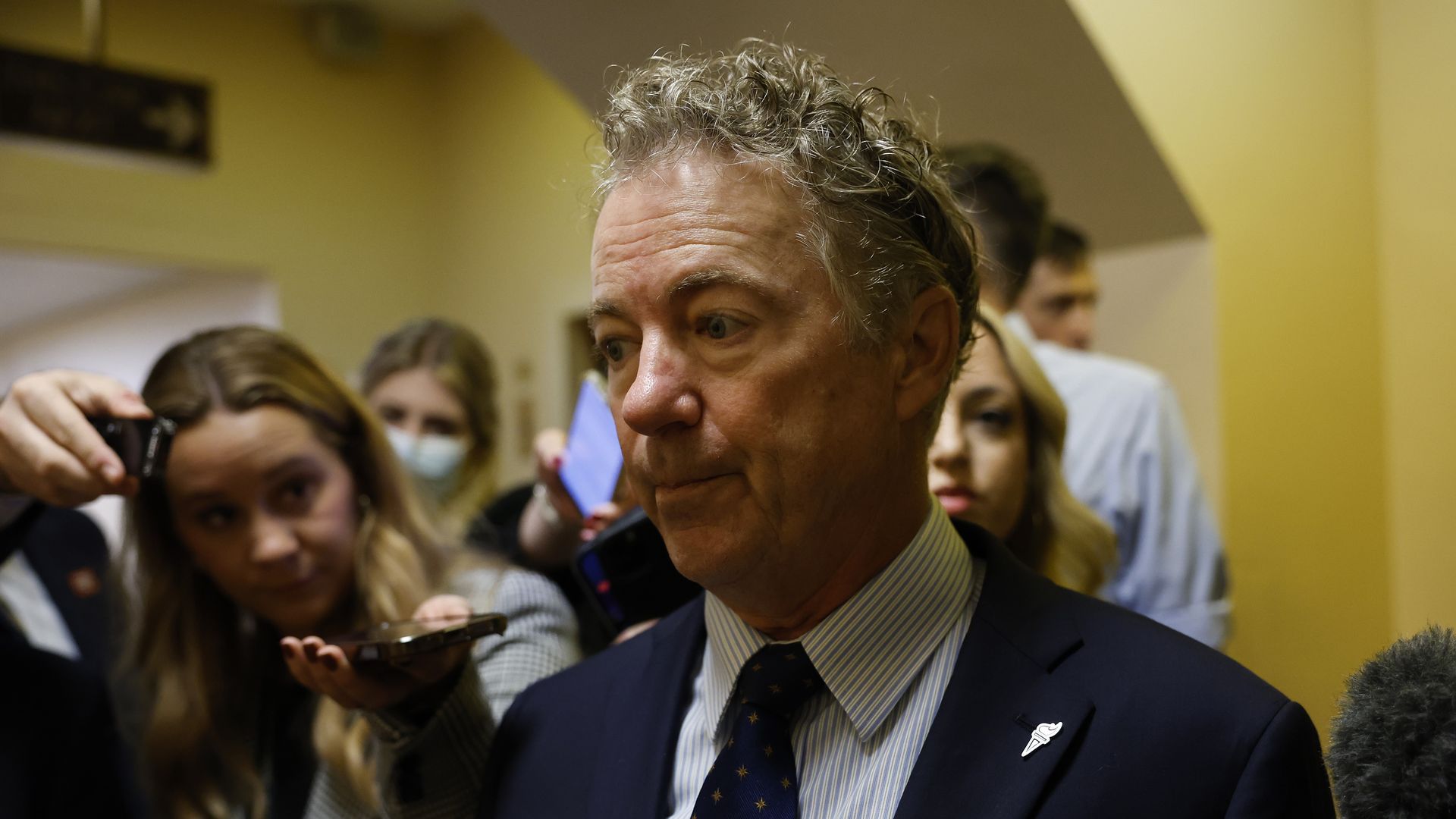
Sen. Rand Paul last night stopped a unanimous consent request to pass a bill that would mandate AM radios in electric vehicles, Jael writes.
Why it matters: For the bill to pass the Senate, Democratic leadership in the Senate must either cue it up for a cloture vote or find a vehicle to attach it to.
Driving the news: Yesterday afternoon, Ted Cruz sought to pass his bill via unanimous consent. Paul objected, saying he'd only support the measure if it included axing EV benefits from the IRA.
- "There is a certain amount of irony in seeing Republicans come to the floor proposing mandates on business," Paul said on the floor. "Mandating that all cars have AM radio is antithetical to any notion of limited government."
- Paul offered an amendment to the bill aimed at opposing EVs more broadly. This led to a fiery exchange with Cruz's Democratic co-author, Ed Markey.
- "Let's not pump the brakes on new jobs in states across the country, including Kentucky — and let's not pump the brakes on riders and passengers receiving alerts during emergencies," Markey said.
Between the lines: Even though Paul's intentions are anti-EV, his opposition to the bill is undoubtedly to the benefit of the auto industry, as we've explained.
4. Catch me up: E&C's COP no-go, DAPL rally

Illustration: Shoshana Gordon/Axios
🌍 1. No COP for Cathy: E&C spokesperson Sean Kelly confirmed that McMorris Rodgers is no longer planning to attend COP28 in Dubai (first reported by E&E's Emma Dumain).
- The delegation will now be led by oil industry vet and E&C vice chair Kelly Armstrong.
☢️ 2. Money for something: The Ex-Im Bank says it'll start giving money to small nuclear reactor projects abroad.
- This got applause from GOP energy world: "I've seen firsthand the need to increase the proportion of our own development and export financing devoted to clean energy projects, including nuclear," ClearPath CEO Rich Powell told Jael in a statement.
🪧 3. DAPL comes to D.C.: Sen. Jeff Merkley and Rep. Raul Grijalva will be holding a rally against the Dakota Access Pipeline at the Senate Swamp this afternoon. You can watch the event here.
✅ Thank you for reading Axios Pro Policy, and thanks to editors Chuck McCutcheon and David Nather and copy editor Brad Bonhall.
View archive