
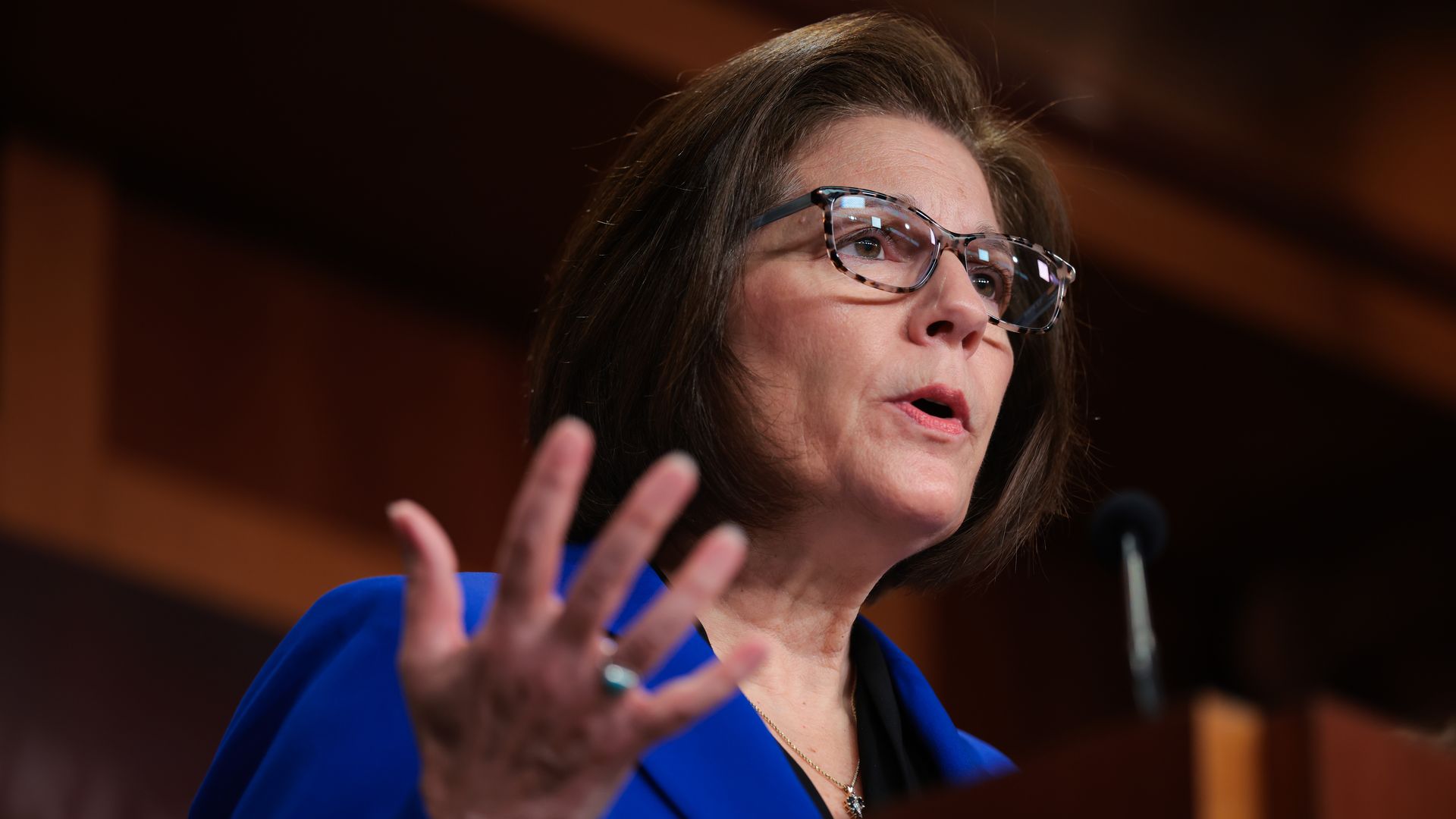
Cortez Masto in April. Photo: Kayla Bartkowski / Getty Images
Sen. Catherine Cortez Masto sees her mining bill forging a path for other bipartisan minerals legislation that can reach President Trump's desk.
Why it matters: The Nevadan is a key Democratic dealmaker, representing a mining-heavy state with a vibrant energy sector: solar, EV supply chain companies, and long-range grid projects.
Driving the news: Her Mineral Regulatory Clarity Act — which would allow mining companies an alternative permitting path — has set the pace for a broader potential mining package.
- The bill would leave the Rosemont decision in place. The 2022 ruling limited where mining companies can locate support facilities in areas that have an economically recoverable mineral resource.
- "You're going to see continued support in a bipartisan way — at least on [Energy and Natural Resources] in the Senate — around the mining piece," she told Axios.
Context: Cortez Masto's bill led the first slate of legislation that ENR marked up in April. It advanced with three Democratic "yes" votes.
- She's still talking to ENR Ranking Member Sen. Martin Heinrich to win support on the fee structure for a mine reclamation fund by the time the bill hits the floor.
- Just a few weeks later, the committee advanced by voice vote ENR Chair Mike Lee's bipartisan legislation that would designate copper a critical mineral.
Between the lines: Cortez Masto criticized the Trump administration for cutting energy funding and House Republicans for pursuing a reconciliation bill that guts IRA tax incentives.
- But she also faulted the Biden administration for providing "no bridge" to build out the mineral supply chain to decarbonize the economy and create jobs in states like hers.
- "That was lost in the last administration, it's lost in this administration, and because they're not thinking of that, we're taking steps backwards," she said.
What's next: Both parties in the Senate will work to address those deep cuts, she said.
- A likely focus is the House-passed provision that denies tax credits for projects until they're placed into service — which would harm advanced nuclear and enhanced geothermal, she said.
- The stricter House-passed standards on mineral inputs would burden manufacturers in both blue and red states, she added.
- "All these incredible projects that we've created, some of them are not going to happen because there's no way they can do it within the timeframe that they're setting," she said. "Some are in the middle of construction that will not be able to move forward, and you're going to lose investors as well."
On a different energy issue, Cortez Masto has sought commitments from the current administration that it will continue a consent-based approach to finding a permanent home for the country's nuclear waste.
- She grilled Theodore Garrish, nominated to lead DOE's Nuclear Energy office, when Garrish declined to say whether he supports her consent-based siting legislation to guarantee state, local and tribal officials a say.
- The federal government has "tried to shove [a nuclear repository] down the throat of Nevadans, and clearly, politically, it was not a winner," she told Axios. "So let's have a thoughtful approach."
