
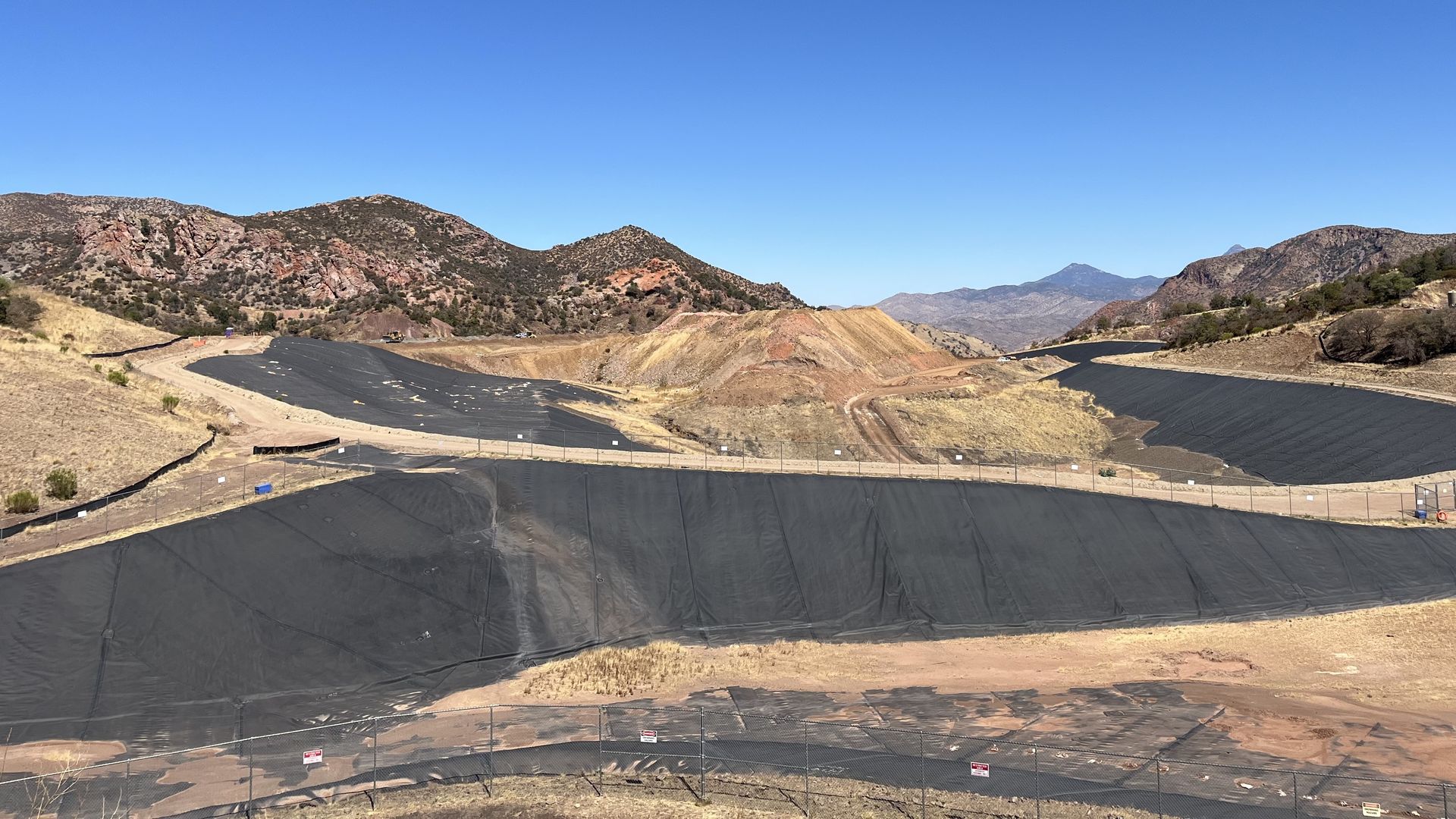
A view of the Hermosa mine. Photo: Daniel Moore / Axios
PATAGONIA, Ariz. — A critical-minerals mine could serve as a national example of sustainability — if it can clear federal permitting and community engagement hurdles.
Why it matters: South32's Hermosa mine was the first mining project that the Biden administration added to a fast-track permitting program.
- It's a test for whether mining projects in the battery supply chain can escape the Trump administration's deepening purge of Biden-era energy funding.
- The Grand Canyon State is also a microcosm of larger debates in Congress and elsewhere over mining. Those debates have intensified in the race to compete with China and shore up defense supply chains.
The big picture: The $2.2 billion mine in southern Arizona is positioned to produce two federally designated critical minerals: manganese and one of the largest untapped deposits of zinc.
- Although South32 has state permits to begin construction, it's applying for federal permits for expansion into the Coronado National Forest.
- The FAST-41 process estimates a two-year NEPA review concluding in 2026, with first production the following year. The draft environmental impact statement was released May 9.
Yes, but: A $166 million grant that the Energy Department awarded to South32 is being examined as part of an agency-wide review of funding priorities.
- A South32 spokeswoman confirmed the company received a DOE questionnaire. She highlighted the significance of zinc and manganese to national security.
Zoom in: The 45,000-acre Hermosa site in the Patagonia Mountains was abuzz with activity during a tour for contractors and mining experts that Axios joined in late April.
- Company officials led the group to a lookout point with sweeping views of the entire operation, where construction is about 40% finished.
- Officials talked up the mine's relatively small footprint and efforts to reduce environmental impacts: plans to quickly recharge underground aquifers, to clean up old mine tailings scattered by legacy mines, and color palettes that mimic the natural scenery.
- The company is working with city and county officials on a Community Protections and Benefits Agreement that aims to provide investment for housing, education, social services, or other areas.
Zoom out: President Trump wants to speed up permitting for mines, including for Rio Tinto's Resolution Copper project in Arizona.
- The Supreme Court this week rejected a Native American group's appeal contending that project will destroy a sacred area.
- The DOE has targeted Biden-era requirements for community outreach and environmental justice considerations, while Democrats have warmed to the idea of some mining.
- "Not every mine is the right mine, but not all mines are bad, either," Sen. Ruben Gallego told Axios.
Between the lines: Developing such mines "can't be forced journeys," said South32 Hermosa President Pat Risner, who spoke on the sidelines that week at the Society of Environmental Journalists conference in Tempe.
- "The municipalities need everyone to be heard, and there are diverse views," he said. "If it takes longer to get it right, then it'll take a little bit longer."
The other side: Some longtime residents and environmental groups worry about the mine's effects on animal and bird migratory paths and disruptions to the landscape and air quality.
- The mine has divided residents of Patagonia, a 19th-century mining town that's become an enclave for retirees, mountain bikers and nature-lovers.
- "Their definition of sustainability is woefully inadequate for this biologically diverse area," said Carolyn Shafer, mission coordinator for the Patagonia Area Resource Alliance.
- Shafer acknowledged that the company had incorporated some of residents' feedback into its mine design.
Our thought bubble: Like real estate, mining is about location, location, location.
- Each project will have a unique footprint, making it difficult to replicate South32's or predict the broader mining industry's success.
