
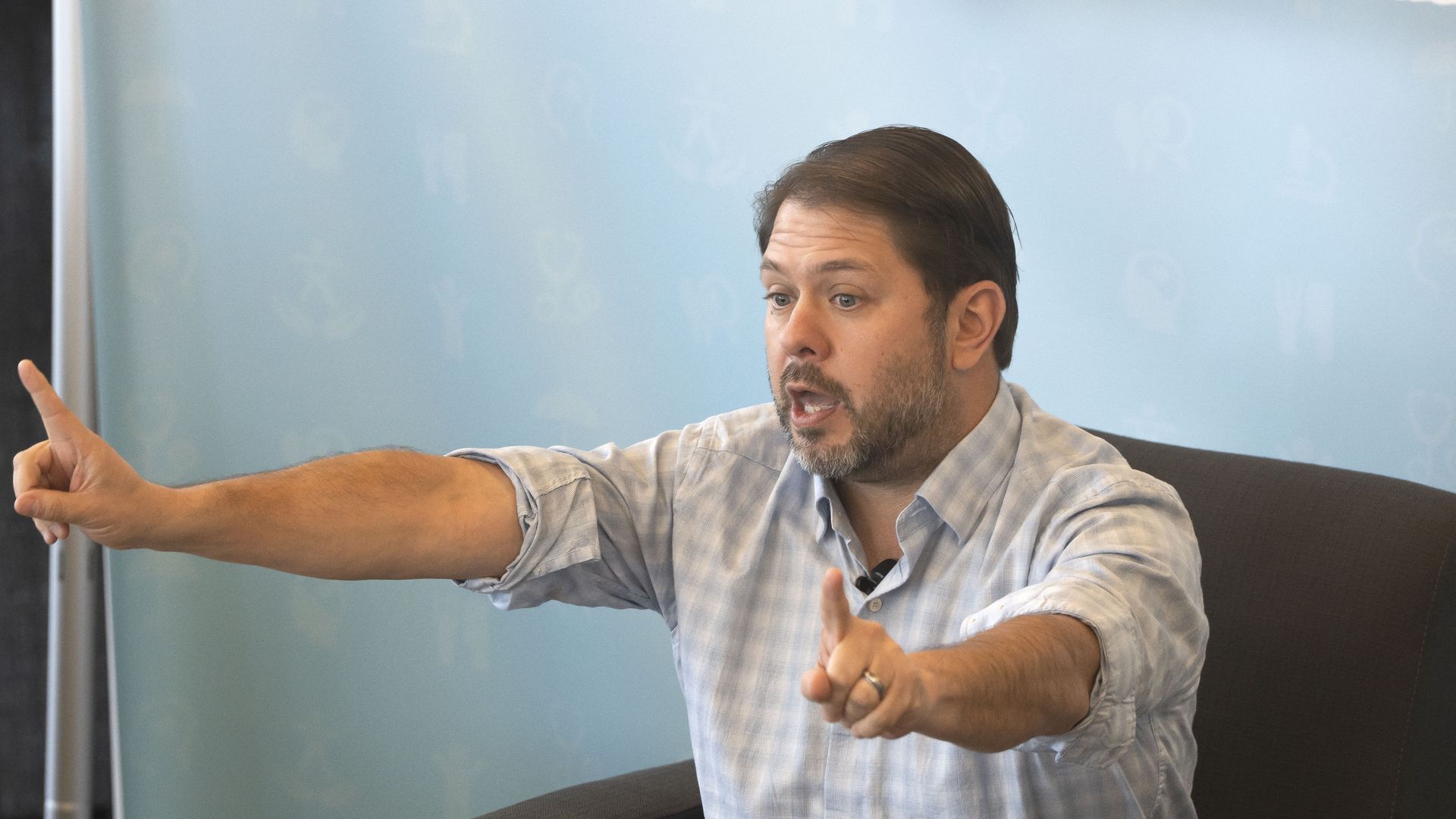
Gallego at a March town hall in Scottsdale, Ariz. Photo: Rebecca Noble / Getty Images
PHOENIX — Sen. Ruben Gallego's recess-break travels across Arizona strengthened his resolve to bolster nuclear energy while leaning on natural gas.
Why it matters: Gallego is the top Democrat on Energy and Natural Resources' energy subcommittee. He's also mentioned as a possible 2028 White House aspirant.
- He's emerged as a skilled communicator in the Senate Democratic caucus, using social media and other platforms to push back against much of the Trump administration's agenda.
Driving the news: "We have to make a very heavy and concentrated investment in nuclear," Gallego told Axios in Phoenix amid what he dubbed an "energy week" of meetings throughout the state. "That's the only way we're really going to meet the demand of the future."
The big picture: Arizona is confronting what Gallego called the "three horsemen": a proliferation of AI-driven data centers, industrial sector growth largely from chips production, and a population boom.
- Gas will have to serve as a bridge to a future energy mix of "nuclear-slash-renewables," Gallego said.
- Gas makes up nearly half of the state's energy mix, picking up the slack when demand peaks and the sun is down. Nuclear accounts for 27% of the state's power.
Zoom in: Gallego is excited by the prospect of using military bases to locate new large-scale nuclear and small modular reactors that can be spread around to address pockets of demand growth.
- He said he's open to a federal backstop for risky reactor projects — an idea floated in a bill that Sen. Jim Risch plans to reintroduce this session.
- Gallego said he hasn't seen the bill, but that the scale of the challenge would require more than the $3.6 billion of federal cost-sharing included in Risch's ARC Act introduced in December.
Zoom out: During the recess, Gallego visited Palo Verde, a 4,000-megawatt nuclear plant west of Phoenix. He also discussed ways to forecast Arizona's long-term energy needs at the Arizona Commerce Authority offices.
- The goal is to "work with the industry to figure out what are the incentives and structures that we need to get them to get going," he said.
- "There's a lot of people that are still stuck in some old ways of thinking of nuclear that create these types of barriers," he said.
Palo Verde officials talked up the plant's unique layout —it's the world's only nuclear plant built without a large nearby freshwater source — to a group of reporters gathered for last week's Society of Environmental Journalists conference.
- "We see nuclear as an important part of a clean energy future and a diverse energy portfolio," said John Hernandez, vice president of site services for Arizona Public Service Company.
Yes, but: Nuclear faces immense cost challenges at a time energy bills are on the rise. The utilities running Palo Verde are looking at the 2040s for new nuclear, including small modular reactors.
- But small modular reactors would be a "costly dead end, especially for AI," said Joe Romm, a senior research fellow at the University of Pennsylvania and a former DOE official.
- "We're talking about an imaginary tech that's never been proven," said Romm, who participated in the plant tour during the conference. "It's not actually practical, and it's a waste of time and money."
State of play: Gallego is fighting the gutting of Energy Department staff and funding, which he said would be "detrimental" to meeting energy goals.
- He was one of seven Democrats who backed DOE Secretary Chris Wright's confirmation, but he voted against DOE and Interior deputies this month.
- He said he's concerned that DOGE cuts will lead lieutenants like DOE deputy nominee James Danly to "have more partisan approaches to their policymaking."
