
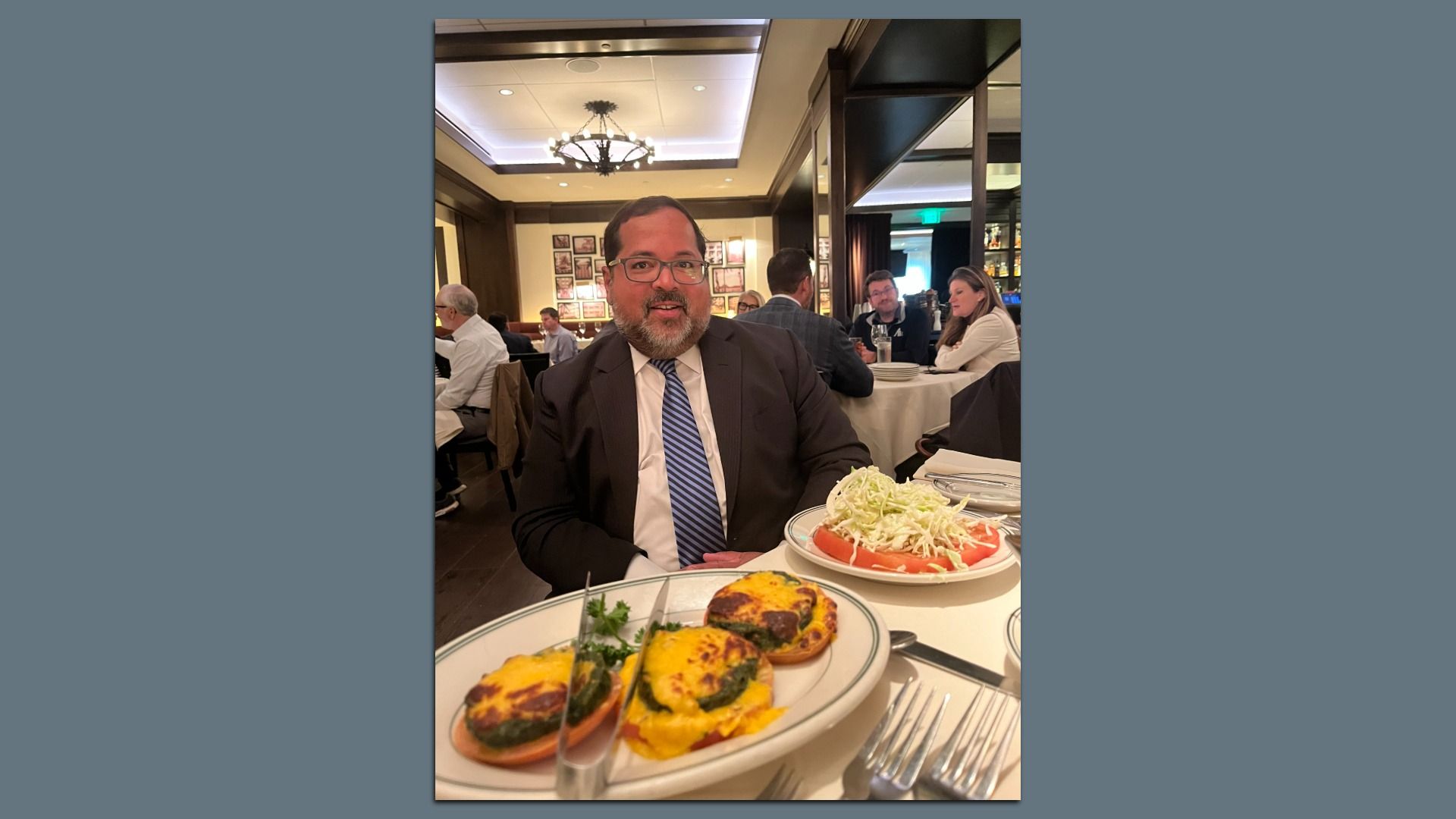
Chatterjee at Joe's Seafood. Photo: Daniel Moore/Axios
Neil Chatterjee wants fellow Republicans to value wind and solar to meet rising energy demand.
Why he matters: Chatterjee twice chaired the Federal Energy Regulatory Commission under Trump 1.0. He joined Palmetto, a rooftop solar energy technology company, as chief government affairs officer in January.
- He sat down over grilled tomatoes and coleslaw at Joe's Seafood, Prime Steak & Stone Crab. His remarks have been edited for length.
What do you make of President Trump's exclusion of solar, wind, and batteries in his day 1 executive orders?
To maintain reliability and keep costs affordable, both sides have to rethink their positioning.
On the political left, there's got to be a realization that we cannot possibly win the AI race and keep prices affordable and reliable for Americans without fossil fuels.
On the political right, there needs to be a recognition that we cannot possibly win the AI race with fossil fuels alone, that we're going to need every available electron.
- We're going to need solar and storage and geothermal and hydrogen and nuclear, but we're also going to need "negawatts" — things like demand response, energy efficiency and [distributed energy resources].
You tweeted at the Trump team hours after the election offering advice in making FERC staffing decisions. Have you kept in touch?
My worry was that there would just be blind cuts, and I wanted them to be smarter about it. Now, some of the stuff that [FERC Chairman Mark] Christie is dealing with around reduction-in-force questions — to the extent he's going to make changes, he's going to go about it in a smart way.
These are things that the administration supports, right? Christie is playing this really, really well. I just hope he gets a chance to continue.
You were demoted as FERC chairman during the end of Trump's first term. Are you finding Trump 2.0 to be receptive?
There's always rivalries, right? There are a couple of folks that I've butted heads with during my tenure who are not there. And there's a lot of people that you know that I've worked with over the years in Washington who are now in high-level positions.
What's your budget reconciliation crystal ball look like?
I'm still not convinced that this one big bill will come out. If it does, then it's very, very hard [for lawmakers] to take a stand on individual provisions, right? Like, are you really gonna sink the whole thing, the whole Trump agenda?
If it goes to the two bills, then I think there's much more room for nuanced negotiation. There's broad support for a lot of these policies, but then, you know, when it comes to deal-cutting time at the end, it'll be interesting to see how all these coalitions hold.
Should Trump once again order DOE and FERC to prop up coal-fired power plants?
If they wanted to pursue a course of constraining retirements, that's a manner in which they could go. But to me, it's more important that we build. We need that supply signal.
High capacity prices are supposed to send that "build" signal so that you get new generation. That's what we really need: that clear indication that we need more supply.
Bottom line, how are you advising nervous renewable energy investors?
In my world — electricity — it's not so cleanly political that I don't see big, dramatic swings.
The reality is, on the ground, nobody wants to see the lights go out. Nobody wants to see electricity bills spike.
