
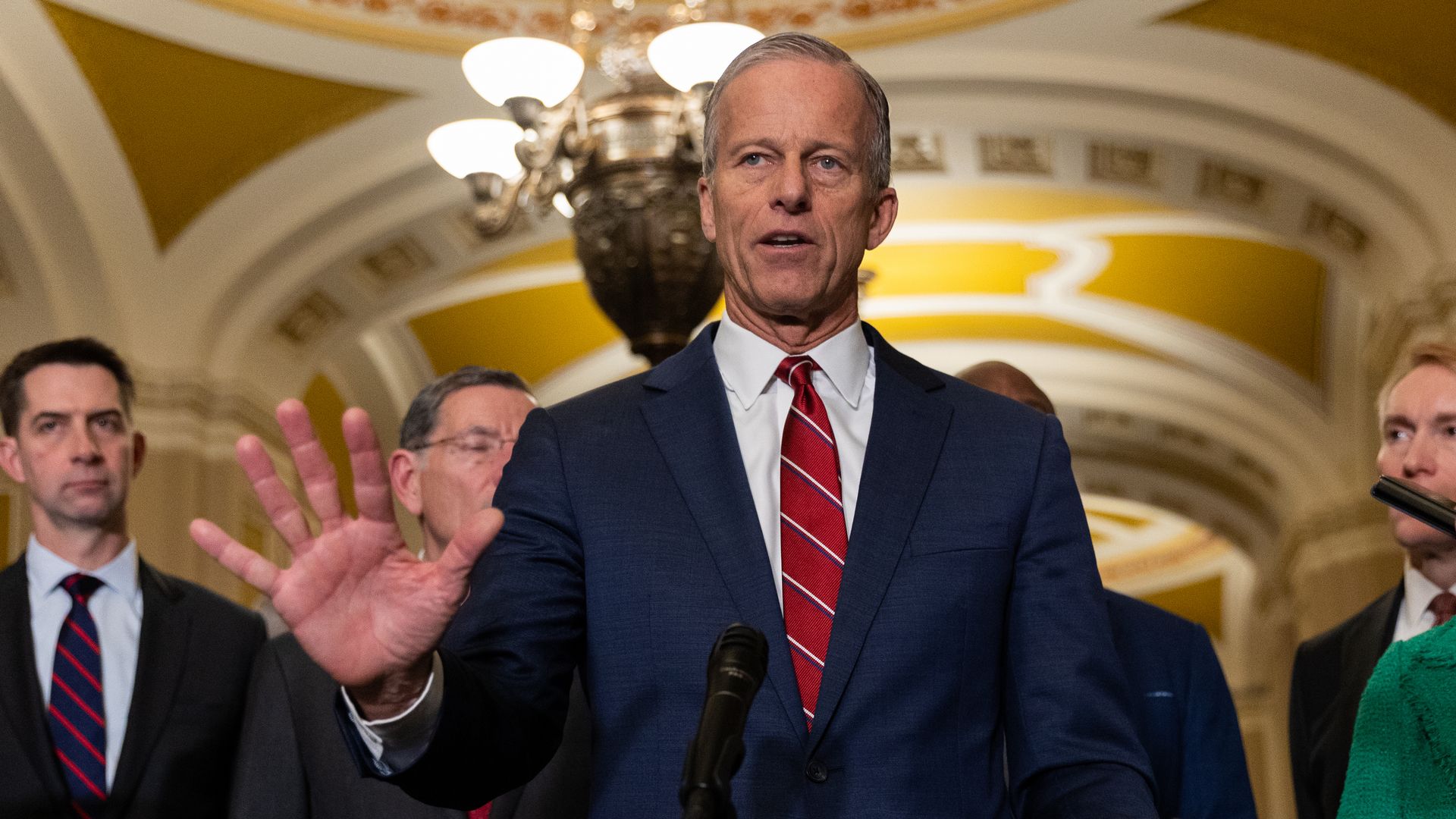
Thune talks to reporters on Tuesday. Photo: Nathan Posner/Anadolu via Getty Images
The Senate's new budget resolution resets the boundaries for the internal GOP debate about cutting the IRA — and could spare some of the climate law's energy tax credits and spending.
Why it matters: While it punts on specific policy fights, the resolution released Wednesday would unlock a one-bill reconciliation strategy for Republicans that could potentially ease the pressure to repeal the climate law.
Driving the news: The resolution, technically an amendment to the House-passed budget, would aim to let Republicans use the "current policy baseline" to score reconciliation.
- That would let them assume that extending the original Trump tax credits, which expire at the end of this year, would not increase the deficit.
- In effect, that means less pressure to find offsets to pay for cuts and less pressure to cut IRA spending and tax credits that many moderates want to leave in place.
- If the Senate amendment can pass both chambers, the move will change how Republicans put together the bill with implications for energy policy and other programs across the board.
What they're saying: "This budget resolution will pave the way for a generational investment in border security and national defense and unleash American energy dominance," Majority Leader John Thune said in a statement.
Zoom in: The Senate amendment would leave the committee allocations that the House has already approved in place — a $4.5 trillion deficit increase for Ways and Means, a $1 billion decrease for Natural Resources and a $880 billion decrease for Energy and Commerce.
- In the Senate, Finance would be directed to increase the deficit by $1.5 trillion or less, while Energy and Natural Resources would be reducing the deficit by at least $1 billion.
- The allocation for Environment and Public Works would also remain the same as the Senate's initial resolution: Increasing the deficit by as much as $1 billion.
- Those numbers are floors and ceilings, so lawmakers will have to reconcile the actual policies committees draw up for a reconciliation bill later.
Yes, but: Fiscal hawks in and out of Congress have derided the current policy baseline as a "gimmick," so Republicans will likely see some pushback from conservatives.
The bottom line: This won't resolve any specific policy disputes. But it's an important marker for the fight over the IRA.
