
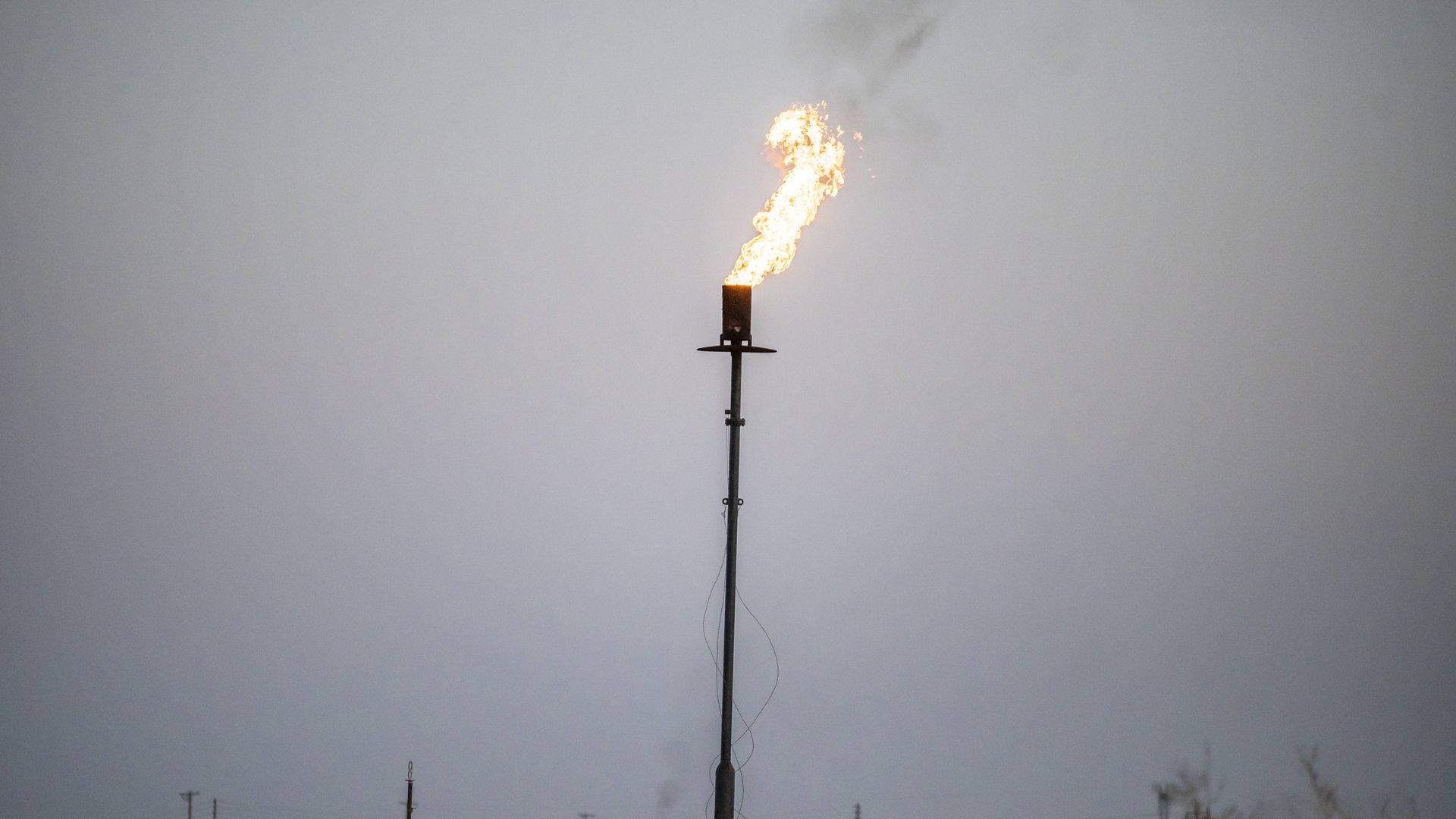
A gas flare stack at an oil well near Midland, Texas. Photo: Sergio Flores/Bloomberg via Getty Images
Red states are launching efforts to limit renewables deployment on the grid, Nick writes.
Why it matters: State legislators will be crucial to the national fight over AI data center–driven electricity demand growth — and President Trump's sweeping deregulatory agenda.
- States and their regulators will be a testing ground for Hill Republicans' push away from renewables and toward natural gas, nuclear and "dispatchable" power.
The big picture: "There's a national trend toward more muscular, more prescriptive policies that favor preferred resources," said Timothy Fox of ClearView Energy Partners.
- "This used to be predominantly a Democratic-leaning state thing.… But we're seeing sort of the opposite approach in a lot of the states with conventional energy resources."
Zoom in: That's playing out in Arizona and Texas, both of which are considering bills that would favor "dispatchable" resources.
- Arizona's House of Representatives approved legislation last month that would ban the state utility regulator from authorizing power retirements unless there is a new source of generation of "equal or greater size" available.
- It would also direct the state commission to prioritize "dispatchable sources."
- Legislators in Texas are proposing to create a dispatchable generation credit trading program, which would specifically exclude battery storage.
Between the lines: In effect, both bills would encourage more new gas and nuclear projects, likely to the detriment of the wind and solar projects that currently dominate queues for grid connection nationwide.
- They mirror legislation Republicans have proposed at the federal level that would require a FERC rulemaking to prioritize dispatchable resources, namely natural gas, coal, oil and nuclear.
- The North Carolina legislature is also moving legislation to drop the state's 2030 emissions target for the power sector.
Yes, but: Devin Hartman, R Street's energy and environmental policy director, argued that energy infrastructure across the board is facing "death by 1,000 cuts" as demand surges.
- "The big issue is the state-level permitting and siting," Hartman said.
- "You can't build gas infrastructure in those blue states," he said, while red counties are increasingly enacting ordinances that block wind and solar development.
What we're watching: Deals between utilities and tech companies could shape the state response to the rise of mega-sized data centers if they cause consumer prices to spike.
- "This is already happening, and we can't quantify it, but it is happening," said Ari Peskoe, director of the Electricity Law Initiative at Harvard Law School's Environmental and Energy Law Program.
- He published a paper on the subject this month.
- Legislators in California and Virginia have floated various measures aimed at preventing data centers from passing power costs to retail consumers and encouraging them to be powered by renewables.
Our thought bubble: Federal policymakers have only so much power to shape the grid, particularly since data center–driven power demand is going to affect some regions more acutely than others.
- But it's worth watching how Trump's energy emergency order and the possible demise of the IRA's lucrative energy incentives shape action in the states.
- Even with the IRA in place, state regulators and legislators "have significant influence over resource planning," said Duke University grid researcher Tyler Norris.
