
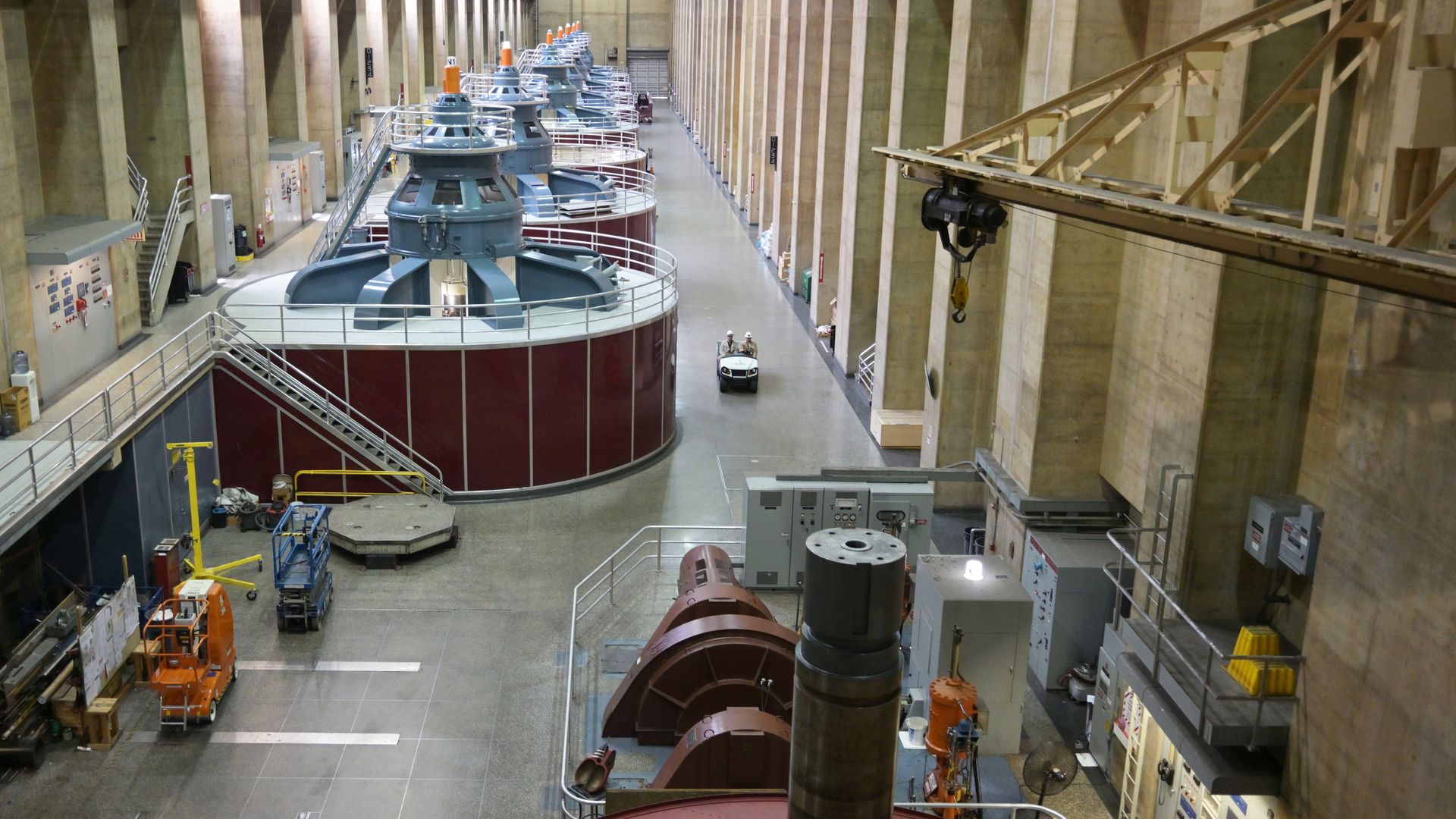
Machinery at Hoover Dam. Photo: RJ Sangosti/MediaNews Group/The Denver Post via Getty Images
Hydropower promoters are pressing the Trump administration and GOP Congress to finally get their priorities across the finish line.
Why it matters: Hydropower is burnishing its credentials as a zero-carbon round-the-clock energy source to appeal to President Trump's "energy dominance" agenda.
- "The kinetic movement of flowing water" — aka hydropower — met Trump's definition of "energy" in his executive order declaring a national energy emergency, which otherwise excluded renewables like wind, solar, and batteries.
What they're saying: That recognition is part of a bigger sea change helping hydro's prospects, Malcolm Woolf, president and CEO of the National Hydropower Association, told Axios.
- "That signal is being sent kind of more broadly, which makes the conversations on the Hill that much easier," Woolf said. "We're fully at the table again."
Reality check: Hydropower, averaging about 7% of U.S. electricity production, has come up short in recent years in pressing for tax credit and licensing reform.
- Hydropower recently lost out on the kind of tax incentives and attention that wind, solar, electric batteries, hydrogen, and other energy technologies received, industry representatives said.
Context: About 450 licenses totaling some 17 gigawatts of hydropower capacity are scheduled to expire by 2035.
- The fear is that dam operators surrender their license in the face of a relicensing process that takes eight years on average and costs operators roughly $3.5 million.
Zoom in: The NHA, joining a lobbying blitz last week to defend IRA tax credits, is pressing for Congress to establish an investment tax credit for upgrades at existing dams.
- It also wants to preserve the IRA's tech-neutral clean electricity tax credits and the tax credit for energy storage.
- "There's broad bipartisan support for that kind of tax parity to preserve and expand the existing fleet," Woolf said, pointing to bipartisan cosponsors of legislation last session. "That is a huge priority for us in reconciliation."
Between the lines: Woolf views Rep. Adrian Smith and Sen. Lisa Murkowski as key Hill players.
- Smith was among the cosponsors of a bipartisan hydro tax credit bill in 2023. And Murkowski sought to add hydropower provisions to the Manchin-Barrasso permitting bill.
- Dan Newhouse of Washington state, a top hydropower producer, told Axios last week that he'll support licensing overhaul legislation and anything to help get more juice out of the existing dam fleet.
- "There's a lot of dams in the country that are not producing electricity," Newhouse said. "So that's another area that we can truly grow our energy production in the country."
Newhouse and other Republicans will continue to oppose dam removal.
- Doug LaMalfa, the new chair of the Congressional Western Caucus, bemoaned the loss of four dams in his Northern California district amid rising energy demand.
- "Where's all that electricity going to come from?" LaMalfa told reporters last week during the caucus agenda unveiling.
What's next: As reconciliation unfolds, NHA is looking to Trump to use executive action to coordinate environmental reviews from agencies like the National Marine Fisheries Service, Fish and Wildlife Service, Army Corps of Engineers, and FERC.
