
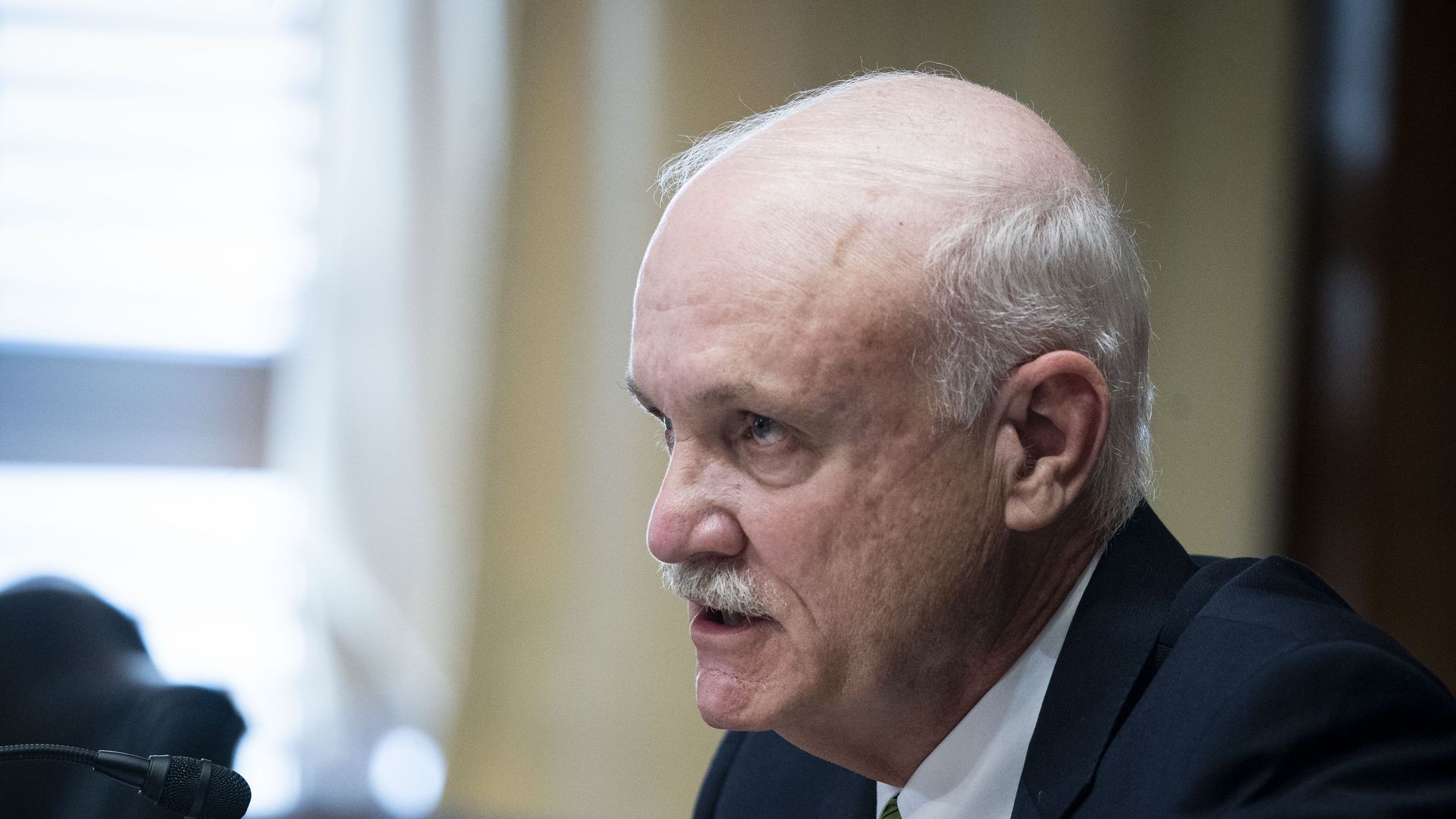
Christie in 2021. Photo: Al Drago/Bloomberg via Getty Images
President Trump's designated FERC chair said the commission is ready to act on data centers connecting to power plants without raising consumer costs or taking away states' authority.
Why it matters: Republican Mark Christie is leading the energy regulator at a time when Trump and congressional Republicans want to dramatically expand the grid to supply data centers while also seeking to lower energy prices.
- Trump's national energy emergency declaration and pledge to fast-track data centers paired with power plants come a few months after Christie voted to reject a co-location proposal.
What he's saying: "We need to act on that, and we're going to act to address that issue," Christie told Daniel, while declining to comment on any specific pending case per commission rules.
- Data centers are "driving up demand at a pretty breathtaking pace," Christie said. "We're going to need a lot more generation capacity to serve that load."
- But he opposes "FERC candy" — what he calls unnecessary federal incentives for electricity transmission projects that he blames for inflating project costs.
- And he emphasized FERC's independence from the White House and its limitations: "You can't come out with any result at FERC unless you have at least three votes."
The big picture: Data centers are expected to require a lot more U.S. power — though Monday's news that a Chinese AI model requires significantly less energy injects uncertainty to those projections.
- Christie argues that wind and solar are too weather-dependent to be reliable and that the country faces a crisis because of the rapid closure of "dispatchable generation" like coal, nuclear, and natural gas.
- "There are people who are saying that transmission is like some magic silver bullet to the rising demand," Christie said. "You have to start with generation."
Christie last fall floated allowing such power plants to quickly jump to the front of the grid queue, and GOP Rep. Troy Balderson introduced a bill that would allow it shortly thereafter.
- Balderson's office said he plans to reintroduce the bill soon.
Between the lines: Christie has expressed concerns about data centers connecting to existing power plants, arguing it could divert existing power supply away from current needs.
- But Trump's comments regarding co-location "appear to align" with Christie, who has supported co-location "on the condition that developers site data centers adjacent to new power plants," ClearView Energy Partners wrote in a note to clients.
- TD Cowen wrote that "we no longer see space/time for a full FERC-led rulemaking and order on the topic of co-location" and anticipates the commission will likely be forced to issue an order on the Amazon-Talen deal in response to a court ruling.
Context: Christie, nominated during Trump's first administration, has been willing to work across the aisle.
- Though he excoriated a transmission rule that he felt trampled on states' input in the regional grid planning process, he ultimately voted for a revised rule.
- Competitive power suppliers are "seeking clarity and rules of the road from FERC to help facilitate near-term action while avoiding erecting any barriers to or discriminating against co-located load or generation," said Todd Snitchler, CEO of the Electric Power Supply Association.
What we're watching: Whether Trump or the DOE will seek to exert influence over FERC and/or clash with Christie over jurisdictional issues.
- Christie's term expires in June, and he would have to depart FERC by the end of the year without White House renomination and Senate confirmation.
