
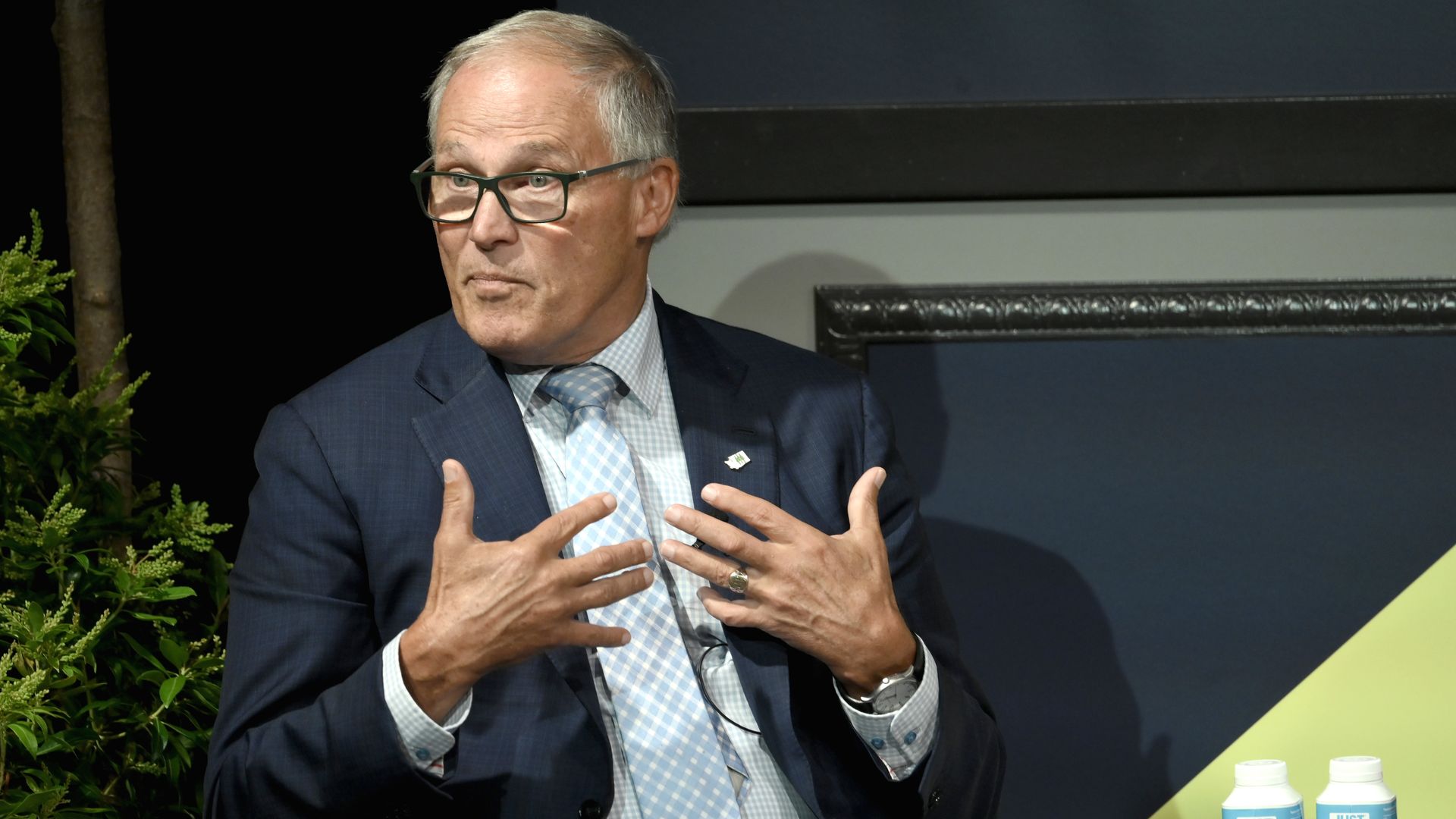
Gov. Jay Inslee in New York in September. Photo: Gary Gershoff/Getty Images
Voters in Washington state will decide on climate policy in a ballot measure with national implications, Nick writes.
Why it matters: The measure to repeal Washington's Climate Commitment Act is a test of whether "cap-and-invest" is a viable policy model for other states and whether climate policy can be durable — even with support from oil and gas.
Zoom in: The law sets declining emissions caps for industry, moving down to net zero in 2050.
- Companies can buy emissions allowances to pollute through quarterly auctions or in a secondary market, with revenue pumped into infrastructure and various community projects.
- "We know that other states like New York are developing their own cap-and-invest programs right now and are really looking to see what happens in Washington," said Caitlin Krenn, climate and clean energy director for Washington Conservation Action.
State of play: The repeal campaign is orchestrated and funded by Brian Heywood, a hedge fund exec who's also bankrolling several other ballot initiatives this cycle.
- He's spent $7 million of his own money on the campaign for the initiatives, including events where he's paid the owners of gas stations to temporarily lower prices to show the climate law's alleged negative impact.
- Opponents, meanwhile, have raised more than $16 million, including from the likes of Bill Gates and Steve Balmer.
- Gov. Jay Inslee, meanwhile, has spent much of his last year in office defending his signature accomplishment, which one recent poll found has public support.
What they're saying: Like his opponents, Heywood sees national implications for the ballot initiative, known as 2117.
"What the rest of the country should learn is that without the proper accountability, this will be like every other government program: We will measure success not by outcome, but by how much money we spend," Heywood told Nick.
Flashback: Washington's got a complicated history with carbon pricing.
- In 2018, climate advocates tried to pass a carbon tax via ballot measure but failed, with the oil industry spending tens of millions of dollars to defeat it.
This time around, BP, which runs the state's largest refinery, is supporting the effort to keep the Climate Commitment Act in place.
- And the Western States Petroleum Association has remained officially neutral. Spokesperson Julie Berge said the group "has not been engaged in the I-2117 campaign."
Between the lines: For climate advocates, that kind of unfamiliar alliance could help unstick the opposition to decarbonization policies.
- But there are also concerns within the state's oil industry that the emissions reductions goals are too quick and allowance costs could get out of hand, according to an industry source, granted anonymity to speak candidly about the ballot measure.
- If voters in a progressive state with a deep blue legislature toss out the Climate Commitment Act, it could show new limits on the popularity of climate policy.
