
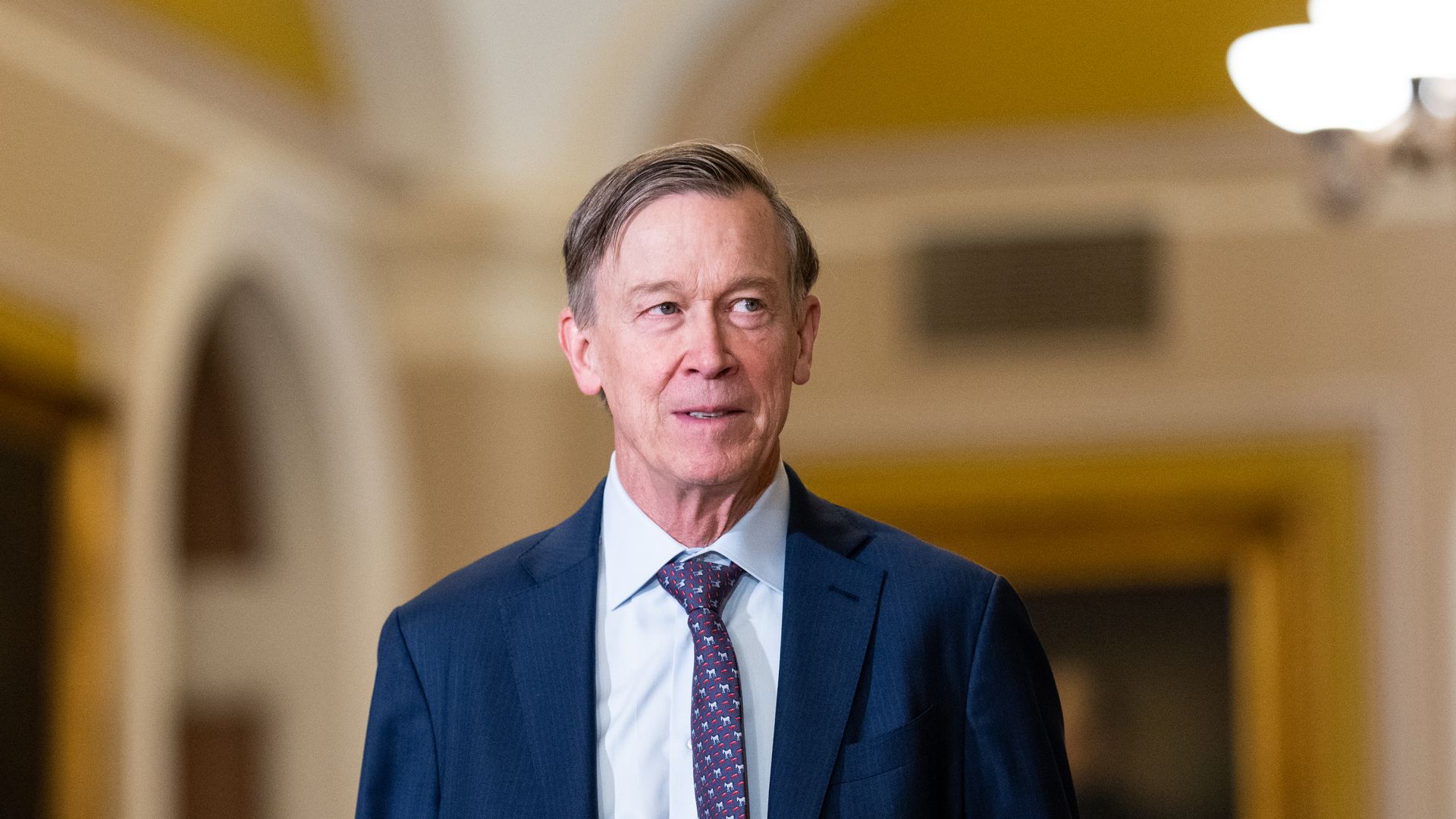
Hickenlooper in September. Photo: Bill Clark/CQ-Roll Call Inc. via Getty Images
The Energy Department is doling out $1.3 billion for transmission projects — but lawmakers still see the funding as a drop in the bucket.
Why it matters: The agency is funding three projects with the infrastructure law money — a hefty sum that's still only a fraction of what's needed to decarbonize the grid in the next few decades.
What they're saying: "When we actually pull together the major components of the great transition … it will probably be a couple trillion dollars," Sen. John Hickenlooper told Axios.
- "It's daunting but it's also inspiring," he said.
- Sen. Kevin Cramer told Axios that more transmission is needed. "But we also need more generation, and you can't do one and then the other. You have to have a better plan than what they've demonstrated to this point."
Driving the news: The funding through the Transmission Facilitation Program will go to projects in the Mountain West, Southwest and the Northeast.
- DOE also concurrently released its final Transmission Needs Study.
- To reach the IRA's full potential, the study said, the U.S. would need to double regional transmission capacity and increase interregional capacity fivefold by 2035.
Between the lines: That's an enormous undertaking, and building this stuff takes a long time. The earliest any of these projects will come onto the grid is 2027.
- Take the Southline Transmission Project, proposed to carry renewable power from New Mexico to Arizona.
- The developers say they have all the permits in hand and completed state siting processes in 2017. It'll still be at least four years until the first phase is completed.
- According to DOE's study, it'll account for 14% of the regional transmission needed in the Southwest.
