
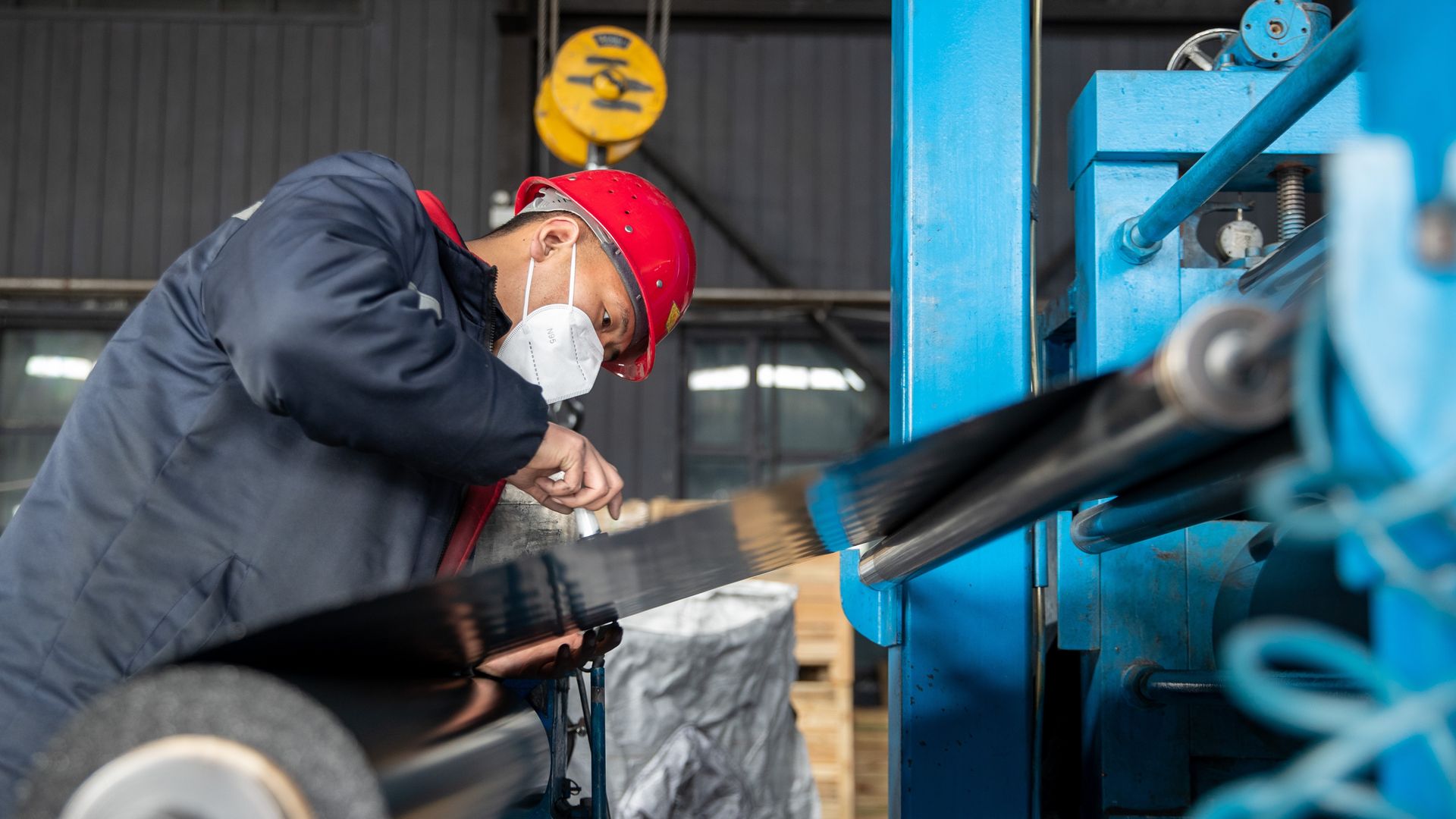
A worker measures flexible graphite paper at a factory in Jixi City in China's Heilongjiang Province. Photo: Zhang Tao/Xinhua via Getty Images
Companies are telling federal officials about a possible loophole in the IRA that may hinder efforts to stop using Chinese graphite for batteries.
Why it matters: The U.S. is deeply reliant on China for graphite — and China is starting to cut off access. It could undermine the global EV sector.
Driving the news: Battery anode companies and graphite producers wrote the Biden administration last week warning that the definition of graphite in the IRA's battery manufacturing tax credits runs "contrary to industry practice."
- These manufacturing credits, known as 45X, include write-offs for "critical mineral" production that companies hope will help marshal a new domestic battery materials industry.
- For graphite production to qualify, per the statute, the minerals must be "purified to a minimum purity of 99.9 percent graphitic carbon by mass."
Yes, but: Companies say that's not how the production of graphite for batteries works.
- Each company produces this material to precise specifications requested by its customers, including coatings and additives.
- Per the letter, while the cumulative makeup of a graphite anode or its materials may sometimes be below 99.9%, the "fundamental anode product remains the graphite that in fact meets the definition, and this core material ... is what uniquely enables the functionality of the battery."
- Applying a strict statutory definition would "create a significant loophole for foreign entities of concern to reap the rewards of the burgeoning U.S. battery industry," the letter stated.
Of note: Graphite for battery anodes is made in two different ways: naturally by mining it from the earth or synthetically through heating coal or oil.
The intrigue: At least one automaker — Ford — has submitted comments suggesting the definition in 45X may also flow into aspects of the IRA intended to stem U.S. reliance on Chinese battery materials.
- In a letter sent last November, Ford requested guidance from Treasury "to confirm that artificial graphite is not an applicable critical mineral" subject to review under the sourcing requirements in the IRA's 30D consumer vehicle tax credit.
- "Artificial graphite is a feedstock from crude oil that is then processed into petroleum coke. Therefore, artificial graphite should not be subject to the analysis to determine if a battery meets the critical minerals requirement," Ford said.
- Treasury officials didn't respond to a request for comment.
What they're saying: "This definition language becomes very critical to get right because everything flows from it," said Chris Burns, CEO of Novonix, a battery anode producer that signed onto the letter.
- "Based on one potential interpretation of the words used, you could try to position an argument that these materials would not be qualified," Burns told Axios. "However, again, when you think about how the industry operates and would interpret these things on a practical basis, it's very clear that these materials should qualify."
