
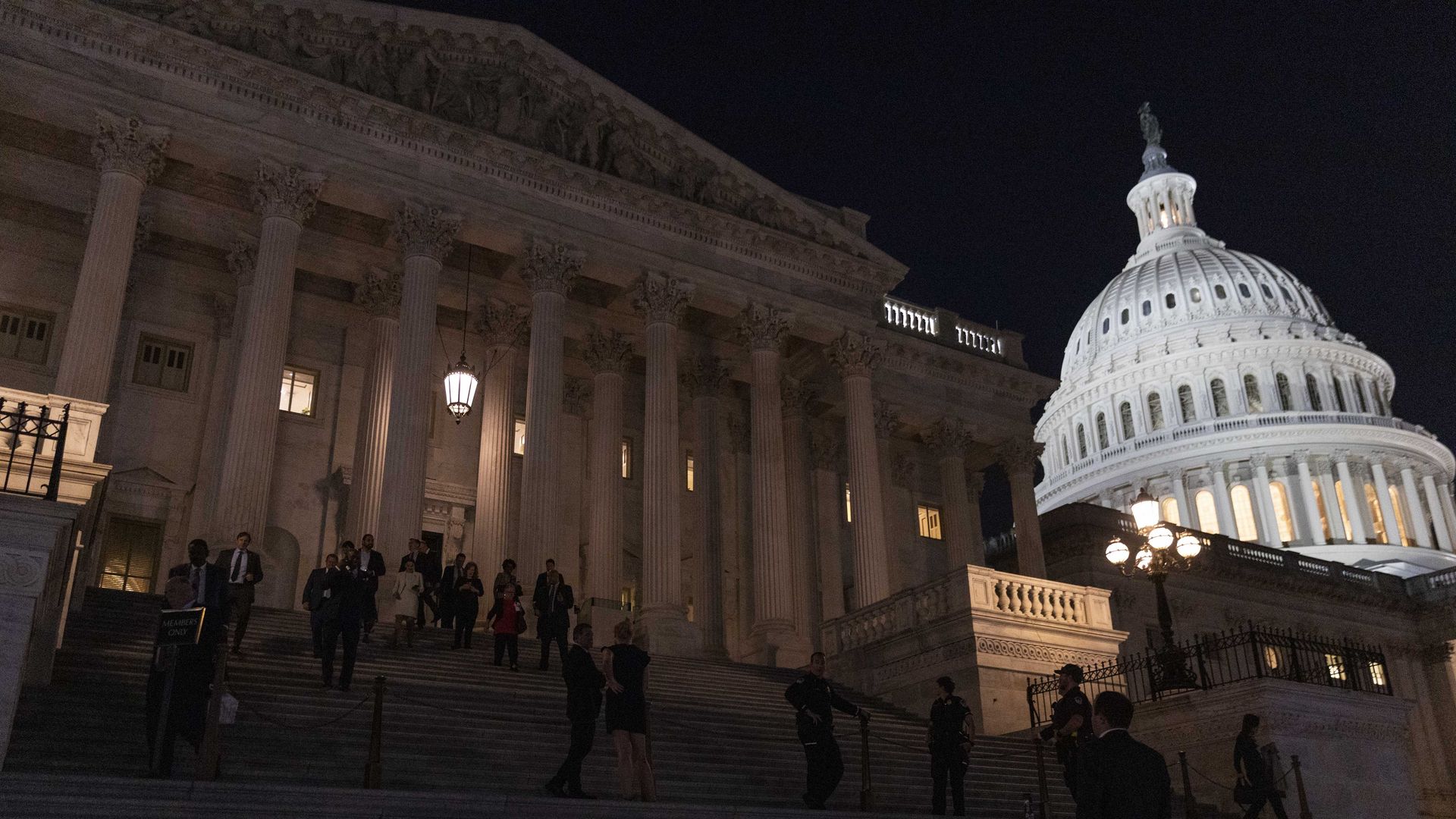
House members depart after debt ceiling vote. Photo: Mostafa Bassim/Anadolu Agency via Getty Images
Congress is on the cusp of overhauling one of the nation’s foundational environmental laws as part of the debt ceiling deal. Here's what it means.
Why it matters: Lawmakers and agencies previously have tweaked the National Environmental Policy Act around the edges, but the debt agreement would mark the first major statutory amendment to the law in decades.
- “In and of itself, that's a big deal,” said Fred Wagner, a partner at Venable LLP.
- The result has environmentalists alarmed and industry happy — but still hoping for more.
Axios talked to lawyers and NEPA experts and came away with three conclusions:
- The White House Council on Environmental Quality has been working on NEPA implementing regulations that, in part, reverse Trump-era administrative changes. Now CEQ might have to revisit some of its work.
- The new debt deal provisions likely would mean faster federal environmental reviews. But they’re also going to prompt lawsuits, and new case law will need to be worked out.
- For that reason, it would take years to see the full impact.
Zoom in: The headline change in the bill would put statutory timelines on NEPA reviews, something that industry has been seeking for a long time and that the Trump administration tried to implement via CEQ.
- The highest level of review — an environmental impact statement — would need to be completed in two years.
- Agencies could delay, but developers would be able to get a court order if they feel it’s taking an unreasonably long time.
- This is a bit squishy, since companies might not want to sue the regulator in charge of their project’s future.
- But “the possibility of lawsuits often motivates agencies to move more quickly,” said Michael Gerrard, director of Columbia’s Sabin Center for Climate Change Law.
Environmentalists are particularly concerned about a provision allowing developers to conduct their own EIS, under the supervision of federal agencies.
- “It's just a giant conflict of interest,” said Raul Garcia, vice president of policy and legislation at Earthjustice.
- But this already happens in other regulatory processes. Under New York state’s environmental law, for instance, “almost all EISes are written by consulting firms hired by the applicants,” Gerrard said.
- “It leads to concerns about biased EISes, and it's on the agencies to police that,” Gerrard said.
Other aspects of the bill would effectively codify existing best practices, or parts of the Trump administration's 2020 NEPA regulations.
- Designating a lead agency for reviews is a largely non-controversial idea.
- And some experts said it makes sense to allow agencies to use categorical exclusions — which allow certain low-impact projects to bypass stringent requirements — that other parts of the government have developed.
- But green groups are wary of changes that could restrict the scope of environmental review documents or, potentially, limit opportunities for public comment.
- "An agency now has to meet an arbitrary two-year timeline for a very complicated project. What does it do to the public comment period? What does that do to the thoroughness of the review?" Garcia said.
