Plowz & Mowz wants to be Uber for snowstorms - Axios
Featured

Plowz & Mowz wants to be Uber for snowstorms

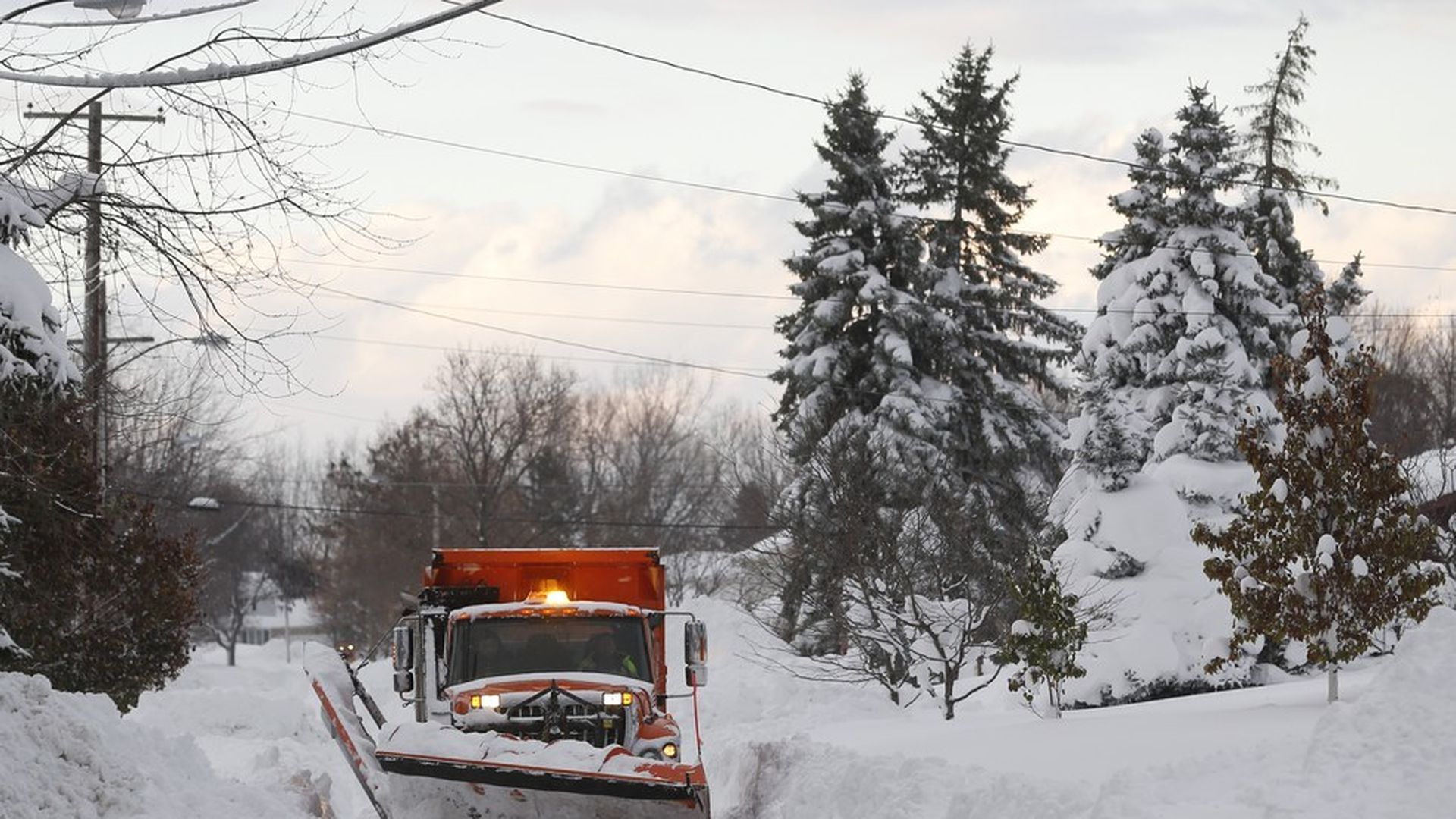
AP Photo/Mike Groll

"We've got a company that offers an on-demand app for snowplows." ― Peter Pham, co-founder of tech incubator Science Inc. (Dollar Shave Club, DogVacay).
"That makes no sense Peter. Snowplowing isn't a consistent business. And you live in LA." ― me.

And with that I was introduced to Plowz and Mowz, the Science-backed company that has around 1,500 plows on hand today in blizzard-affected areas. Its co-founders, Andrew Englander and William Mahoney, spent some time on the phone, explaining why my gut rejection was unfounded:

The genesis: Mahoney is from Syracuse, and the idea came to him when he couldn't find anyone to plow his mother's long driveway. "I would call plow operators, but no one picks up the phone once it begins snowing. So I'd shovel, and watch the plows drive by and think that they were missing out on an opportunity to make extra money."

The synergy: The co-founders recognized that most residential snowplow operators work as landscapers in the warmer months, so plowing becomes lead generation for mowing which becomes lead generation for lawn-mowing or leaf blowing.

The opportunity: Use technology to optimize existing coverage routes. "We use a live-tracking GPS so that drivers can see other jobs that are already on, or close enough to, their way to the next job. These jobs can be done in as little as six minutes, so it's incremental income," Englander says. "For users, this eliminates the need to sign seasonal contracts. They can also put in notes about when they need a plow by, like if it's a doctor who needs to be on the road by 6am. Lawn-mowing works the same way, although the timing is a bit more flexible ― such as today in the morning or tomorrow in the afternoon. The pricing is competitive, and people get a picture of the completed job within the app once it's done, which is useful, for example, if you're on vacation and just need a one-time mow."

Numbers: The company said last month that it was approaching 100,000 paid transactions, and that it has raised $1.5 million in VC funding. It is unprofitable, but the co-founders say they have had a few break-even months. Overall they have over 3,000 landscape companies signed up, many of which have multiple crews.


Featured

Nikki Haley: Trump "believes the climate is changing"

AP

During an interview with "Face The Nation," UN Ambassador Nikki Haley said that Trump "believes the climate is changing, and he believes pollutants are part of that equation." She even repeated the phrase when John Dickerson said that wasn't reflected in Trump's actions.

This comes just two days after Trump announced he's withdrawing the U.S. from the Paris climate deal, which is a global pledge to reduce greenhouse gas emissions. Yet Haley insisted that Trump is "absolutely intent on making sure that we have clean air, clean water, that he makes sure that we're doing everything we can to keep America's moral compass in the world when it comes to the environment."

Other WH officials have refused to comment on Trump's views on climate change since the Paris exit.


Featured

Marc Kasowitz is no stranger to Trump, but he is to Russia

AP

President Trump has tapped Marc Kasowitz to legally represent him in the investigation into Russia's meddling in the election and whether Trump aides colluded with them, per WSJ. He has helped Trump many times in the past 15 years — whenever Trump has been in a bind over money or trying to salvage his reputation — but the Russia case is totally new territory for the New York litigator.

Trump vs. NYT

  • Trump wanted to sue the NYT for libel last October when they ran an article featuring two women accusing him of sexual misconduct.
  • Kasowitz demanded that NYT take the story down and issue a public apology to Trump.
  • "Your article is reckless, defamatory and constitutes libel per se," Mr. Kasowitz wrote to NYT. "It is apparent from, among other things, the timing of the article, that it is nothing more than a politically motivated effort to defeat Mr. Trump's candidacy."

Trump vs. Timothy O'Brien

  • O'Brien is the author of the book "TrumpNation: The Art Of Being The Donald"
  • Trump filed a $5 billion lawsuit against O'Brien in 2006 because he claimed Trump was only a millionaire, not a billionaire.
  • Kasowitz filed the defamation suit, alleging that instead of reviewing business records while visiting the Trump Organization, he was flirtatious with a Trump Org. employee.
  • The lawsuit was dismissed.
Trump vs. divorce records
  • NYT and Gannett wanted to make Trump's divorce records, from his marriage to Ivana, public.
  • The papers argued that the records were "necessary for public debate" about then-president-elect Trump.
  • Kasowitz won that case and the records remained sealed.

Trump vs. Trump University

  • Kasowitz recently stepped in to help with the appeal to the case against Trump University for fraud litigation.
  • The case has already been settled, but he's providing legal counsel to Trump for the eventual appeal.
Trump vs. "The Apprentice" contestant
  • Summer Zervos is suing Trump for defamation.
  • She alleged that he made unwanted sexual advances to her when she was a contestant on "The Apprentice"
  • "Every woman lied when they came forward to hurt my campaign, total fabrication," Trump said at an October rally in Pennsylvania.
  • Kasowitz is defending him in this case and he argued that Trump is "immune from the lawsuit under the Supremacy Clause of the U.S. Constitution, which provides that federal law supersedes state law."
  • "As the U.S. Supreme Court has repeatedly recognized, courts should show great deference to the president and his duties," Kasowitz wrote.
Trump vs. Trump properties
  • Kasowitz successfully defended Trump in 2006 when Trump World Tower board members wanted to terminate their management agreement with the Trump Org, per WSJ.
  • In 2005, he represented Trump in a lawsuit against "Trump's partners, a consortium of Chinese investors."
    • They sold Trump's Tower in Manhattan $1.76 billion, which the lawsuit claimed was $1.5 billion less than what other bidders were offering.
One big question: Will Trump even listen to Kasowitz or take his legal advice? The Russia investigation is a completely different ballgame from what Kasowitz has helped Trump with in the past. And Trump increasingly views himself as the only effective spokesperson for his actions, especially now that he's president. This investigation will require a lot from Kasowitz, particularly in terms of constructing the media narrative — that could lead him to suggest staying silent or coming forward with information, which are two options that don't really align with Trump's way of doing things.
Kasowitz declined to comment for this story.


Featured

Instagram co-founder shares one thing he does every day

Marcio Jose Sanchez / AP

Here's a quick weekend breakfast conversation with one of the world's most interesting and consequential people. Our debut guest is Kevin Systrom, CEO and co-founder of Instagram — 700 million people, connected by the power of visual communication:

1. What is the one thing you won't skip – or shorten – in the morning? An hour-long workout on my bike.

2. What's your favorite trick for getting smart quickly? Read voraciously, but intelligently. In Mortimer Adler's "How to Read a Book," he says you should not read every page in a book, and spend most of your time figuring out the most important parts to read.

3. What's your favorite life hack? If you don't want to do something, make a deal with yourself to do at least five minutes of it. After five minutes, you'll end up doing the whole thing.

4. What's the one thing you are insecure about? My inability to understand the term "business casual."

5. Name one item on your bucket list. One day, I'd like to ride in the Paris-Roubaix, a road race in northern France. It's one of cycling's oldest races and boasts some of the roughest terrain. I have some training to do!

6. What tech gadget or app saves you the most time? That's easy – Waze! Bay area traffic can be trite, but I use Waze every day to avoid sitting on the 101.

Featured

People aren't spending money like before

AP

American consumers aren't spending with the gusto you'd expect, what with U.S. unemployment plumbing a 16-year low of 4.3%, wages ticking up, and the stock market hitting record highs, Barron's columnist Kopin Tan writes in "The Surprising Threat to the American Economy":

The problem: "Real U.S. personal spending is growing at about 2.6% year over year, when it should be closer to 4%, given the much-ballyhooed global recovery."

The reason: "Our attitude toward spending and debt has changed, as well, and the bursting of the housing bubble has deflated our love of conspicuous consumption. Families are saving more, despite being penalized for saving by zero interest rates."

Key stat 1: "Thanks to the levitating stock market and recovering home prices, household net worth is 37% higher than it was at the housing-bubble peak ... with 30% of our net worth now tied to stocks and mutual funds."

Key stat 2: "The share of national spending eaten up by three items — health care, housing, and education — has ballooned from 25% in 1980 to more than 36% by 2015."

The bottom line: "A stock market trading at all-time highs carries with it the burden of great expectations, but investors might be looking to the burgeoning middle class overseas to pick up the spending slack and goose the global economy. American consumers have done their fair share, and they deserve a break."

Featured

Trump's obsession with his core voters inspired the Paris exit

Michael Snyder / AP

I'm told that in addition to Ivanka Trump, the presidential confidants making a last-minute pitch to soften the Paris deal included national security adviser H.R. McMaster, who argued to President Trump that he could accomplish what he needed to domestically, while adding significant caveats that would avoid alienating allies.

Trump rejected the advice in part because he thought a clean exit looked stronger, and partly because he was tired of all the conflicting advice he was getting.

But the biggest reason was all about that base: Using the muscle memory from the campaign, Trump is increasingly obsessed with his core voters. Officials explain that Trump and his inner circle learned in the darkest days of the campaign that they could power through by doubling down and focusing on the the base, so they're bringing those instincts to government.

Sound smart: McMaster, in these meetings, is the opposite of Trump: precise, detailed, methodical and persistent. And this style can drive Trump nuts at times.

CNN's Jim Acosta, on White House unwillingness to say whether Trump still thinks climate change is a hoax: "It guarantees the question will be asked over and over again."

WashPost lead story, "Europe's view of U.S. ties darkens," by Michael Birnbaum in Brussels: "The pullout left the United States a global outlier and, many European leaders and experts said, a severely diminished force in the world. And it gave China fresh weight in a newly unbalanced landscape where longtime U.S. allies are searching for stability."

Featured

Trump admin's changing stance on "unmasking"

Charles Dharapak / AP

The House Intelligence Committee, led by Devin Nunes and controlled by Republicans, asked spy agencies in the U.S. to "unmask" Americans last year, WashPost reports.

The committee wanted the agencies to reveal the names of five to six Americans or corporations identified in classified reports regarding Russian meddling in the election. On Thursday, Nunes tweeted: "Seeing a lot of fake news from media elites and others who have no interest in violations of Americans' civil liberties via unmaskings."

Why it matters: He and President Trump have been critical of the Obama Administration's "unmasking" efforts, but the Intelligence Committee under Trump and Nunes reportedly requested the same thing.

This week, the House Intelligence Committee issued seven subpoenas alleging the Obama Administration illegally collected information about citizens via unmasking. "The big story is the 'unmasking and surveillance' of people that took place during the Obama administration," Trump tweeted last Thursday.

Go deeper: U.S. intelligence agencies collect numerous documents related to foreign communications, and often those reports include information about Americans or American corporations. Because of their classified nature, the U.S. intelligence agencies will "mask" the identifying information about citizens and businesses. But, those higher up in the government can request an "unmasking" of this information if they have a legitimate reason or believe it will be vital to understanding the classified reports.

Featured

Small business owners celebrate Trump's Paris decision

John Locher / AP

Small business owners were elated when President Trump withdrew the U.S. from the Paris deal. "It was like a major win at a football game," a management consultant told NYT. Although many big companies (Apple, IBM, Disney, etc.) criticized Trump for the decision, the small business owners he's kept happy are reflective of the base of voters who delivered him to the White House.

"There is a new sheriff in town," said another business owner whose company develops control panels for larger factories. "But the biggest frustration that I have is that there is so much resistance that is keeping him from moving forward."

Why it matters: Trump's decision to withdraw was political. He's appealing to his base (something he's done through continued campaign style rallies) instead of large corporations and business elites like Tim Cook.

Featured

Amazon goes beyond internet

Lazaro Gamio / Axios

Amazon opened two drive-up grocery stores in Seattle and a bookstore in New York City last week, adding to a growing brick-and-mortar venture. The online retailer now has nine stores total — seven bookstores (with plans to open six more) and two grocery stores.

Why it matters: Amazon had $136b in sales last year — 43% of all online shopping. But there's a lot more money to be made in the offline retail industry. In 2016, e-commerce only made up $1.9 trillion of the $22 trillion in total retail sales, according to eMarketer, so the upside of expanding into the offline market is massive. And Amazon's experimentation in offline stores (using cameras to track customers to automatically charge for purchases and using mountains of data to track customer preferences and sales) could further disrupt retail employment — which has already been falling for four straight months.

How it works: AmazonFresh, the company's e-grocery department, is available to AmazonPrime members (who pay a $99 annual fee for two-day shipping). For a grocery subscription, they pay an added $14.99-a-month fee, for which they can order and pick up their groceries at a drive-up neighborhood store within 15 minutes. Customer data (name and license plate number) are stored so that subsequent pickups are available more quickly, Amazon says.

Amazon's physical bookstores, the newest of them in the heart of Manhattan, feature sections like "Highly rated children's books, 4.8 stars & Above" and "Most-Wished for Books on Amazon.com." The strategy is data-centric, offering products that the company already knows sell well online — and now, the company hopes, in person.

"Data is becoming the new crude oil — a valuable resource," Mark Hamrick, senior economic analyst for BankRate.com, tells Axios. Amazon is incorporating data it gathers online into the offline world, with the objective of broadening its already-commanding place in global retail. No matter if you're buying food or books, whether you are doing it online or in a traditional store, founder Jeff Bezos is going to try to get you immersed in the Amazon Way.

Bottom line: Unlike other stores, Amazon might not employ a lot of people in its physical shops. (The company has tested a cashier-less store called AmazonGo.) Asked about store employees, Nell Rona, an Amazon spokesperson, said the number "varies depending on the day and the time."

Featured

Report: Trump interviews for FBI chief are chaotic

Alex Brandon / AP

Three sources close to the contenders who have interviewed to fill former FBI Director James Comey's vacated role at the helm of the FBI tell Reuters the interview process so far has been chaotic. Two other highlights from inside the interviews:

  • One of the sources said "Trump spoke mostly about himself and seemed distracted" in one interview.
  • All three sources said the interviews were "light on questions about substantive issues facing the agency," as Reuters wrote.
Why it matters: It's three weeks out from when Trump fired Comey.
The White House declined to comment.
Featured

Exclusive: Apple Music executive Bozoma Saint John plans to leave the company

Apple

Bozoma Saint John, the Apple executive who garnered significant attention for her demo at last year's worldwide developer conference, plans to leave the company, Axios has learned. Saint John was head of Global Consumer Marketing for Apple Music (and predecessor Beats Music). Prior to that she was head of music and entertainment marketing for Pepsi.

An Apple representative declined to comment.

Why it matters: While Apple has several women of color in higher-ranking positions, Saint John had a high profile beyond Apple and was widely praised for her on-stage work last year. She was also fairly unique among Apple executives in maintaining a strong personal brand beyond her work identity, with a strong following on Instagram and Twitter. Her exit also comes shortly after Apple shifted former HR head Denise Young Smith to a new role as VP of diversity and inclusion.