Health Care Policy
May 29, 2024

Happy recess Wednesday! The pandas are returning and so are we, with a look at how industry and conservative groups are hashing out what health policy could look like in a second Trump administration.
- We'll be back next week when Congress is back, or earlier if there's breaking news you need to know.
- And if you have tips on people changing jobs, send them here for our next installment of people moves.
1 big thing: Gaming out health policy under Trump

Illustration: Tiffany Herring/Axios
Official Washington is starting to game out what a second Trump presidency would mean for health policy, with industry and conservative groups prioritizing options — including for if there's a GOP sweep, Victoria and Peter report.
Why it matters: A Trump win would once again shock the system, bringing unpredictability and the possibility of cuts to federal health programs.
Inside the room: Several GOP lobbyists told Axios that client requests to help game out 2025 have intensified in the last six weeks, with more requests to connect to and build relationships with Trump world.
- The sessions are starting out with a review of how reconciliation works, said one lobbyist. Then, there's gaming out how particular health policies could affect various industries.
- There also are plenty of questions about who may be tapped for a Trump administration, though K Street feels much more prepared on that front than in 2016.
The latest: A Republican administration and Congress would likely use reconciliation to extend the 2017 Trump tax cuts, but there is also discussion of bundling health care elements into one big package.
- House Majority Leader Steve Scalise has said that if Republicans are in control on all fronts, they want to take the Democratic "whole of government" approach to reconciliation, the way it was used in the Inflation Reduction Act, per one GOP lobbyist.
- Possible options include Medicare site neutral payments for hospitals, a crackdown on Medicare Advantage overpayments to insurers, or Medicaid cuts.
- All of those policies may be attractive because they could generate savings and help to offset the cost of a big legislative package.
It promises to be an exceedingly busy year regardless of the election outcome, with enhanced ACA subsidies due to expire along with the tax cuts and another showdown over raising or suspending the debt ceiling.
- There's even the long shot prospect of a renewed push to repeal and replace the Affordable Care Act.
What they're saying: "If Republicans run the tables in November, the margin of victory will be so narrow that repeal and replace is probably unrealistic, but I do think the IRA enhanced ACA credits are as good as dead," said Dean Rosen, partner at Mehlman Consulting.
- GOP sources say there is more planning in Republican circles than there was in 2016, when the transition was more chaotic.
Reality check: It's never certain what Trump will decide to focus on.
- One possibility is a "most-favored nation" policy to lower drug prices.
- Trump talked about that a lot in his first term but a last-minute push to finalize it was blocked in court.
- "I think you'll see him give that a lot of attention," said Brian Blase, a former Trump health official and president of Paragon Health Institute, one of the Trump-aligned groups working on policy options.
2. Bill of the week: 340B overhaul

Illustration: Gabriella Turrisi/Axios
Reps. Larry Bucshon, Buddy Carter and Diana Harshbarger want to revamp the 340B drug discount program, establish new eligibility criteria for hospitals and impose more oversight over program grantees.
Why it matters: Their effort comes a week after a federal appeals court handed drugmakers a major win over the use of 340B discounts at contract pharmacies, and as the program is caught up in a thicket of litigation and multiple state efforts to set rules of the road.
What's inside: The 340B ACCESS Act, introduced on Tuesday, would better define 340B patients and reset eligibility requirements for hospitals.
- It would establish a sliding fee scale for low-income patients to lower their out-of-pocket costs on discounted drugs and require hospitals to spend minimum amounts of charity care.
- It contains restrictions on PBMs, contract pharmacies, and third-party administrators to prevent them from profiting off the safety net program.
- There would be more public reporting of 340B program data, and the legislation adds new requirements for manufacturers, who currently aren't required to ship or ease delivery of 340B drugs to contract pharmacies.
What they're saying: Groups including Third Way and the National Association of Community Health Centers are supporting the effort.
- 340B Health, a lobbying group representing hospitals and health systems in the program, said the bill amounts to a drug industry wish list that would make many hospitals ineligible for the program, reduce the amounts of 340B-eligible drugs and the number of eligible patients.
What's next: The House Energy and Commerce oversight and investigations subcommittee will hold a hearing on 340B next Tuesday at 10:30am ET.
3. Fauci returns for post-retirement testimony
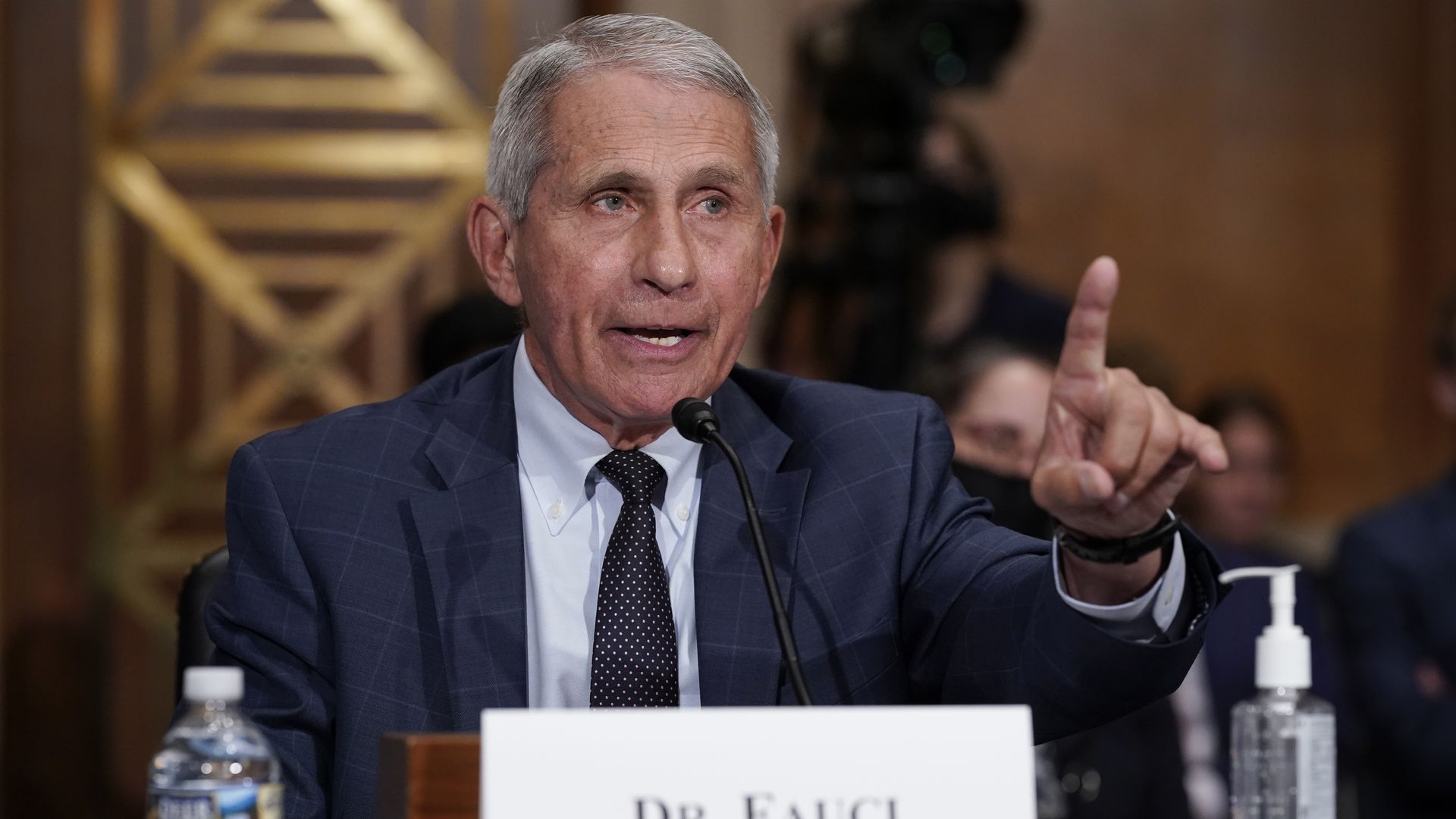
Fauci responds to accusations by Sen. Rand Paul at a 2021 Senate HELP hearing. Photo: J. Scott Applewhite-Pool/Getty Images
Former NIAID director Anthony Fauci is due to appear before the House's COVID Select Subcommittee on Monday, marking the first time that he'll testify publicly in front of Congress since he retired at the end of 2022, Victoria reports.
Why it matters: While Fauci will probably face more questions from GOP members on COVID origins and what they characterize as a heavy handed federal response, it will be telling if Democrats sound any critical notes now that he's no longer a federal official, Victoria reports.
- Fauci in January had a two-day, closed-door interview with the subcommittee about the pandemic's origins and the government response.
State of play: Last week the subcommittee held a hearing with one of Fauci's former aides, David Morens, who was criticized by Republicans and Democrats for using a private email account to send emails about COVID origins and trying to bypass federal records disclosure rules.
- Committee members have questioned whether Morens' behavior is a sign that Fauci may have also engaged in covering up communications or violating federal records laws.
What they're saying: Subcommittee Chairman Brad Wenstrup said that Fauci in January "testified to serious systemic failures in our public health system."
- "We also learned that Dr. Fauci believes the lab leak hypothesis he publicly downplayed should not be dismissed as a conspiracy theory," Wenstrup added.
4. Catch me up: MultiPlan probe, Cal. minimum wage

Illustration: Tiffany Herring/Axios
1. MultiPlan inquiry: Senate Finance Chair Ron Wyden and HELP Chair Bernie Sanders are asking a data analytics firm that works with insurers to discuss a New York Times investigation that found its pricing services could leave patients with unexpectedly big bills when they go out-of-network.
2. Minimum wage: California legislators are trying to delay the phase-in of a $25-an-hour minimum wage for health care workers that's due to begin on Saturday as they grapple with a budget deficit. More from the SacBee here.
3. Pandemic prep: Concern over how the globe deals with the next big viral threat are hanging over the World Health Organization's annual meeting this week after negotiations on a pandemic treaty stalled, Axios' Jason Millman reports.
4. Research diversity: Clinical trials funded by NIH often "fell short" in enrolling underrepresented racial and ethnic groups, the federal health department's watchdog found in a new review.
5. Postpartum pill: The first pill for postpartum depression is working, though some patients still face barriers accessing it, per NBC News.
✅ Thank you for reading Axios Pro Policy, and thanks to editors Adriel Bettelheim and David Nather and senior copy editor Bryan McBournie. Do you know someone who needs this newsletter? Have them sign up here.