Axios What's Next

November 09, 2022
Systems that prevent drunk driving could be about to join seatbelts, airbags and backup cameras as the latest federally mandated car safety tech, Joann reports today.
Today's newsletter is 1,141 words ... 4½ minutes.
1 big thing: The end of drunk driving
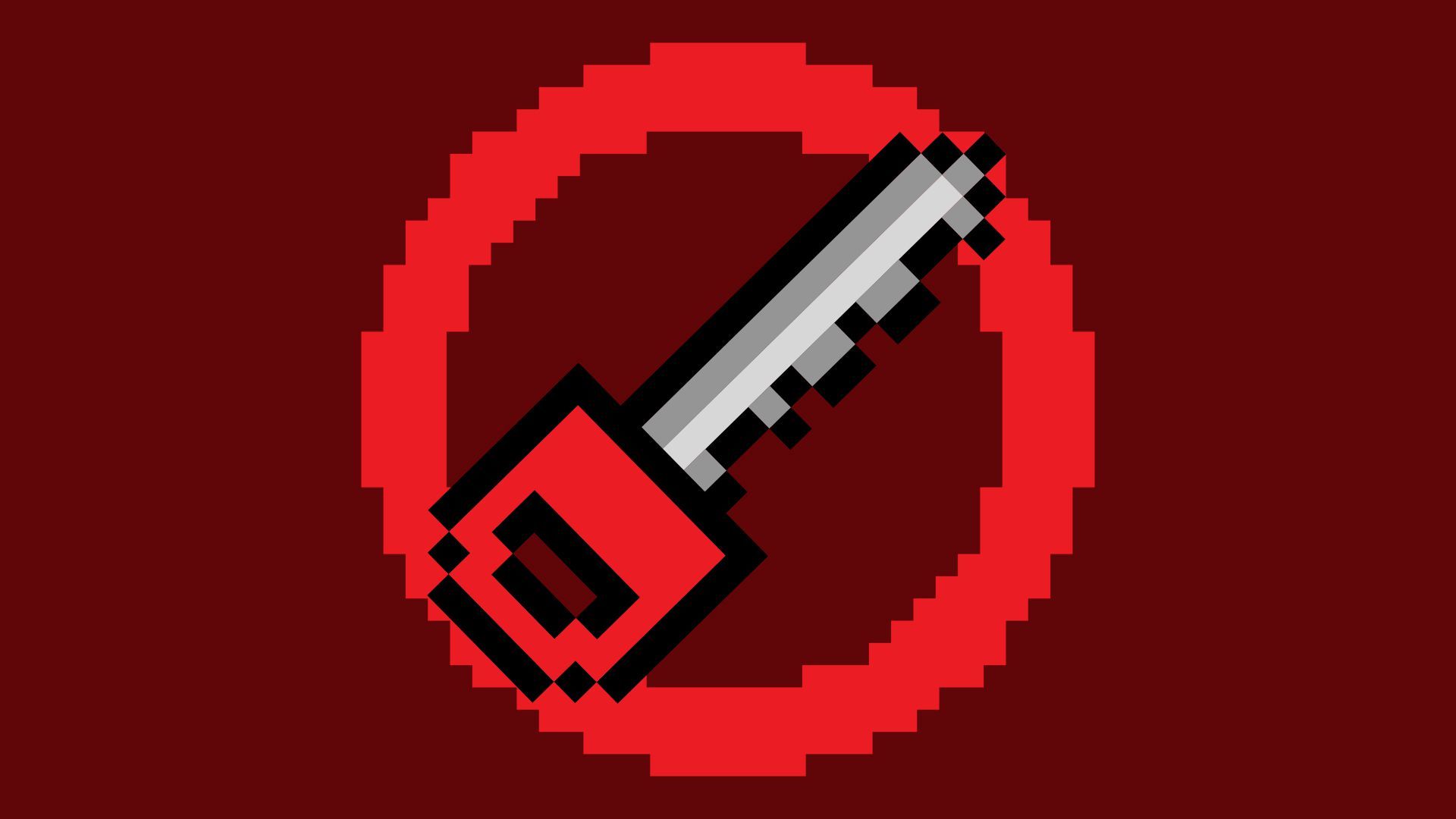
Illustration: Natalie Peeples/Axios
Your next car is likely to know if you've been drinking too much and could block you from driving — even if you think you're sober enough to do so, Joann Muller reports.
Why it matters: Drunk driving crashes kill 32 people per day in the U.S. That's one person every 45 minutes, and more than 10,000 per year.
Driving the news: Sophisticated alcohol detection technologies now in development could save most of those lives, experts say.
- They'll soon be required in every new car: Last year's Infrastructure Investment and Jobs Act gave the federal government until November 2024 to create a rule guiding how these drunk driving prevention systems will be implemented.
What's happening: Automakers and federal safety regulators are researching two high-tech alcohol detection systems.
- One automatically detects alcohol on a driver's breath and the other measures it through the driver's skin.
- An early version of the breath sensor is currently being tested by truck and livery drivers in Virginia.
The breath-based system is further along in development and could be ready by 2024.
- Unlike existing breathalyzers, which require a person to blow forcefully into a mouthpiece, the new system automatically determines a driver's alcohol concentration with a sensor in the door or steering column that captures a person's breath.
- A beam of infrared light is then directed at the molecules in the breath. If the system detects the proportion of alcohol to carbon dioxide is above the legal limit, the vehicle won't move.
- The system can distinguish between the breath of drivers and passengers, and parents can program it for zero-tolerance to keep their underage children from driving after consuming any alcohol.
The touch-based system could be ready by 2025.
- It reads drivers' blood alcohol level below the skin surface using touch sensors in the car's ignition button or gear shifter.
- The sensor shines a beam of light onto a person's finger and uses near-infrared tissue spectroscopy to take measurements.
Where it stands: A Swedish company, Senseair, has licensed the first iteration of the breath sensor technology, and could bring it to market as early as next year, Robert Strassburger, president and CEO of the Automotive Coalition for Traffic Safety, tells Axios.
- One challenge: Engineers are trying to get the touch sensor to work even if the driver is wearing gloves.
- And they're refining the breath sensor to eliminate "interference" from benign substances with alcohol, such as hand sanitizer, certain vaping liquids and even a monk fruit sweetener found in some energy bars.
Yes, but: Some liability lawyers wonder how such technologies would interact with other assisted-driving systems, and whether automakers could ultimately be held responsible for drunk driving accidents.
What to watch: Whether drivers accept this new tech as a vital safety measure or lambast it as a privacy overreach.
- "We've taken an audacious idea and proven the concept," Strassburger says. "The last red flag is consumer acceptance and being able to explain to folks what the system does — how they benefit from it and why they shouldn't fear it."
2. What to expect when you're expecting layoffs

Illustration: Allie Carl/Axios
As the tech industry faces layoffs, workers are unprepared for the ordeal and management has little experience with the wrenching process, Axios' Scott Rosenberg writes.
Driving the news: Meta is expected to announce its first-ever large-scale job cuts this week. That comes on the heels of major layoffs at Twitter and other flagship tech firms.
The big picture: The industry's 20-year run of largely unimpeded growth means most of its workforce doesn't have much idea what to expect from widespread layoffs. Here's a brief guide:
1. For those laid off, the pain is personal.
- Even in the best cases, people who are let go can feel a sense of failure — even though the actual failure typically belongs to the company and its management.
- The worst cases create a broader kind of sorrow among a workforce as well.
2. While no one should shed tears for the managers, they're having a hard time too.
- Middle managers often find themselves having to select winners and losers from groups of people they handpicked to join their teams.
- Then they have to face the people who are left and help them through what can be extended bouts of anger, depression and survivor's guilt.
3. For companies, layoffs leave slow-healing psychic wounds.
- Tech companies often aim to inspire workers with mission statements and caring rhetoric. But once a firm has gone through a round of layoffs, it becomes effectively impossible to persuade employees that anything matters beyond the bottom line.
3. 📈 Mastodon's growth

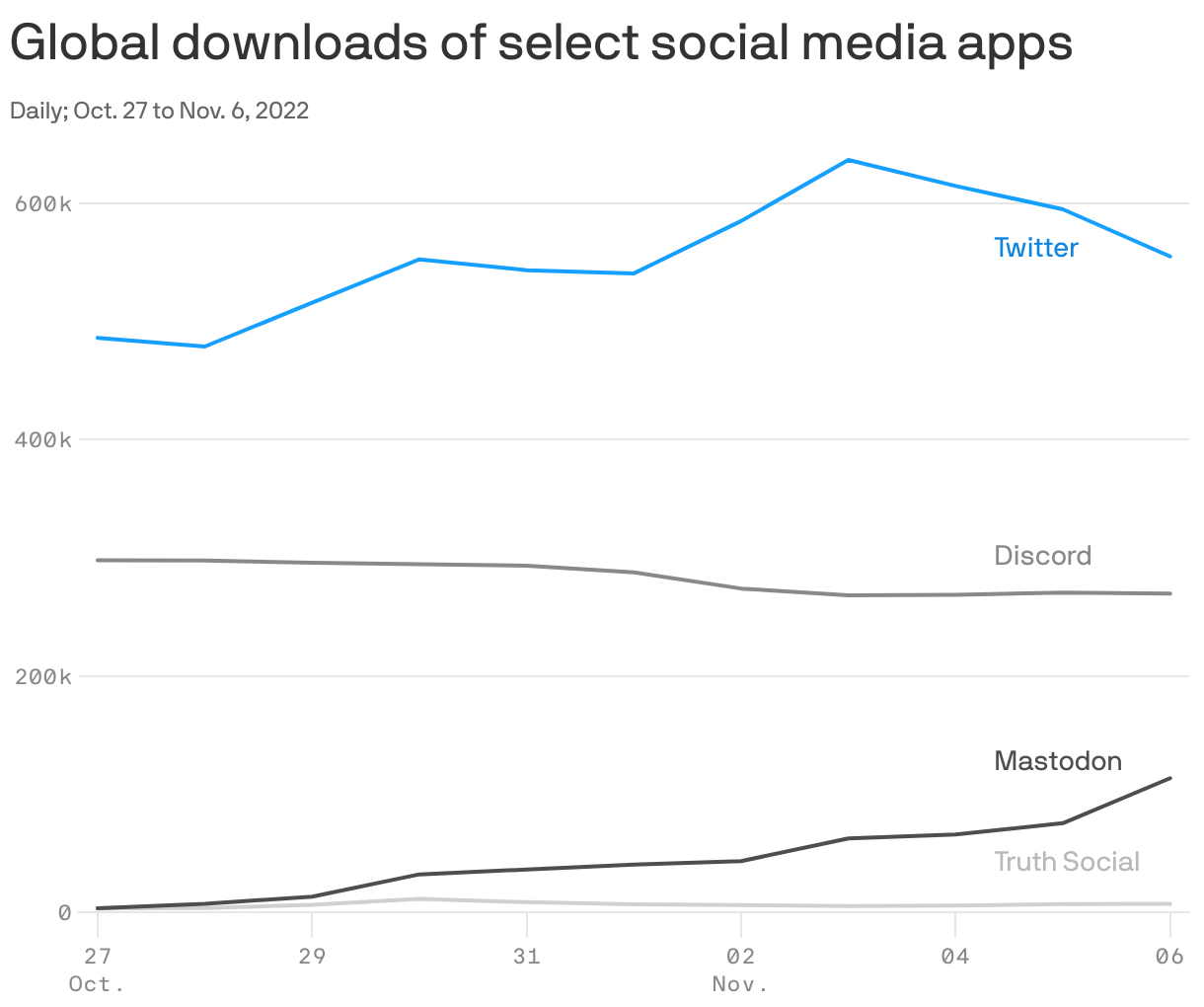
Lots of people have been downloading social media app Mastodon since Elon Musk took over Twitter, Axios' Sara Fischer reports.
By the numbers: Mastodon's daily downloads increased from 3,400 to 113,400 between Oct. 27 and Nov. 6, per data from market intelligence firm Apptopia.
- Mastodon now has more than 1 million monthly active users, founder Eugen Rochko said Monday.
Yes, but: Just because people download an app doesn't mean they'll stick around.
💬 Alex's thought bubble: Mastodon's confusing onboarding process will probably keep it from becoming a mainstream Twitter replacement.
4. 📸 Look Ma, no pilot
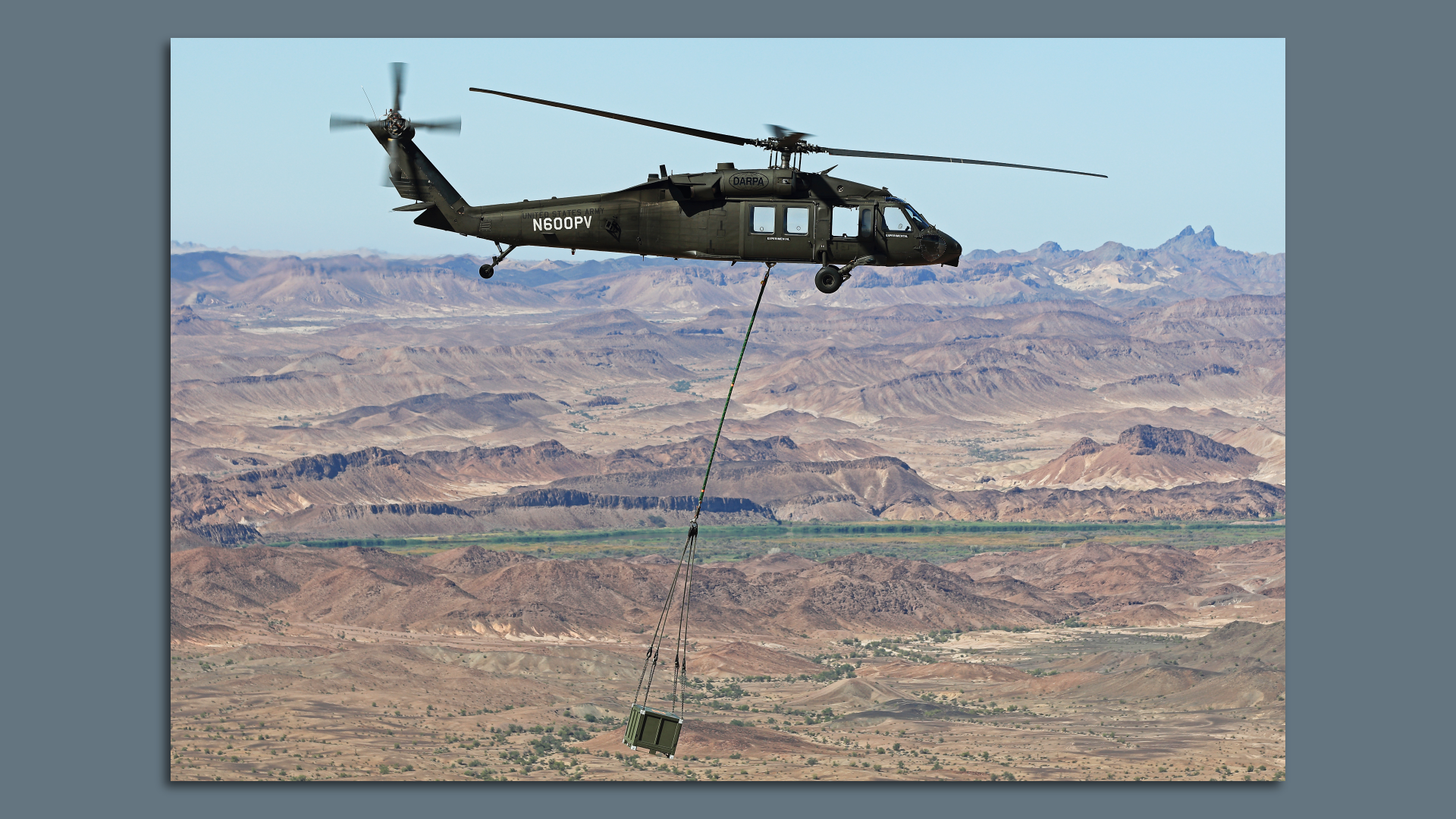
Photo courtesy of Sikorsky, a Lockheed Martin company
An autonomous Black Hawk military helicopter has successfully flown simulated cargo resupply and rescue missions, aerospace giant Lockheed Martin recently announced.
Why it matters: Military fleets have lots of drones built to be autonomous. But what Lockheed's done here is retrofit an old-school helicopter to make it self-flying.
- Such retrofits could help aging choppers find new life, or give military leaders "greater flexibility in how and when aircraft and pilots are used," Lockheed said in a release.
What's next: Such tech could one day find civilian use in fields such as aerial firefighting.
5. One fun thing: Meteor showers' secrets
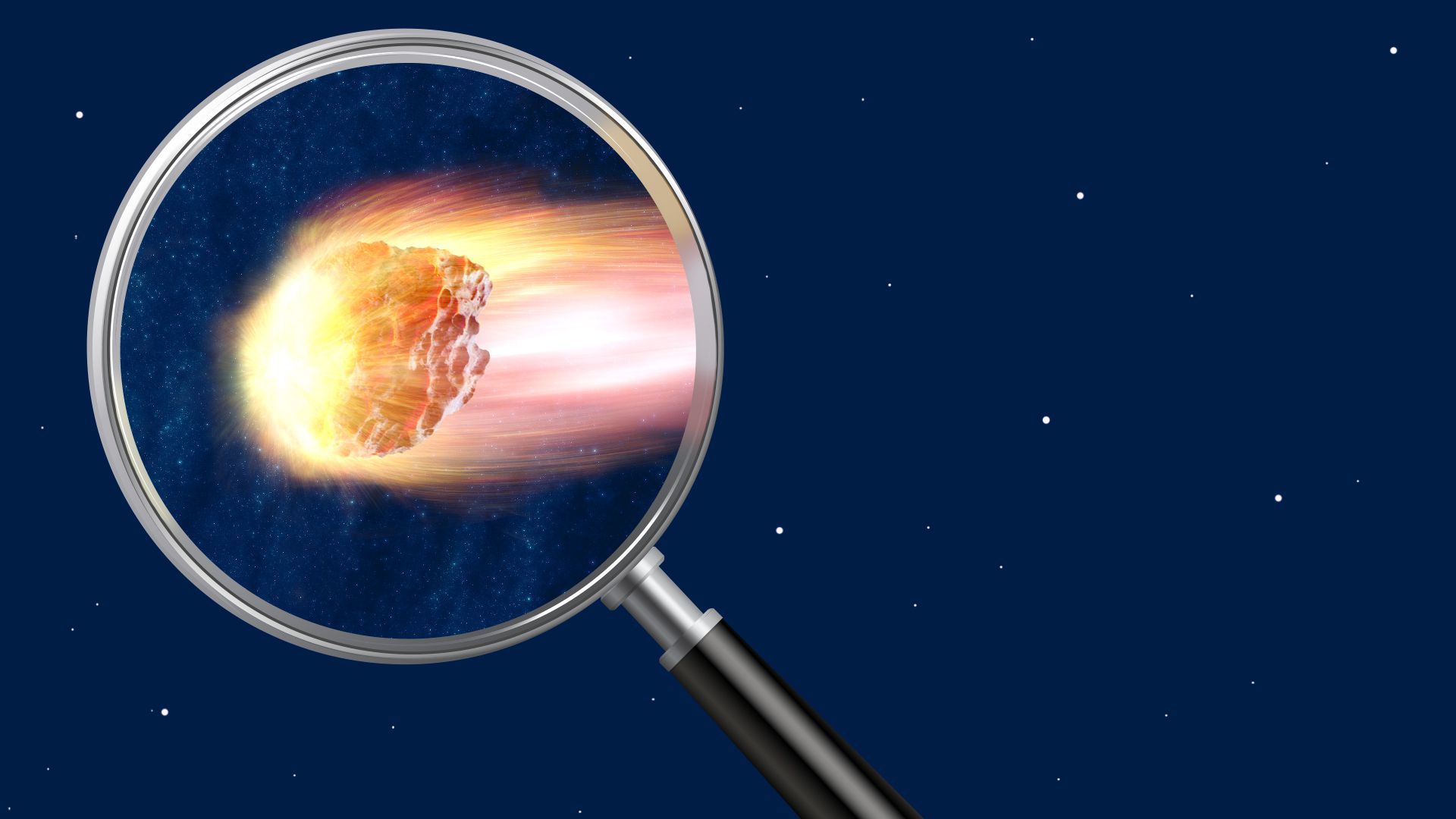
Illustration: Annelise Capossela/Axios
Meteor showers aren't just awesome cosmic spectacles — they sometimes deliver big scientific clues, Axios' Miriam Kramer writes.
- Meteors bring information about their parent asteroids and comets, which carry evidence of the solar system's history.
What's happening: November and December are banner months for meteor-lovers — the Geminids are usually an especially good show.
How it works: Researchers use powerful radar systems to survey the sky for meteors.
- Citizen-scientists with backyard cameras also contribute important data, Quanzhi Ye, an astronomer at the University of Maryland, College Park, tells Axios.
- "You don't need to have a million-dollar lab in order to do meteor observations."
Zoom in: Meteor science sometimes challenges long-held ideas about the solar system's formation.
- A fireball observed over Canada in 2021 came from a part of space thought to be populated by icy comets.
- But when scientists observed the streaking meteor, they found it had the qualities of a rocky object, challenging theories about how our galactic neighborhood evolved.
A new study in the Astrophysical Journal, meanwhile, suggests a 2014 fireball was actually an interstellar object.
- Finding interstellar meteors would allow scientists to learn more about other solar systems without launching expensive probes.
Big thanks to What's Next copy editor Amy Stern.
Was this email forwarded to you? Get your daily dose of What's Next by signing up here for our free newsletter.
Sign up for Axios What's Next

The next decade of big, sweeping changes will unfold in cities and communities where new technologies like 5G, AI and drones are transforming how we work, live and play together. What’s Next will guide you through the revolution.