Axios What's Next

August 16, 2024
A clever new gadget can turn your regular old bike into an e-bike, Joann reports today.
- 👋🏻 Thank you so much for your support, ideas and feedback. Today will be our last daily send of the What's Next newsletter — but coverage of all the ways we work, play and get around will continue to appear on Axios.com.
- We also hope to see you in person at What's Next events, and plan to share special coverage of those with you. Follow Axios Events to be the first to know about them.
Today's newsletter is 1,055 words ... a 4-minute read. One last thanks to our copy editor Amy Stern.
1 big thing: Instant e-bikes, just add CLIP
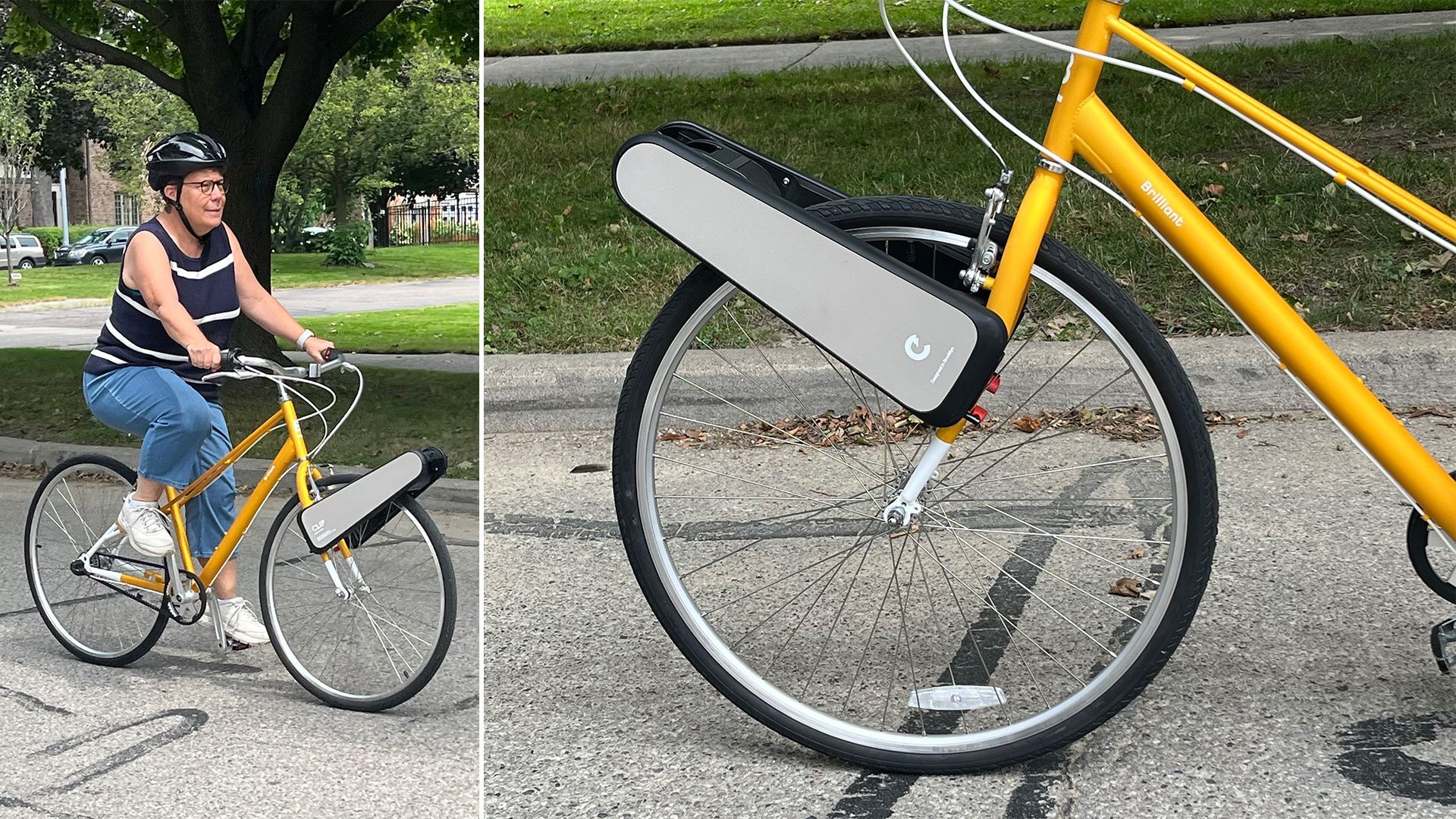
I'm usually test-driving electric cars, but lately I've been playing with a fun alternative: a clip-on electric motor that converts an ordinary bicycle into an e-bike.
Why it matters: CLIP is billed as a common-sense solution for urban commuters, making it easier for people to switch from driving to bicycling for short trips.
- With pedaling assistance from a simple friction drive system, it's less complex and a lot cheaper than a fully electric bike.
Zoom in: Half of all urban trips are 3 miles or less, which is CLIP's target market.
- These commuters don't need a powerful e-bike with lots of range — they just need a little extra oomph for the occasional hill, say CLIP co-founders Som Ray and Clement de Alcala.
- For many commuters, an e-bike is over-engineered and expensive, they argue, with prices ranging from around $1,500 to $5,000.
- CLIP's "plug & play" device, starting at $499, offers many of the benefits of an e-bike at a fraction of the cost.
What they're saying: "What we really want to do is make it easy for people to ride every day for their commute to reduce emissions," de Alcala tells Axios.
- "There are 100 million bikes in circulation in the U.S. Why not make them more convenient to use each and every day?"
How it works: The slickly designed device has a spring-loaded clamp that attaches to the forks of the bike's front wheel, just below the brake calipers.
- Propulsion is provided when the unit's roller comes in contact with the front tire, matching the torque of the wheel up to 15 miles per hour.
- A Bluetooth controller that attaches to the handlebars provides an added boost at the push of a button. A second button acts as a digital brake and can recharge the battery on downhill glides.
By the numbers: CLIP provides 6 to 18 miles of range, depending on the battery size, and recharging takes less than an hour.
- It's available in two models: the $499 Commuter, with a 98 Wh battery, and the $599 Explorer, with 192 Wh.
💬 My thought bubble: CLIP is a brilliant idea and makes sense for short jaunts around town.
- I tested the Explorer model and used it to bike to church and to a couple of meetings, and didn't feel sweaty or out of breath when I arrived.
- I felt the CLIP's pull at the very beginning of my ride as the mechanical roller synced up with the bike's tire, but most of the time I was pedaling at a steady rate in "auto-roll" mode.
If I got tired, or had to ride uphill, I pressed and held the remote button on the handlebars to accelerate effortlessly.
- The unit I tested weighs just under 10 pounds and is not difficult to attach, but takes a little practice to get it right.
- I like that you can detach it and carry it by the handle or in a backpack.
- There are other DYI e-bike conversion kits, but CLIP is simple to attach or remove without any tools.
Yes, but: My family has four bikes in the garage, and the only one it would fit was a 40-year-old Motobecane racing bike that's gathering dust on the wall.
- The forks on the other bikes were too thick, or have a shock-absorbing suspension on the front wheel, so the company loaned me a tester bike as well.
- CEO Ray tells me the CLIP is designed to fit most basic urban commuter bikes — including rental bikes — but the company is working to expand the line for other types of bikes.
What's next: CLIP wants to democratize access to e-biking worldwide, and plans to pilot a $100 version in India later this year.
- It's also developing a vending machine concept that would allow people to rent a CLIP along with a bike.
2. Back to cool


Classrooms nationwide need more cooling during back-to-school season now compared to past decades, a new analysis finds.
Why it matters: Maintaining a comfortable and healthy environment in schools is key to kids' educational success, but that's getting harder amid a warming climate.
- Many schools are already making adjustments — some in the Austin area, for example, have shifted recess earlier and are limiting kids' outside time, Axios' Nicole Cobler reports.
Driving the news: A Climate Central report finds that cooling demand between late July and early September increased in 95% of nearly 250 U.S. locations analyzed between 1970 and 2023.
- The nonprofit climate research group's analysis is based on a metric called "cooling degree days" (CDD), which measures the difference between a location's daily average outdoor temperature and 65°F — "considered the ideal indoor temperature," per the report.
- "For example, a day with an average temperature of 90°F has 25 CDD (90°- 65°)."
What they did: To get annual demand, CDD was added together for every day in the 7-week time period when students typically return to school.
Zoom in: Reno, Nevada (+320%); Eureka, California (+300%); and San Francisco (+240%) saw the biggest percentage increases in back-to-school CDD between 1970 and 2023.
Between the lines: Back-to-school cooling demand was around 34% higher over the last decade largely due to human-caused climate change, Climate Central estimates.
- That's based on the group's Climate Shift Index, which seeks to measure how climate change has affected daily temperatures.
Threat level: Many schools in rapidly-warming locations also start school in mid-to-late August, when heat waves can strike.
What's next: Like other buildings, schools must adapt to a changing climate — and that can mean costly upgrades.
- "Buildings can be retrofitted with better windows and insulation to reduce energy waste, and existing fossil-fuel burning systems can be replaced with safer, more energy-efficient options," per Climate Central.
3. Thank you for reading
Alex here. It was a pleasure bringing you What's Next for the last two-plus years.
- It's been especially heartwarming to get notes from many of you over the past few days about how much you've enjoyed this newsletter.
What's next: I'll still be here at Axios, writing about data, aviation and more — drop me a line anytime at [email protected], and find me on Threads at @AlexJamesFitz.
- For continuing coverage of the future of transportation, bookmark Joann's author page at Axios or follow her on X or LinkedIn. Get in touch at [email protected].
Sign up for Axios What's Next