Axios Vitals

February 24, 2025
Welcome back to the workweek, Vitals readers. Today's newsletter is 1,013 words or a 4-minute read.
📆 Save the date: Axios' fourth annual What's Next Summit returns to Washington, D.C., on Tuesday, March 25. The speaker lineup and info on how to attend will launch next week! More info here.
1 big thing: Businesses that will boom under RFK
Supplement makers, practitioners of alternative medicine and others in the wellness movement are hoping to capitalize on Robert F. Kennedy Jr.'s tenure as the nation's top health official.
Why it matters: Kennedy's interest in treating the root causes of chronic illnesses through lifestyle changes could elevate unregulated alternatives and risky pseudoscience while relegating diagnosis and treatment of disease to the back burner, critics warn.
- The question is how this will resonate with Americans frustrated by corporate health care and seeking control over their care. Kennedy, an environmental lawyer with no health background, has long criticized drug companies profiting from illness.
- "It's sort of open season for grifters. There's no doubt in my mind," said Peter Lurie, executive director for the Center for Science in the Public Interest.
But supplement makers who generally don't have to provide evidence for the FDA to determine if their products are safe say they're hoping for a fairer playing field for products that help people live healthier lives.
- Natural health retailers and testing labs also expect a boost from the current leadership.
- "To have RFK coming in and basically controlling the largest budget of any health organization, and him backing functional medicine, I think that's going to go a long way for the industry as a whole," said Adam El-Hosseiny, COO of Access Medical Labs, which provides testing for a range of providers including functional medicine doctors.
Food-as-medicine startups hope Kennedy's advocacy for nutrition-based health solutions will lead to expanded Medicaid coverage. The Natural Products Association is working on legislation to allow supplements to be covered by health savings accounts and public assistance programs.
- The group has already been pressing Congress to allow people to use flexible savings accounts and health savings accounts on supplements, CEO Daniel Fabricant said. It's also trying to get supplements to be eligible for WIC and SNAP dollars.
But critics warn alternative medicine companies making dubious claims could thrive under Kennedy. The FDA has issued warnings to stem cell clinics and chelation therapy centers over unsubstantiated claims, but oversight may weaken.
The bottom line: Patients could wind up wasting money or avoiding evidence-based care, including vaccines.
- "The more things you treat people with, the more likely you are to do harm, especially with unproven methods," said William Matthew London, editor of the Center for Inquiry's Quackwatch.
2. Disability protections in peril
People with disabilities say President Trump's DEI purge is eroding health care, education and legal protections they've only won in recent decades.
Why it matters: The Trump administration has taken actions that undermine accessibility measures — which are critical for leveling the playing field for people with disabilities — as part of its efforts targeting diversity, equity and inclusion efforts.
- "It's very clear that there is an orchestrated attack by conservatives to dismantle the rights of people with disabilities," said Shawn Murinko, a Washington resident who has cerebral palsy.
The other side: The Trump administration takes issue with lowering standards to achieve diversity, equity, inclusion and accessibility goals — not DEIA itself, the White House told Axios.
State of play: Trump last month ordered an end to all federal programs that mandate or invoke accessibility, alongside diversity, equity and inclusion.
- Cuts to National Institutes of Health funding also threaten existing and future disability research.
- Republicans have floated cutting Medicaid, which provides health care for more than 10 million children and adults with disabilities — nearly 15% of the program's beneficiaries.
Threat level: A Republican-led lawsuit challenging a Biden-era policy to treat gender dysphoria as a protected disability has the potential to undermine a 1973 civil rights law that prohibits discrimination based on disability, advocates warn.
3. Shortage over for Novo's Ozempic, Wegovy
Makers of copycat weight-loss drugs and digital health companies that sell them are bracing for upheaval now that the FDA has declared Novo Nordisk's blockbusters Ozempic and Wegovy are no longer in shortage.
Why it matters: The announcement on Friday effectively ends an FDA policy that allowed drug compounders to make less expensive off-brand versions of the semaglutide injections when the brand-name products are in short supply.
- And it may force patients to pay more to stay on their regimens.
State of play: To provide a wind-down period, compounders have until at least April 22 to stop selling copycat versions before the FDA starts enforcing the cutoff.
Where it stands: Compounders and pharmacies knew the semaglutide shortage would end at some point but are questioning whether now is the appropriate time to declare it over.
- Noom, a digital health company that prescribes compound semaglutide, said it believes patients are still having trouble accessing the branded Ozempic and Wegovy.
- Digital health company Hims & Hers said it will continue selling compounded semaglutide as it seeks to "personalize the delivery of existing, clinically studied medications," CEO Andrew Dudum wrote in a post on X Friday.
4. Fatal overdoses fall

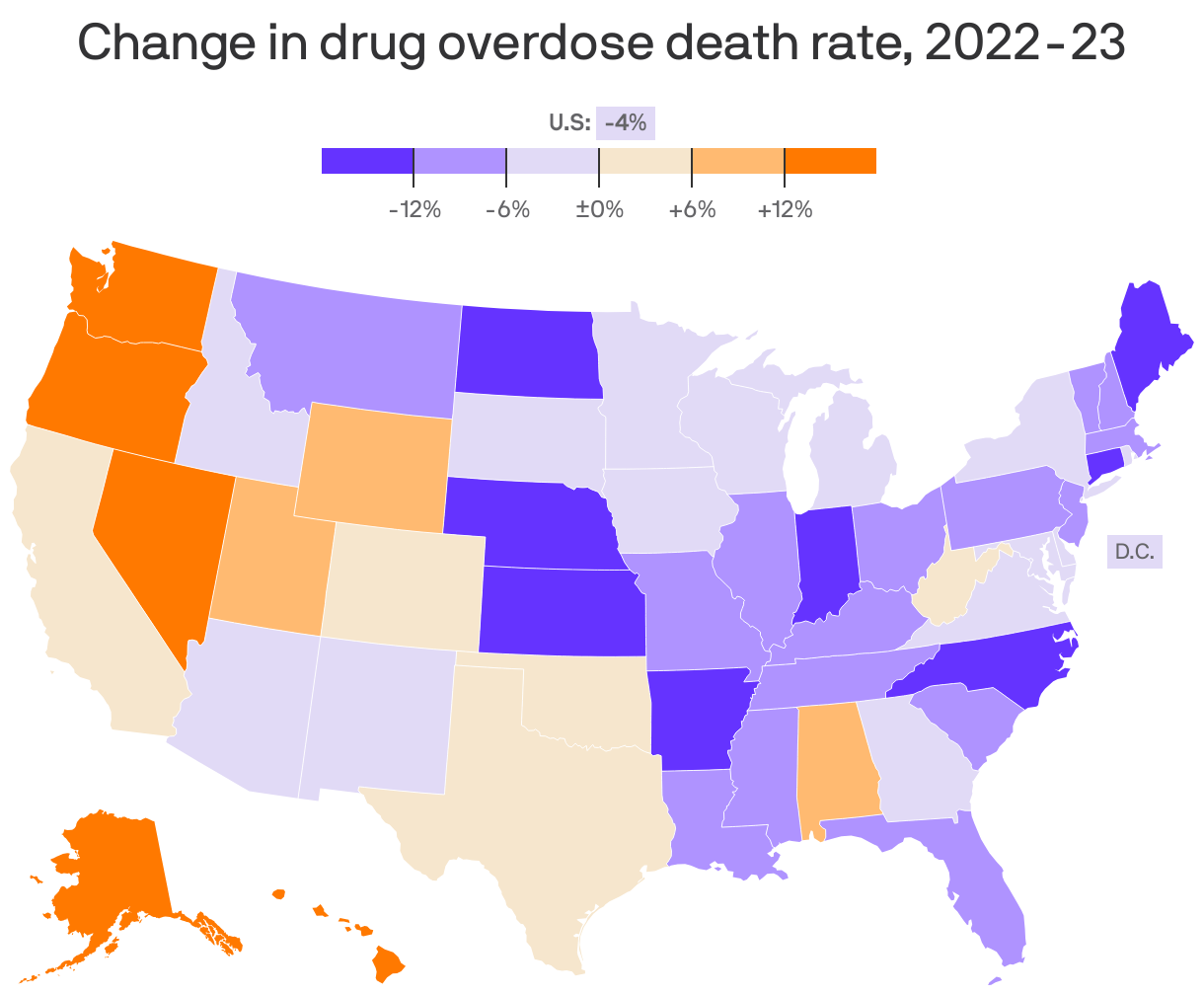
The fatal drug overdose rate fell 4% nationwide from 2022 to 2023, per new CDC data — but grew notably in the West and in Alaska.
Why it matters: Overdose deaths seem to be falling as pandemic-era isolation ebbs and access to life-saving medications like Naloxone grows.
Driving the news: The age-adjusted rate of U.S. fatal drug overdoses fell from 32.6 per 100,000 people in 2022 to 31.3 in 2023, the CDC says.
- The rate for synthetic opioids specifically — including fentanyl — dropped from 22.7 to 22.2.
Yes, but: States like Alaska, Oregon and Washington bucked the national trend, reporting major increases in their fatal OD rates.
5. While you were weekending

🚨The White House is preparing to bring back the Title 42 border policy enacted in Trump's first term that ended in 2023, which would allow migrants to be expelled on the grounds that they could spread diseases. (CBS)
👉 A backdrop of harsh scrutiny of the health care industry explains sharp market reaction to DOJ investigation into UnitedHealth. (WSJ)
🩺 As public health teams focused on preventing patient deaths are being gutted, workers fear what would happen to the work they left behind. (ProPublica)
🏥 An officer was killed responding to a hostage-taking at a UPMC hospital in Pennsylvania over the weekend. (NYT)
Thanks for reading Axios Vitals, and to senior health care editor Adriel Bettelheim, managing editor Alison Snyder and copy editor Matt Piper. Please ask your friends and colleagues to sign up.
Sign up for Axios Vitals