
Axios Vitals

April 07, 2022
Good morning, Vitals readers. Today's newsletter is 1,024 words or a 4-minute read.
1 big thing: The high-stakes push to get COVID vaccines to young kids

Illustration: Maura Losch/Axios
As federal health officials debate the logistics of administering fourth coronavirus vaccines to some older Americans, children under 5 remain ineligible for any shots — and it's unclear when that will change, Axios' Caitlin Owen's writes.
The big picture: Less-than-ideal clinical trial results and growing backlash against children's vaccinations writ large have complicated what was already a delicate decision-making process.
Why it matters: Young children generally aren't at high risk of severe COVID infections, but some do get seriously ill or, in rare instances, die. Plenty of parents remain anxious to vaccinate their children as soon as possible.
- At the same time, vaccine hesitancy is high among parents of young children, and only 27% of children ages 5 to 11 — the most recent age group to become eligible for vaccines — have been fully vaccinated, according to the American Academy of Pediatrics.
What they're saying: The FDA is balancing "the urgency" people feel to vaccinate the youngest with the knowledge that this is also the age people are most concerned about potential side effects, top FDA vaccine official Peter Marks recently told reporters.
What we're watching: Moderna said last month that it would request FDA authorization for its two-dose vaccine "in the coming weeks," but CEO Stéphane Bancel told Yahoo Finance on March 24 that the vaccine likely won't be available for "a couple of months ... not a couple of weeks."
- Pfizer expects data on the effect of a third shot in young children this month. Moderna is also testing a booster shot for kids.
2. COVID cases rise again in half the states
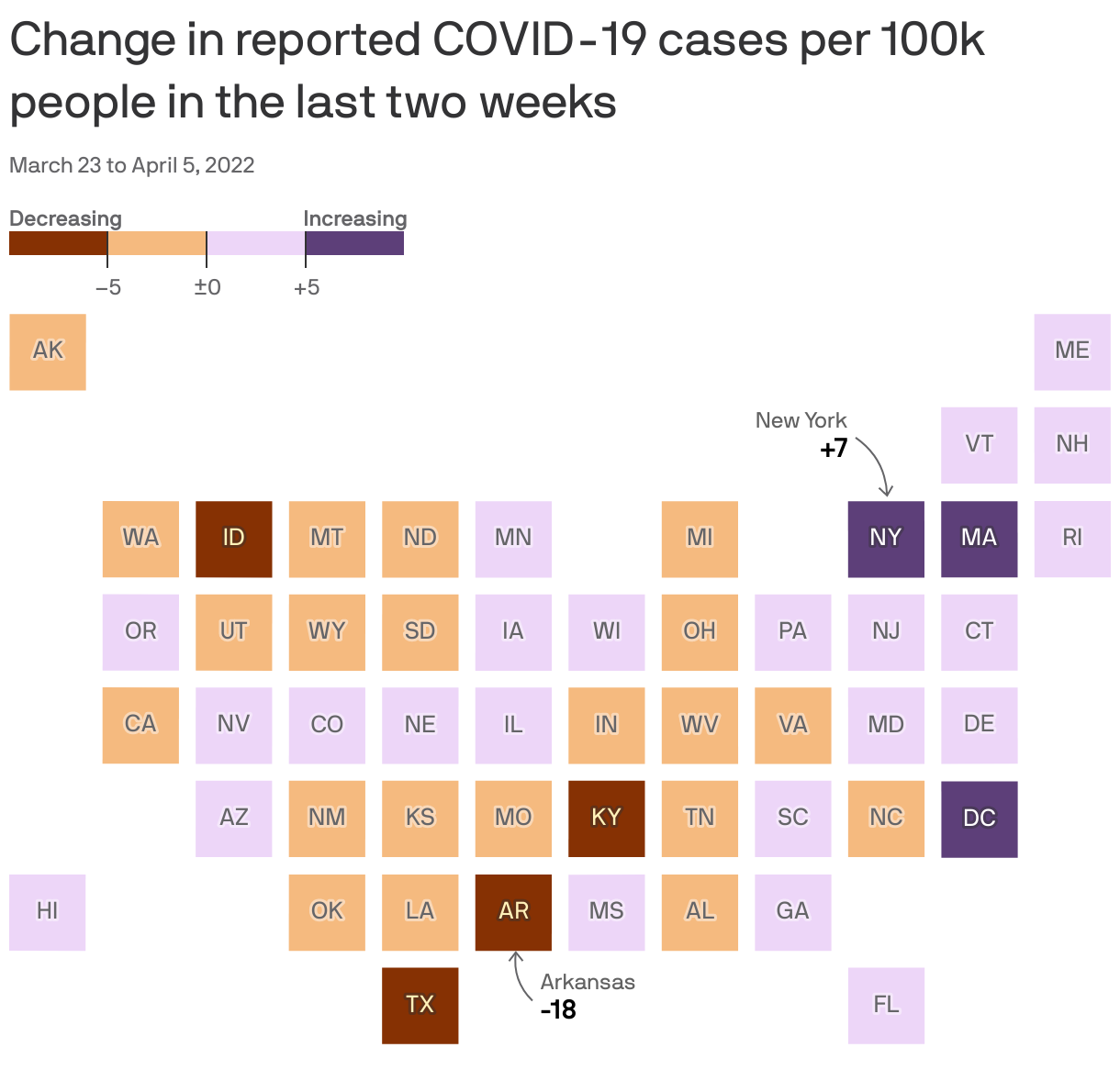
Half of the states are seeing COVID case numbers rise again while nationwide totals continue to fall, Axios' Kavya Beheraj and I write.
The big picture: The Omicron subvariant known as BA.2 is the dominant strain circulating around the U.S., accounting for almost three out of every four cases.
- As in-person gatherings have begun again, COVID has sickened a number of Washington A-listers, reminding everyone — yet again — we're not out of the woods with this pandemic.
By the numbers: Overall, cases dropped 5% across the U.S. to an average of 28,700 cases from an average of more than 30,000 cases two weeks ago.
- Three states — Alaska, Vermont and Rhode Island — had more than 20 new cases per 100,000 people.
- Nine states — Utah, Montana, South Dakota, Kansas, Louisiana, Iowa, Arkansas, Indiana and Tennessee — had three or fewer new cases per 100,000 people.
- Deaths fell to an average of 600 a day, down 34% from just over 900 a day two weeks ago.
3. Emergency COVID funding may get punted
Congress may punt on a $10 billion COVID preparedness funding package until the end of this month due to a fight over immigration policy, Axios' Adriel Bettelheim writes.
Why it matters: The Biden administration has warned that it’s running out of money for countermeasures to ward off future pandemics and COVID surges — and already ended testing and treatment for the uninsured.
Driving the news: With a two-week recess looming, Republican senators are demanding a vote on an amendment to the funding package that would block the administration’s plans to halt a pandemic-inspired public health policy called Title 42 used to rapidly expel migrants at the southern border.
- Some centrist Democratic senators support adding the Title 42 language to head off another border crisis — but that would make the underlying bill unacceptable to House progressives.
What’s next: The Senate could revisit the COVID funding package later this spring. But it likely will remain stuck until Democrats resolve their internal differences over immigration and border policies.
4. Hospital drug spending up
Illustration: AĂŻda Amer/Axios
The COVID-19 treatment remdesivir accounted for more than 10% of what hospitals spent on drugs last year, and more than the next three drugs combined, according to a new report from the American Society of Health-System Pharmacists.
Driving the news: The report charted higher clinic and hospital drug spending last year due in large part to COVID — and projects spending could jump even more this year.
What they're saying: “Uncertainty remains around how long the federal government will continue to pay for COVID treatments, and around inflation, which is moving through most economic sectors,” lead author Eric Tichy said in a statement.
By the numbers: Total drug spending in the U.S. grew 7.7% in 2021 to $576.9 billion.
- Hospitals accounted for $39.6 billion of that spending, with 8.4% growth in 2021 over 2020.
On the flip side: Biosimilars, particularly in cancer treatment, helped blunt some of the increase in drug spending.
5. Return-to-the-office problems
Illustration: Annelise Capossela/Axios
As more companies call their workers back into the office, the millions still suffering the symptoms of long COVID could lose the flexibilities that come from working at home, TIME reports.
Why it matters: There's growing recognition of debilitating effects like fatigue and brain fog that even mild cases of the coronavirus caused. More than 23 million are estimated to still suffer from long COVID.
- This week, Biden announced a new research strategy for understanding long COVID, as well as an effort to define legal disability rights protecting "long haulers."
Between the lines: Experts recommended incorporating flexible scheduling, resting areas and medication storage that could help anyone with disabilities, per TIME.
- They also warned there could be more flare-ups amid transitions from work-from-home status.
- “It’s not uncommon for returning to work to re-trigger symptoms that had been improving or resolved," Benjamin Abramoff, director of the University of Pennsylvania’s Post-COVID Assessment and Recovery Clinic, told MIT Sloan Management Review.
Our thought bubble: While those with this illness have largely been hidden, the return to work could make the scope of the problem much more apparent soon — and spawn more discussions about workplace accommodations.
📬 Are you suffering from a diagnosed case of long COVID? I'd love to hear your story for an upcoming feature. Email me at [email protected].
6. Catch up quick
- Trauma among health care workers is comparable to that of combat veterans, a new study found. (NBC News)
- Parents and caregivers looking for baby formula are facing increasingly dire shortages owing to supply chain challenges and a massive recall. (Axios)
- Zoos across the country are taking precautions to protect their bird populations against a recent bird flu outbreak. (Axios)
Sign up for Axios Vitals

Healthcare policy and business analysis from Tina Reed, Maya Goldman, and Caitlin Owens.