Axios Vitals

January 22, 2024

Happy Monday. Today's newsletter is 962 words or a 3.5-minute read.
⚡️ Don't miss: Download our latest white paper on drug pricing and health care legislation to watch this year.
1 big thing: AI's real promise

Illustration: Sarah Grillo/Axios
Even AI optimists don't envision the technology fundamentally remaking the U.S. health care system anytime soon, but there's widespread agreement that it has the potential to vastly improve the quality of care and trim costly waste.
Why it matters: The scale of change that AI could bring to health care not only impacts patients but also the millions of people the system employs — who will ultimately shape how widely it's adopted, Axios' Caitlin Owens writes.
The big picture: Recent breakthroughs in AI technology are coming up against a health care system that is very resistant to change, in no small part because of how heavily it's regulated and the trillions of dollars at stake.
- Uses that drive up revenue, increase productivity or improve health care workers' quality of life will be especially attractive.
- For example, there's a lot of talk about AI's potential to discover more drugs, speed up the development process and better match drugs to patients.
- Other commonly discussed uses include improving diagnostics, reducing providers' paperwork hassle and streamlining billing processes.
"A lot of the transformation will occur by helping the companies that we fund be better at what they do and more efficient. So it's the efficiency that is probably key," said Dan Mendelson, CEO of Morgan Health, a unit of JPMorgan Chase.
Between the lines: Just how ingrained AI becomes in health care will depend on the incentives in place.
- There are already some strong use cases that can benefit patients and industry alike.
- But for others, adoption will be resisted by those who stand to lose money or employment — be it front office staff, lab techs suddenly made redundant or providers who would lose revenue from performing fewer procedures in some cases.
2. The blue states bucking CDC guidance

Illustration: Shoshana Gordon/Axios
California earlier this month relaxed COVID-19 isolation guidelines, telling people who tested positive they can still go about their daily routines if they don't have symptoms. Oregon outlined a similar stance last May.
Why it matters: The guidance from the blue states runs counter to recommendations from the CDC, which advises people with COVID to isolate for five days regardless of whether they're experiencing symptoms.
- State officials said their relaxed guidance is an acknowledgment that the pandemic phase has passed and an effort to minimize disruptions to workers and students.
What they're saying: Some health experts said they weren't surprised by the shift, as officials have treated it more like other respiratory illnesses and the public has largely grown tired of restrictions. But others said the relaxed guidance creates more risk for vulnerable people.
- "I don't want people coming to work and interacting with me if they've got the flu and are still infectious, if they've got strep throat and they're still infectious, and of course if they've got COVID-19 and they're still infectious," University of South Florida epidemiologist Jason Salemi told the New York Times.
What's next: Other states could follow. Officials from six other states and the CDC have discussed the isolation policy with Oregon, per NBC News.
3. Biden focuses on reproductive rights
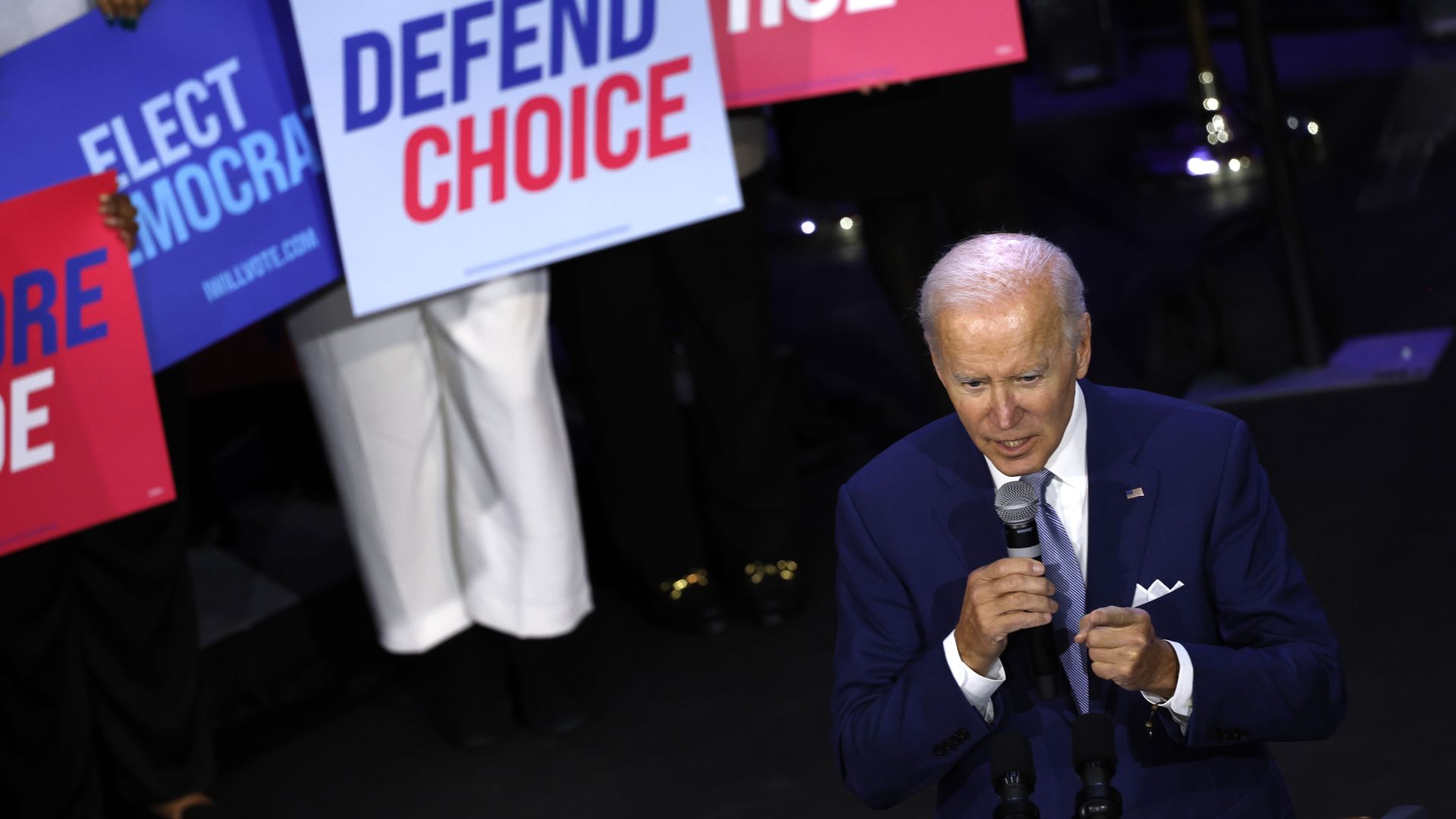
Biden at a Democratic National Committee event on reproductive rights in 2022. Photo: Anna Moneymaker/Getty Images
President Biden this week is highlighting his administration's efforts to protect abortion rights, aiming to elevate an issue that Democrats believe will turn out voters this fall.
Driving the news: The Biden campaign this weekend released its first abortion ad of the year, a 60-second spot that features Austin Dennard, a Texas OB-GYN and mother of three who said she had to leave the state to end a planned pregnancy after learning the fetus had a fatal condition.
- "It's every woman's worst nightmare, and it was absolutely unbearable," Dennard said in the ad, in which she blames former President Trump for the overturning of Roe v. Wade.
- The ad is running on national TV during the season premiere of "The Bachelor," and it will air in battleground states this week on cable channels with larger audiences of younger and female viewers like HGTV, Bravo and Hallmark, as well as next weekend's NFL playoff games.
Vice President Harris is in Wisconsin today, the 51st anniversary of Roe, to kick off a series of events focused on reproductive rights. She'll join Biden — and their spouses — for a campaign rally in Northern Virginia on Tuesday.
- Administration health officials also said Monday they are taking steps to expand access to free birth control.
- They are also launching an education campaign to increase awareness among patients and health care providers about the right to emergency abortion care under EMTALA — though the administration's guidance on the issue has been in dispute and will be reviewed by the Supreme Court this term.
4. The state eyeing a big workforce boost

Illustration: Tiffany Herring/Axios
Florida lawmakers are advancing a plan that would invest hundreds of millions of dollars toward expanding the health care workforce in one of the oldest and fastest-growing states.
Driving the news: The Florida Senate has unanimously approved a $800 million package that includes money for medical education tuition assistance, loans to build clinics and pay raises for certain Medicaid providers, per the Orlando Sentinel.
- It comes as other states are also expected to consider measures to address provider shortages and support their pandemic-fatigued health workforces.
Details: The Florida measure, which still has to go to the House, would also expand residency slots, make it easier to hire foreign-trained doctors and allow some birthing centers to provide cesarean deliveries, the Tampa Bay Times notes.
5. While you were weekending

Illustration: Annelise Capossela/Axios
🏥 The operator of nine Massachusetts hospitals is facing such serious financial distress it may not be able to keep running some facilities. (Boston Globe)
🏛️ Lawmakers are urging the FDA to review a supplement that's been dubbed "gas station heroin" and has been linked to overdoses and death. (USA Today)
❌ Theranos founder Elizabeth Holmes has been banned from participating in government health programs for 90 years. (Ars Technica)
🌧️ How climate disasters hurt young people's mental health. (Grist)
Thanks for reading Axios Vitals, and to health care editor Jason Millman and copy editor Matt Piper. Please ask your friends and colleagues to sign up.