Axios Vitals

February 11, 2026

Happy mid-week, Vitals readers. Today's newsletter is 981 words, a 3.5-minute read.
🚨 Situational awareness: Moderna yesterday said the FDA refused to review its application for a new mRNA flu vaccine, in the latest twist surrounding the Trump administration's vaccine policies.
1 big thing: The fight over copycat GLP-1s peaks
An intensifying showdown over copycat GLP-1 weight-loss drugs is pitting the administration and drug companies against compounding pharmacies and some telehealth companies.
Why it matters: The outcome will decide if cheaper versions of the blockbuster treatments that haven't been evaluated by the FDA for safety and effectiveness remain widely available.
State of play: At issue is whether compounded GLP-1 drugs can still be widely sold after the FDA declared that the blockbuster anti-obesity treatments were no longer in shortage.
- Telehealth company Hims & Hers backed off plans to sell a compounded version of the Wegovy pill this week after the FDA threatened regulatory action and HHS referred the company to the Justice Department for potentially violating federal drug law.
- Hims & Hers still is offering its versions of injectable weight-loss drugs, leaving open questions about whether regulators will act against those next. The company also is facing a patent infringement suit from Wegovy's maker, Novo Nordisk.
What they're saying: "In some instances, it seems like Hims is doing their best to get right up to the line of what the [compounding law] allows," said Jacob Sherkow, a law professor at the University of Illinois.
- Efforts like Hims' short-lived attempt to launch its own version of the Wegovy pill "don't necessarily pass the sniff test," he said.
The big picture: If Hims & Hers prevails, it and other companies could try to do the same for other types of drugs, which critics say would further undermine the U.S. drug approval system and FDA checks on safety and efficacy.
- That also would put telehealth companies in competition with the Trump administration, which has been negotiating lower prices for branded GLP-1s and other treatments — and touting them on its TrumpRx platform.
2. Charted: Where health coverage breaks the bank

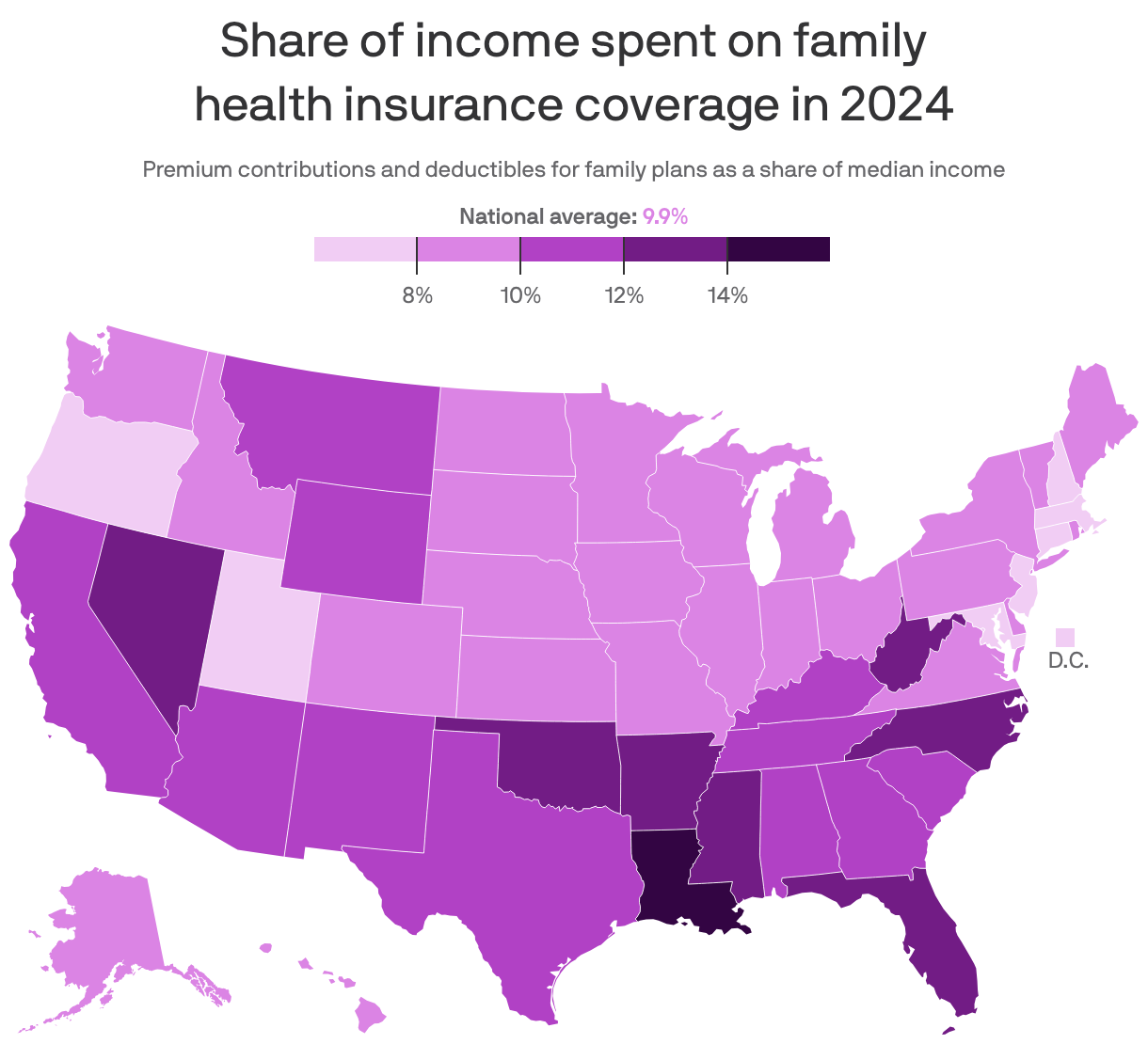
Health insurance costs ate up 10% or more of median family income in 19 states, according to a new analysis.
Why it matters: The findings show how tough it can be to afford health care, even with insurance, for many of the estimated 167 million Americans who get coverage through an employer.
- The state-by-state breakdown of federal data by the Commonwealth Fund looked at how much people spent on premiums and deductibles.
What they found: The share of income people spent on premium contributions and deductibles for family coverage in 2024 ranged from a high of 15.6% in Louisiana to a low of 5.7% in the District of Columbia, according to the analysis.
- Premiums alone exceeded the threshold of what the government considered "affordable" coverage in five states: West Virginia (8.6%), Mississippi (8.8%), North Carolina (8.8%), Florida (9.3%) and Louisiana (10.7%).
- Large deductibles threatened to make workers skip care or take on medical debt in half of the states, with Kentucky faring worst when deductibles were measured as a percentage of household income.
3. Get your measles shot, Oz says

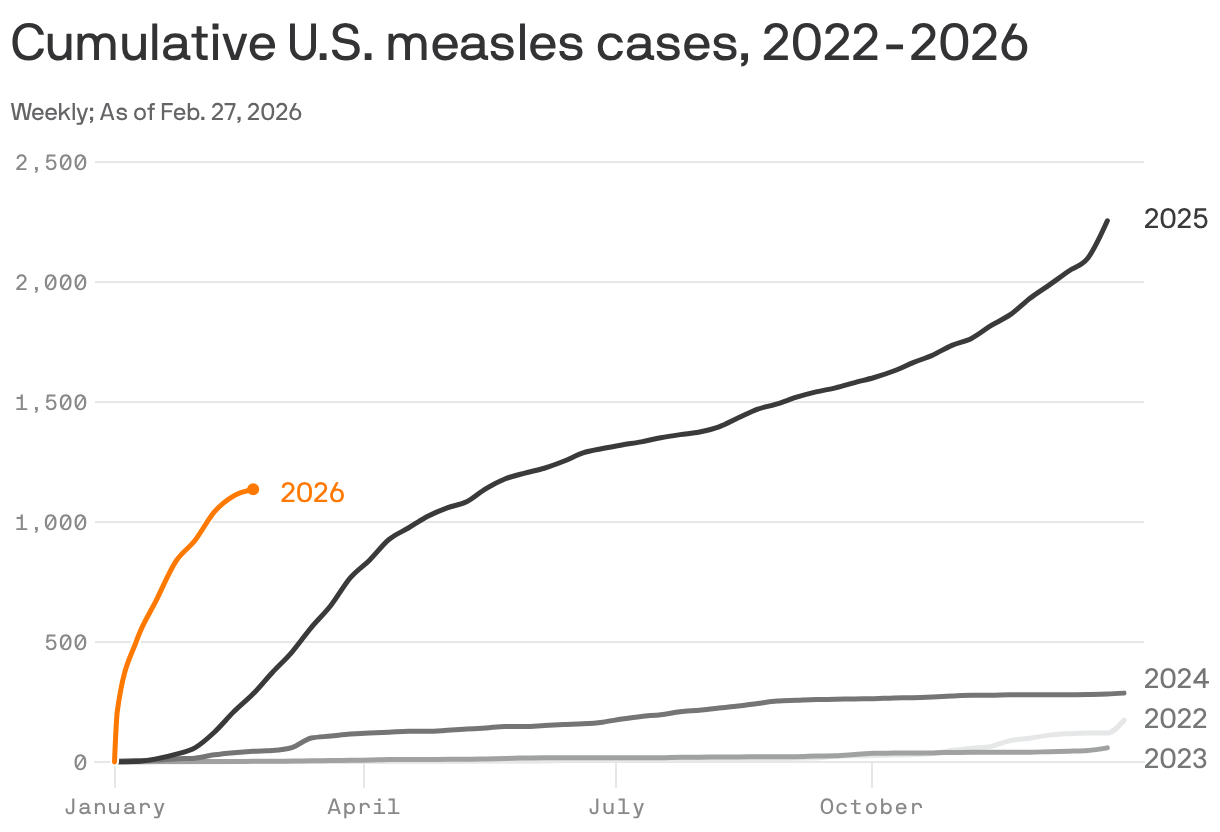
One of President Trump's top public health voices is urging Americans to get their measles shot amid an outbreak jeopardizing the country's disease elimination status.
- Said CMS administrator Mehmet Oz on CNN's "State of the Union" Sunday: "Not all illnesses are equally dangerous and not all people are equally susceptible to those illnesses."
- "But measles is one you should get your vaccine."
Why it matters: Oz's comments contrast with the general vaccine skepticism of his boss, Health Secretary Robert F. Kennedy Jr.
By the numbers: More than 900 cases have been confirmed in South Carolina, with another hotspot along the Utah-Arizona border.
- Cases have also been reported this year in California, Florida, Georgia, Idaho, Kentucky, Minnesota, North Carolina, Ohio, Oregon, Virginia and Washington, AP reports.
- Headlines have warned of potential exposures at Washington, D.C.'s National March for Life, Phoenix's Sky Harbor International Airport, a Charlotte-area grocery store and more.
Rising shares of U.S. kindergarteners have been issued exemptions for one or more vaccines in recent years, the CDC says, amid a wave of vaccine skepticism among parents.
- Oz said on CNN: "Take the vaccine, please. We have a solution for our problem."
4. Warren, Hawley reunite on conglomerate curbs

Sens. Elizabeth Warren (D-Mass.) and Josh Hawley (R-Mo.) are joining in another bipartisan effort to rein in vertically integrated health care companies.
Why it matters: A new bill the pair introduced yesterday reflects continued frustration with the way conglomerates can profit by controlling insurers and other entities that pay for health care services and the providers that set prices for those services.
- The senators in 2024 tried to split up pharmacy benefit managers and pharmacies.
Driving the news: The latest legislation would prohibit a parent company from owning a medical provider or management services organization and a PBM or an insurer.
- It also would bar a parent company of a prescription drug or medical device wholesaler from owning a provider or management services organization.
Between the lines: While the lawmakers come from opposite ends of the political spectrum, they contend companies controlling multiple parts of the health supply chain can steer business to affiliates, boost payments from federal programs and evade laws aimed at preventing profiteering.
What's ahead: The new bill faces long odds but could provide a rallying point in a year when affordability is foremost on voters' minds.
5. Catch up quick
🔬 The National Cancer Institute is studying ivermectin as a potential cancer treatment, according to its top official. (KFF Health News)
🥼 The American Medical Association and a public health research group are collaborating on a system to review vaccine safety and effectiveness, mirroring the CDC's role. (WashPost)
🧠Differing criteria for diagnosing Alzheimer's can result in patients going misdiagnosed, or worse, being prescribed drugs with negative health effects. (WSJ)
Thanks for reading Axios Vitals, and to editors Adriel Bettelheim and David Nather and copy editor Matt Piper. Please ask your friends and colleagues to sign up.
Sign up for Axios Vitals