Axios Vitals

February 06, 2025

Good Thursday to you! Today's newsletter is 1,003 words or a 4-minute read.
1 big thing: Musk's team accesses CMS records
Elon Musk's Department of Government Efficiency has gained access to the inner workings of HHS, including data systems of the agency that manages a nearly $2 trillion budget, handles Medicare and Medicaid benefits and runs NIH, the world's biggest biomedical research institution.
Why it matters: As they march through the federal bureaucracy, Musk and his team now have a seemingly unfiltered view of the sensitive inner workings of much of U.S. health care.
- DOGE is looking for examples of waste, fraud and abuse as it pursues "opportunities for more effective and efficient use of resources" at CMS, an agency spokesperson said.
- But it's not clear how wide a net it's casting or how it's defining those words.
State of play: Two senior agency staff, one focused on policy and one focused on operations, are leading collaborative efforts with DOGE and "ensuring appropriate access to CMS systems and technology," a CMS spokesperson said Wednesday.
- DOGE team members have also visited the Atlanta offices of the CDC and asked for sensitive information from the agencies, per the Washington Post.
- Musk's staff have been given read-only access to a database including information on contracts the agency maintains, according the Wall Street Journal, which first reported on DOGE entering CMS.
- DOGE is also looking at the technology used by CMS and its organizational structure, per WSJ.
- CMS did not respond to questions on specific systems DOGE staff have access to, or how long the review is expected to last.
What they're saying: "Yeah, this is where the big money fraud is happening," Musk wrote on X Wednesday, referring to DOGE going into Medicare systems.
The definition of abuse or waste "is really in the eye of the beholder," Chris Meekins, managing director at Raymond James, wrote in a client note.
- For example, there are disagreements over whether the government is overpaying privately administrated Medicare Advantage plans that now cover more than half of the country's seniors.
2. Academic journals push back on data changes
The scientific community is showing signs of pushing back against President Trump's blackout and selective changes to federal health websites and datasets.
Why it matters: That data has long been considered the gold standard in public health. But the lack of visibility into to what's been altered is raising questions about the integrity of government reports.
State of play: The American Journal of Public Health will scrutinize research submitted by government scientists or drawing on federal datasets, publisher Georges Benjamin, who's also executive director of the parent American Public Health Association, told MedPage Today on Tuesday.
- The journal isn't changing its standards for what gets published, Benjamin later told Axios. He acknowledged that means federally funded projects may have a harder time getting through the peer review process.
- "The problem comes in when someone submits a paper that doesn't have a demographic [like gender or sexual orientation] that is essential to making the assertion that they've made. And then in that case, peer reviewers are going to have to say, 'Well, what happened to this group?'" he said.
- Other medical and academic journals told Axios they aren't changing their policies to accommodate the Trump administration, either.
Benjamin's group is also suing the Trump administration over its now-rescinded memo to freeze outgoing federal funding.
Context: CDC officials have reportedly required that scientific papers from its researchers under review at journals be withdrawn in order to remove language related to gender from the papers.
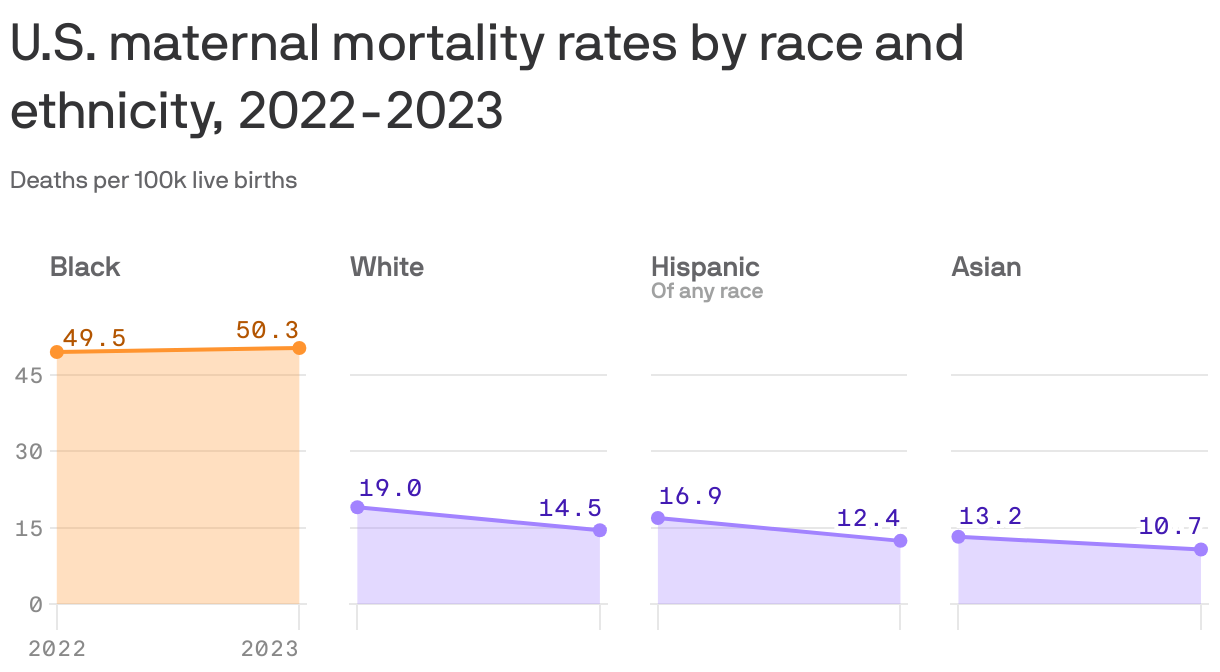
3. Charted: Maternal deaths for Black mothers

The mortality rate for Black mothers in the U.S. has not improved, new CDC data shows.
Why it matters: The pregnancy-related death rate for Black women is more than three times the rate for mothers of other racial and ethnic groups.
By the numbers: The maternal mortality rate for non-Hispanic Black women rose from 49.5 to 50.3 deaths per 100,000 live births, according to 2023 data from the CDC's National Vital Statistics System, the most recent available.
The fine print: The rate for Black women dying from pregnancy-related causes from 2022 to 2023 did not increase a statistically significant amount, the CDC says, but it's the only rate for a race or ethnic group tracked in the report that didn't appear to decline.
Context: The medical system has a racist history, and a 2023 study in The Lancet found that even Black women in areas with more access to maternal health care are at a "disproportionately" higher risk of dying during or after childbirth than white women who live in underserved areas.
4. Trump pardons may prompt abortion protests

Abortion clinics could face increased antagonism and threats of violence after Trump's recent pardons emboldened anti-abortion protestors who now view the White House as an ally.
Why it matters: While Trump has repeatedly flip-flopped on abortion, Republicans are eyeing new restrictions on the most common form of medication abortion and rolling back the law that sent anti-abortion protestors to jail.
The big picture: In his first week in office, Trump pardoned 23 anti-abortion activists who had been convicted of illegally blockading a reproductive health clinic in D.C.
- Among them was Bevelyn Williams, who was sentenced to more than three years in prison after crushing a clinic volunteer's hand with a door.
- The Justice Department also announced that it would curtail prosecutions of violations of the Freedom of Access to Clinic Entrances (FACE) Act, pursuing them only under "extraordinary circumstances" or in cases involving "significant aggravating factors," like death or property damage, the Washington Post reported.
- On top of these changes, Rep. Chip Roy (R-Texas) reintroduced legislation last month to repeal the FACE Act, which he said was "weaponized" against "pro-life Americans."
5. Catch up quick
🛑 The Trump administration is considering a move to repel asylum-seekers at the southern border on the basis that they might bring measles or tuberculosis infections into the U.S. (WSJ)
🐄 Dairy herds in Nevada tested positive for a newer bird flu strain that's been linked to severe human infections. (CNN)
⚕️ Digital health interests want new Attorney General Pam Bondi to scrap the Drug Enforcement Administration's proposed rule for remote prescribing of controlled substances. (Inside Health Policy)
Thanks for reading Axios Vitals, and to senior health care editor Adriel Bettelheim, managing editor Alison Snyder and copy editor Matt Piper. Please ask your friends and colleagues to sign up.
Sign up for Axios Vitals