Axios Vitals

December 19, 2024

Welcome to Thursday! Today's newsletter is 1,191 words or a 4.5-minute read.
1 big thing: Hospital spending surged in 2023


U.S spending on hospital care grew at its fastest clip in more than three decades last year, according to a new federal analysis of health expenditures.
The big picture: Higher demand for medical procedures, including more Medicare patients receiving outpatient care, helped drive a 10.4% year-over-year spending surge on hospitals while prices for services remained relatively stable.
- The increase was the highest recorded since 1990.
- Hospital spending totaled $1.5 trillion in 2023, by far the most of any category of medical care, per actuaries at the Centers for Medicare and Medicaid Services.
By the numbers: The nation's health expenditures reached $4.9 trillion overall in 2023, a 7.5% increase from 2022.
- Hospital spending constituted 31% of the total, compared with physician and clinical services, which accounted for 20%. Retail prescription drugs accounted for 9%, according to the analysis.
Zoom in: The spike in hospital spending stems mostly from Americans' increased use of hospital services and higher-intensity care, said Anne Martin, an economist with the Office of the Actuary at CMS.
- Hospital discharges, often used to illustrate how many patients are getting hospital care, increased 1.6% in 2023, following a small decline in 2022.
Zoom out: Momentum is building in Congress for policy changes that decrease spending on hospitals and particularly their outpatient clinics. But hospitals have so far successfully fought back against substantial changes, which they say would end up destabilizing care.
- There's also more attention being paid to private equity ownership of health systems, which is frequently blamed for putting profits ahead of patients.
Retail prescription drug spending grew by more than 11% last year, driven in part by increased uptake of diabetes and obesity drugs.
2. Major health deal imperiled in shutdown drama

A sweeping package of health policy changes wrapped into the deal to fund the government appeared in jeopardy late Wednesday after President-elect Trump publicly came out against the spending bill.
Why it matters: The measure got pushback from Republicans who pointed to its length and concerns about spending and the debt.
- Provisions raising congressional pay and allowing members of Congress to opt out of the Affordable Care Act also had some lawmakers sweating the potential political fallout.
- Trump then further complicated matters for GOP leadership on the Hill by torpedoing the deal and making a surprise demand that lawmakers raise the debt ceiling.
What's inside: The health policy portion included a two-year extension of Medicare telehealth flexibilities, funding for community health centers and reforms to how pharmacy benefit managers like CVS Caremark, Express Scripts and OptumRx are paid.
- It also would reauthorize the Medicare hospital-at-home program, a federal pandemic preparedness law and the SUPPORT Act addressing the opioid crisis.
But consternation appeared directed at separate provisions, including language that would give Congress a pay increase for the first time since 2009 and would allow lawmakers to drop ACA coverage and join the Federal Employee Health Benefits plan.
3. Heroin use skyrockets in the West

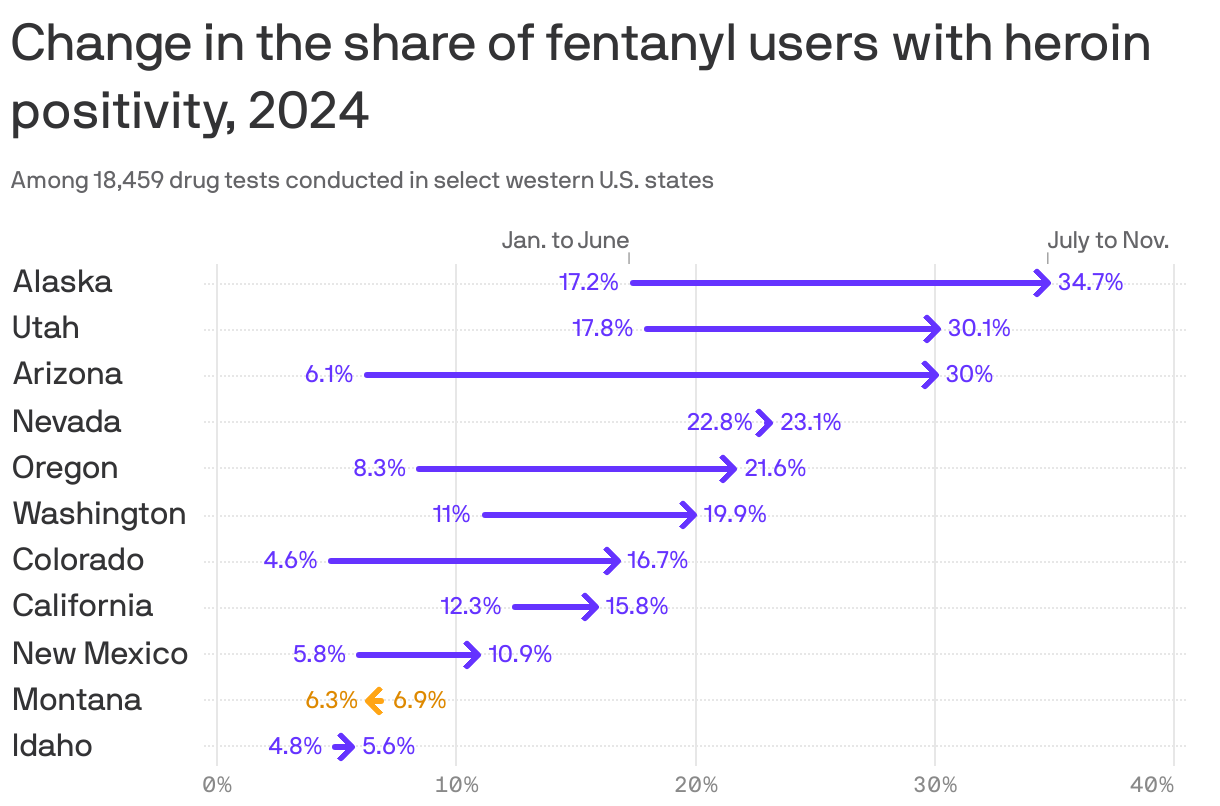
Fentanyl users appear to be rapidly shifting to heroin in western states, as supplies of the potent synthetic opioid tighten.
Why it matters: Data from specialty lab Millennium Health provided first to Axios suggests a reversal in drug use trends that "seemingly happened almost overnight," according to Eric Dawson, Millenium's vice president of clinical affairs.
What they found: Between January and June, heroin was detected in about 10% of people using fentanyl in the western part of the U.S., according to drug testing data.
- Between July and November, it increased to 23% in the region.
- In five states, there were statistically significant increases, including Arizona (389%), Colorado (264%), Oregon (160%), Alaska (102%) and Washington (80%), between the first and second half of 2024.
Flashback: Earlier this year, sources of fentanyl appeared to be drying up in some parts of the country, NPR reported. Other reports have suggested the potency of fentanyl supplies are getting "weaker."
Between the lines: That suggests fentanyl suppliers or those using the drug could be using heroin to stretch the opioid supply.
- "The fact that it's so consistent throughout much of the West, that suggests that it is a supply-side phenomenon, that the drug-trafficking organizations have made a decision to increase the amount of heroin in the fentanyl supply," Dawson said.

4. Moderate drinking could reduce mortality risk
One or two alcoholic drinks a day may reduce the risk of dying more than completely abstaining, according to a review of existing research by the National Academies of Science, Engineering and Medicine.
Why it matters: The findings help inform HHS and USDA in developing guidance on alcohol consumption in the next Dietary Guidelines for Americans, expected in late 2025.
- Current guidelines come down on the side of temperance, saying it's a choice between not at all or moderation and that "drinking less is better for health."
What they found: The review, which was ordered up by Congress, looked at multiple studies of light to moderate drinking, defined as two drinks a day for men and one for women.
- When it came to cardiovascular health, the moderate use of alcohol was associated with a lower risk of nonfatal heart attacks and strokes, as well as a lower overall risk of death.
- There was some increased risk for breast and colorectal cancer, but no broader conclusion could be made for most other cancers.
Between the lines: The findings appear to contradict studies and a World Health Organization position that "no amount of alcohol" appears to be safe, largely based on increased cancer risk.
5. California declares emergency over bird flu

California Gov. Gavin Newsom proclaimed a state of emergency Wednesday over the H5N1 bird flu outbreak.
The big picture: The virus, which has now spread among dairy cattle in 16 states, was detected in 645 California dairies — almost half of them in the last 30 days.
Zoom in: The state first detected cases in cattle in August.
- There hasn't been any person-to-person spread of bird flu in California, and nearly all infected individuals had exposure to infected cattle.
- The state of emergency is intended to expand monitoring and to provide state and local agencies resources for their response to reduce the spread of the virus, the governor's office said in a news release.
Meanwhile, a Louisiana resident was hospitalized with a severe infection from H5N1 bird flu tied to exposure to a backyard flock, the CDC said Wednesday.
- It marked the first case of severe bird flu resulting in a hospitalization in the U.S., and early indications are the virus causing the infection was the same type found in recent human cases in Canada and Washington state.
Between the lines: The case in Canada raised alarms because scientists discovered it may have had a variation that made it easier to transmit to other humans, though there was no evidence it spread. They were also unable to track down where the teenage patient contracted the illness.
6. Catch up quick
🛑 Sen. Josh Hawley (R-Mo.) said HHS Secretary-designate Robert F. Kennedy Jr. is open to reimposing restrictions on the widely used abortion pill mifepristone. (Notus)
💊 CVS pharmacies illegally dispensed controlled substances including opioids, fueling an overdose crisis, the Justice Department alleged in a whistleblower lawsuit. (Bloomberg News)
⚖️ The Supreme Court will review South Carolina's decision to cut off state funding for Planned Parenthood clinics. (WaPo)
Thanks for reading Axios Vitals, and to senior health care editor Adriel Bettelheim, managing editor Alison Snyder and copy editor Matt Piper. Please ask your friends and colleagues to sign up.
Sign up for Axios Vitals