
Axios Vitals

January 20, 2023
Happy Friday, Vitals readers. Today's newsletter is 988 words or a 3½-minute read.
Situational awareness: The FDA rejected accelerated approval of Eli Lilly's experimental Alzheimer's drug, the company announced Thursday.
- The company did not submit enough trial data from patients who were treated for at least a year, they said.
1 big thing: The post-Roe fight dividing anti-abortion activists

Illustration: Shoshana Gordon/Axios
As anti-abortion activists gather in Washington, D.C., on Friday to celebrate the overturning of Roe v. Wade, some factions are split over the movement's next steps and whether new laws should target health providers or individuals seeking the procedure, Axios' Oriana Gonzalez writes.
The big picture: While mainstream anti-abortion messaging still revolves around sanctioning doctors or clinics, a small but growing group of self-described abortion abolitionists are taking steps to single out and punish those seeking to end a pregnancy.
- The debate over individual liability has intensified as more people access abortion pills through telehealth and mail.
State of play: As state legislatures start to convene for their 2023 sessions, some lawmakers are embracing the new thinking.
- Lawmakers in Oklahoma and Missouri are eyeing changes to state law that could allow the prosecution of pregnant people. Louisiana had a similar bill introduced last year that was later pulled from consideration.
- Last week, the Alabama attorney general's office suggested to 1819 News that pregnant people who take abortion pills could be charged under a state chemical endangerment law that's been used to punish patients for consuming drugs during pregnancy. The AG later walked back those comments.
The other side: Abortion rights advocates say the debate over prosecuting individuals reveals the anti-abortion movement's actual goal, which is to ultimately punish those who seek abortions.
- "I think they're just biding their time," said Jennifer Dalven, director of the Reproductive Freedom Project at the ACLU, in a press call.
2. Ambulance services a surprise bills source
Nearly a third of commercially insured emergency ambulance trips from 2014 to 2017 resulted in a potential surprise bill, a new study in Health Affairs found, Axios' Arielle Dreher writes.
Why it matters: Ground ambulatory services are exempt from the federal No Surprises Act and can be the source of unexpected charges, particularly in areas where such services are privatized.
What they found: Researchers analyzing 3.72 million commercial payer claims from Aetna, Humana and UnitedHealth Group found that 28% of emergency ambulance trips and 26% of nonemergency trips resulted in a potential out-of-network surprise bill.
- Privately owned ambulance transports were associated with higher prices and more cost-sharing for patients than publicly owned services, as well as potential surprise bills, the analysis shows.
- For example, in 2017, a private ambulance ride meant 25% higher cost sharing for the patient than if they were picked up by a publicly operated ambulance.
- Just 15% of emergency transports and 43% of nonemergency transports were in-network during the time period analyzed.
The bottom line: Surprise billing protection "may be necessary" for both emergency and non-emergency ambulance rides, study authors write. "A law similar to the No Surprises Act can more easily be crafted to generally benefit, or at least not harm, public sector ambulance revenues without increasing federal deficits," the study says.
3. Davos highlights the era of biology

Illustration: Aïda Amer/Axios
The world is entering an era of biology — and the field's power is an emerging theme on the agenda in Davos, Axios' Alison Snyder reports from this week's World Economic Forum.
The big picture: Scientific capability and prowess have been "a defining feature of power" over the past 100 years, Matthew McKnight, general manager of biosecurity at the synthetic biology company Ginkgo Bioworks, told Alison.
- First, it was chemistry that created an economy fueled by petroleum.
- Next, physics was harnessed to build atomic weapons during World War II and then for the development of airplanes, communications and the space industry.
- Then, physics and chemistry together birthed the microchip and the computing revolution.
Now, it's biology.
- Base pairs, amino acids, enzymes and other biological molecules underpin a vision for an economy built on biologically engineered and produced materials, medicines, fuel and food.
In the public health sphere, Davos discussions focused on the need to spot new variants of the SARS-CoV-2 virus.
- For example, Ginkgo Bioworks is working with a CDC program at airports to try to spot variants as travelers enter the U.S.
What to watch: Science is an economic force but new science especially comes with a risk of being used for nefarious purposes. (A separate panel explored so-called dual use technologies, which include pathogen-enhancing research and genome editing.)
4. Data du jour: Opioids at ED discharge
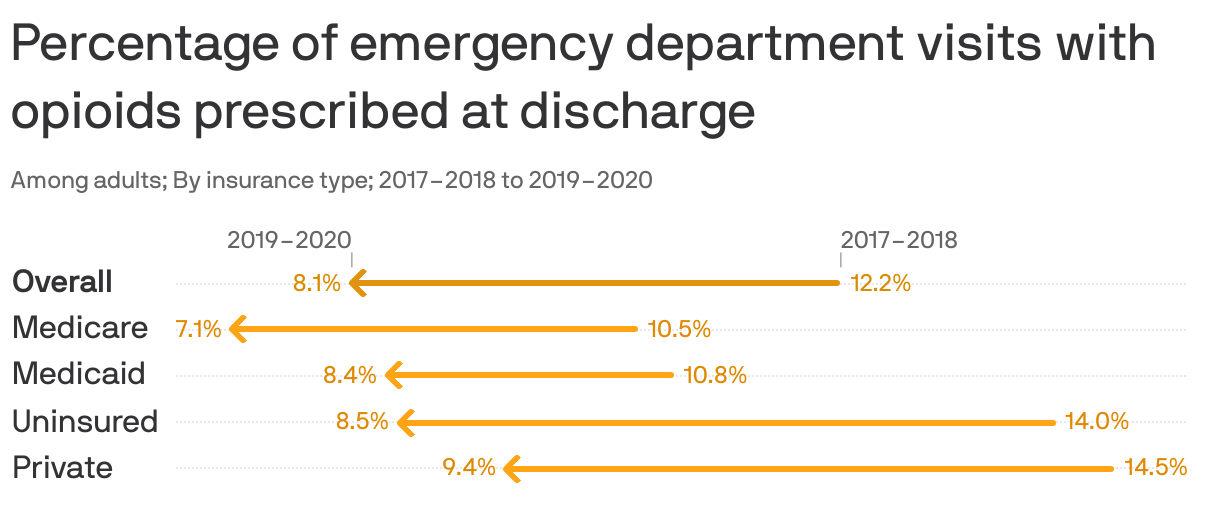
Doctors sent patients home with opioids after emergency department visits about 8% of the time in 2019–2020, down from about 12% in 2017–2018, according to figures released today by the CDC.
Why it matters: It continues a downward trend line from about 21.5% of emergency department discharges in 2010–2011 that resulted in an opioid prescription and a signal that efforts to educate doctors and reduce the use of opioids have gained traction.
Yes, but: Rates of opioid prescribing at discharge still vary depending on factors like a patient's source of insurance or their race, according to the data from the National Hospital Ambulatory Medical Care Survey.
By the numbers: In 2019–2020, opioids were prescribed at discharge at 36.4 ED visits per 1,000 adults, down from 50.5 per 1,000 adults in 2017-2018.
- About 9% of emergency department visits by Hispanic adults results in an opioid prescription at discharge, compared to 8.3% of non-Hispanic white adults and 7.2% of non-Hispanic Black adults.
- Commercially-insured patients were the most likely to leave with an opioid prescription.
5. Catch up quick
👀 A new gonorrhea strain that's resistant to multiple antibiotics detected in Massachusetts, officials say. (CNN)
🔥 A hotter planet is taking another toll on human health. (New Yorker)
💉 Monoclonal antibodies be a solution to chronic pain — and the opioid crisis. (National Geographic)
👉 Cambridge University researchers trial an artificial pancreas in Type 2 diabetics. (BBC)
6. Dog of the week
Dobis. Photo: Dave Ferraris
Meet Dobis P.R., a half-chow chow mix adopted from a shelter in Delaware and named after a joke from "Tim and Eric Awesome Show, Great Job!," a sketch comedy series.
- Dobis, who is clearly living the zen life at his Easton, Maryland, home, "loves chasing squirrels, monitoring the walking trail that passes in front of our house, and attending our boys' soccer games as the unofficial team mascot," writes his human Dave Ferraris.
Thanks for reading, and thanks to senior editor Adriel Bettelheim and senior copy editor Bryan McBournie for the edits.
Sign up for Axios Vitals

Healthcare policy and business analysis from Tina Reed, Maya Goldman, and Caitlin Owens.