Axios Vitals

January 12, 2026

Welcome back. Today's newsletter is 1,059 words, a 4-minute read.
1 big thing: Backlash against drug review revamp
FDA commissioner Marty Makary's flagship effort to overhaul how the agency reviews drugs is facing intensifying scrutiny from Congress and the medical establishment over whether it's putting politics over science.
The big picture: The Commissioner's National Priority Voucher program is aimed at expediting reviews of drugs and biologics that are "aligned with U.S. national health priorities."
- But it's prompting concern about legal challenges and rushed reviews as Makary faces broader scrutiny over turmoil at the agency, including a succession of departures at the top of the FDA's drug center.
State of play: The program has so far awarded 18 vouchers for accelerated reviews to treatments for cancers, sickle cell disease, obesity, deafness, infertility and other conditions.
- For products that receive the voucher, the agency aims for reviews in one to two months rather than the typical 10-12 months.
Yes, but: Critics say the criteria and process for obtaining the vouchers are opaque and driven by political appointees, not career staff, raising the prospect of favoritism.
- Rep. Frank Pallone (D-N.J.) and Sen. Bernie Sanders (I-Vt.), the ranking members of House and Senate committees overseeing the FDA, have questioned whether the program will "enable corruption" and favor drugmakers and allies favored by President Trump.
- They also said the vouchers envision "absurdly short" review timelines that could strain an FDA staff that's already depleted from layoffs, potentially leading to safety issues.
- Harvard researchers warned in the New England Journal of Medicine that the program "could undermine trust in the FDA's approval decisions" and "is ripe for both abuse and legal challenge," due to "broad and opaque" criteria.
Between the lines: The program is a departure from the way the FDA has traditionally done drug reviews, in part because a key criteria for receiving a voucher is whether the sponsoring company increases affordability by lowering drug prices or reduces use of health services.
- The agency has in the past been careful not to consider the price of a drug, focusing instead on safety and efficacy.
- "That's not [FDA's] thing. ... I'm not going to say it's patently illegal, but it's certainly in tension with the way the agency has historically operated," said Dan Troy, a former FDA chief counsel under President George W. Bush.
2. S.C. measles outbreak spreads to more states
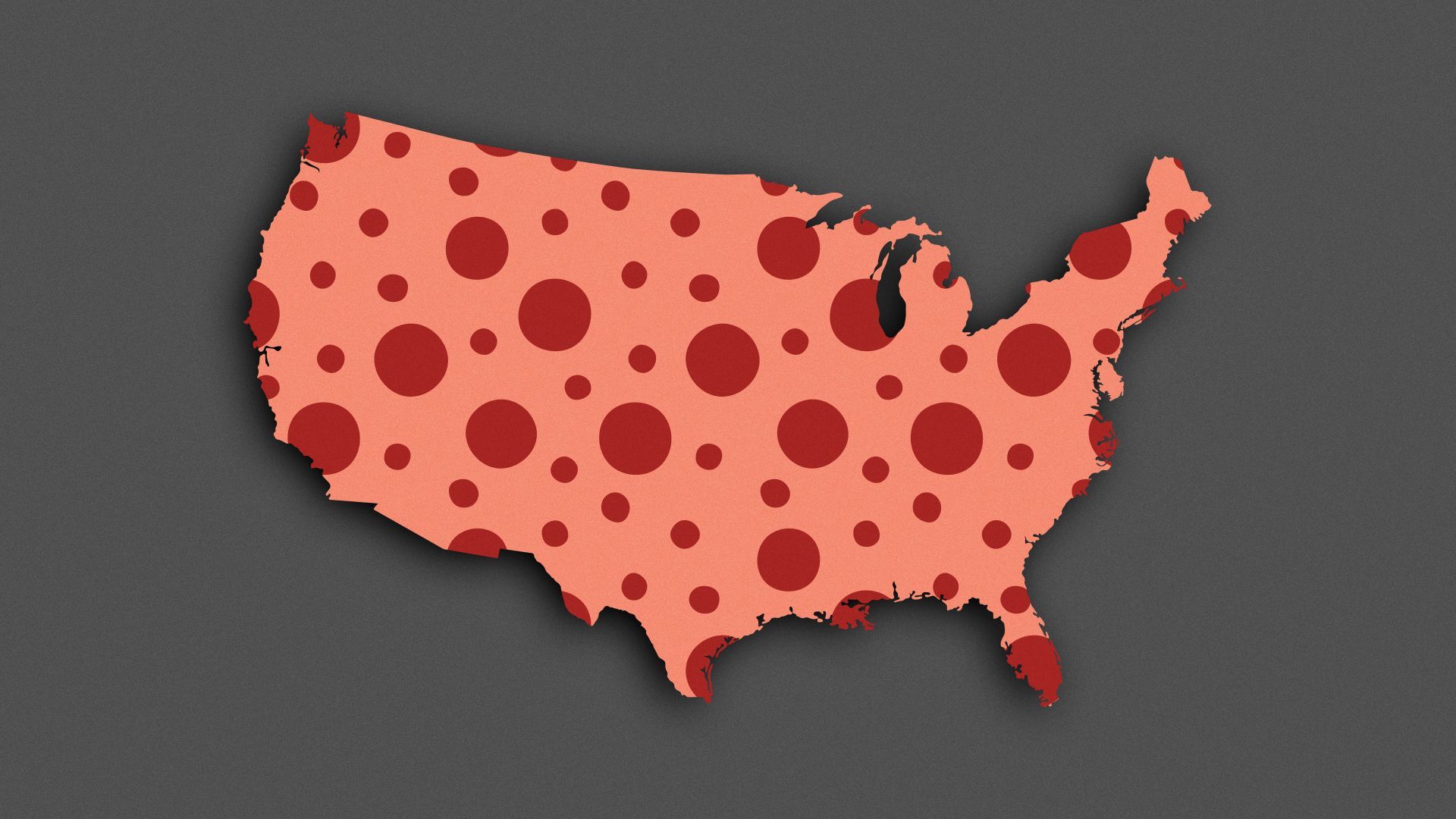
South Carolina's surging measles outbreak has brought cases to North Carolina and Ohio among families who traveled over the holidays to the outbreak area in the northwestern part of the state, AP reported.
Why it matters: It's proof that the hundreds of people in quarantine don't constitute everyone who was exposed, with potentially hundreds more unaware they should be isolating if they're not immune to the virus.
State of play: The outbreak centered in Spartanburg County, South Carolina, spawned 99 new cases just in the last week, bringing the total to 310.
- The South Carolina Department of Public Health issued an alert to health providers about the importance of heightened awareness for measles and recommended measures for the use of masks and rapid isolation.
- The state has ruled out vaccine mandates to control the spread, emphasizing that vaccination is a personal choice.
Zoom out: South Carolina is one of two major outbreaks in the U.S., along with a region on the Utah-Arizona border. Both are outlying areas where vaccination rates were below the 95% threshold public health authorities say is necessary to contain the virus' spread.
- The risk of spillover has increased with holiday travel. North Carolina has logged five new measles cases since late December, and Ohio last week reported three infected individuals, all children from a single household, who traveled to the outbreak epicenter.
What's ahead: With more than 2,100 confirmed cases for 2025 and new cases rising, the U.S. could be on track to lose its measles "elimination status" by the end of January.
More from Axios:
3. China fentanyl crackdown tied to overdose dip


Chinese crackdowns on fentanyl may have reduced overdoses and saved American lives, new research shows.
Why it matters: The data-backed explanation for the 34% plunge in overdose deaths from its peak suggests diplomatic pressure was more effective than decades of mass street-level arrests.
- "There was a major disruption in the illicit fentanyl trade, possibly tied to Chinese government actions, that translated into sharp reductions in overdose mortality beginning in mid- or late-2023 and continued into 2024," researchers wrote in Science.
Context: Overdose deaths in 2024 dropped to their lowest annual level since 2019 after rising during the COVID pandemic, reversing a surge that killed more than 100,000 Americans in 2023, per CDC data.
- Purity rates and fentanyl overdose deaths decreased at about the same time, researchers found.
4. RFK Jr. debates health autonomy with Germans

Health officials in Germany exchanged sharp messages with Robert F. Kennedy Jr. over the weekend after he suggested the nation punished doctors for exempting patients from wearing masks or getting COVID-19 vaccines during the pandemic.
Why it matters: The charge drew a sharp rebuke from Germany's health minister, who said it was completely unfounded and factually incorrect. And the official who oversaw much of the nation's pandemic response suggested Kennedy should focus on health problems at home.
Driving the news: Kennedy posted on X Friday that he wrote to German minister Nina Warken asking her "to restore medical autonomy" and "end politically motivated prosecutions" without providing sources for the claims, per Deutsche Welle.
- While most Germans were vaccinated against the virus during the pandemic, there were protests by a minority of vaccine skeptics in Germany that were sometimes supported by far-right movements, AP reported.
- Warken said there were no professional sanctions for not offering vaccinations and that prosecutions only occurred in cases of fraud or document forgery, such as issuing false vaccination certificates.
5. While you were weekending
💰 Physicians, podcasters and influencers with ties to the supplement industry stand to benefit from the spotlight Kennedy has placed on alternative health. (WSJ)
⚖️ A lawsuit alleges that an insurer's "ghost network" hindered New York City employees from accessing mental health care and harmed the reputation of psychiatrists wrongly listed as being in-network. (ProPublica)
🧑🏻⚖️ The Federal Trade Commission won a court ruling blocking an acquisition it said would decrease competition for a device meant to treat a potentially fatal heart condition. (Reuters)
Thanks for reading Axios Vitals, and to editors Adriel Bettelheim and David Nather and copy editor Matt Piper. Please ask your friends and colleagues to sign up.
Sign up for Axios Vitals