Axios Space

March 02, 2021

Thanks for reading Axios Space. At 1,602 words, this week's newsletter is about a 6-minute read.
- Please send your tips, questions and new space SPACs to [email protected], or if you received this as an email, just hit reply.
1 big thing: We're starting to take the Sun seriously
Illustration: Aïda Amer/Axios
Politicians, the public and scientists are increasingly paying attention to the danger solar storms pose for life on Earth and off of it.
Why it matters: Solar storms can wreak havoc on our modern, technology-dependent way of life.
- The most extreme events can overload satellites, harm astronauts in space and bring down electrical grids around the world.
- But even a quiet Sun can harm the electrical grid through normal wear and tear.
- "It's not necessarily about catastrophic failure, but it just decreases the lifetime of the infrastructure, which costs money in the long run," says Alexa Halford, a solar scientist at NASA.
Driving the news: In October, former President Donald Trump signed the PROSWIFT Act into law to aid in studying and forecasting space weather.
- A fleet of new spacecraft — like the Parker Solar Probe and Solar Orbiter — are gathering data about the Sun now to help researchers learn more about the inner workings of our nearest star and advance methods of forecasting in the future.
- All of this is unfolding as the Sun's next 11-year solar cycle, which governs its activity, is beginning, with some forecasters predicting it will be more extreme than the last, relatively quiet cycle.
The big picture: These advancements in policy and science are all expected to lead to space weather being treated in much the same way that weather forecasting is treated on Earth.
- NOAA, NASA and other agencies are now working to develop systems, as required by the new law, to help get forecasting and other data into the hands of the people who need it, including utilities and satellite operators.
- Creating an effective system will require "funding the very basic research to answer the many questions that need answering in space weather, and then taking that and making something out of it into a model that can be used into operation," said William Murtagh, program coordinator at NOAA's Space Weather Prediction Center.
Yes, but: Agencies are still waiting on funding to actually make those changes required by the PROSWIFT Act.
- The government, utilities and satellite operators will need new scientific tools that can gather specific data for forecasting and for the basic science that can help researchers get a better understanding of the star's behavior.
The intrigue: The Sun has been particularly quiet over the last two decades. In that time, hundreds of new satellites have been launched to orbit, possibly presenting new challenges if the Sun's activity increases.
- It's not clear exactly how a more active solar cycle might affect new satellites in orbit today, experts say, raising concerns about the risk of creating new space junk.
- Not all companies readily share information about how their satellites are negatively impacted by space weather with the government, due to concerns about competition, giving forecasters and scientists incomplete or limited information to go on.
What's next: As NASA works to send astronauts to the Moon in the coming years, space weather prediction and protection will also need to take center stage for the space agency.
- Radiation emitted by the Sun during solar storms could harm people outside of Earth's atmosphere, as they don't have the full protection of the planet's magnetic field.
- NASA is expected to send a shelter to the Moon to protect astronauts in case of a solar storm, but it takes about 30 minutes to get the tent set up, so having some kind of early warning forecasting in place will be key for safety.
- "If you're really serious about Artemis and the road to Mars, you need to be setting up a safety net on space weather in parallel, and you can't wait to the last minute," Scott McIntosh, deputy director of the National Center for Atmospheric Research, said.
2. Rocket Lab is going public
Illustration: Annelise Capossela/Axios
Rocket Lab, a company that has built its business on launching small satellites to space, is going public via a special purpose acquisition company (SPAC).
Why it matters: The announcement comes after a number of other space companies — including Virgin Galactic, Astra and Momentus Space — have made plans to begin trading publicly via SPAC.
- Going public via SPAC could be a good way for space companies to find new avenues of funding that aren’t dependent on government or private investors.
- "As we methodically plodded down that path of going for an IPO in a more traditional way, it became very clear that the SPAC would give us the opportunity to accelerate our time frame, not compromise on quality of partner or quality of what we ultimately want to deliver," Rocket Lab CEO Peter Beck told me.
Details: Rocket Lab's merger with the SPAC Vector Industries is expected to be completed by the second quarter of 2021, when the company will be listed on the Nasdaq under RKLB.
- Rocket Lab, which is based in the U.S. and New Zealand, also announced Monday that it is planning to build a new, larger rocket with its first test flight expected in 2024.
- The rocket — called Neutron — is designed to launch satellites for mega-constellations and is expected to directly compete with SpaceX for launch business.
- "If you look at the magnitude of spacecraft that need to be launched, you can't rely on one vehicle. ... I think that there is room in the market for an alternative vehicle that is really optimized to build constellations," Beck said.
The big picture: Rocket Lab has taken 97 satellites to orbit so far using its Electron rocket, and its Photon spacecraft can be used for interplanetary and orbital missions.
ICYMI: The satellite company Spire also announced it's going public via SPAC on Monday. (CNBC)
3. Space Force is here to stay
Illustration: Eniola Odetunde/Axios
Key Democrats in the House and Senate are in support of the U.S. Space Force, firmly signaling that the newest branch of the military — championed by Donald Trump — will continue under President Biden, my colleague Ursula Perano reports.
Why it matters: It would take an act of Congress to dissolve the Space Force as a separate service branch, and while Democrats were widely critical of its creation, the political tide now appears to have turned in favor of the force.
Driving the news: Senate Armed Services Committee Chair Jack Reed (D-R.I.) supports the Space Force existing as a separate branch of the military, despite previous comments insisting the force would add unnecessary bureaucracy, a Reed spokesperson tells Axios.
- Reed’s outright support for the branch comes after White House Press Secretary Jen Psaki said last month that Space Force has President Biden’s "full support" and is here to stay.
- Reed told Fox News in 2018 that while America does need to "reorganize [its] space forces … creating a separate service with all of the infrastructure and the bureaucracy is not the way to go."
- At a 2019 Senate Armed Services hearing on the Space Force, which was projected to be only 16,500 members, Reed questioned why "such a small fighting force" needed its own undersecretary and whether having such a small pool of members would lead to less qualified leadership.
House Armed Services Chair Adam Smith (D-Wash.) also "remains committed to the Space Force as a standalone service," per committee spokesperson Monica Matoush.
Between the lines: Some members, including Democrats, have been jockeying over where the Space Force should be headquartered, also indicating a clear but quiet degree of support for the branch.
- But Republicans are at the ready, should any challenge slip through. Rep. Mo Brooks (R-Ala.) told Axios in a statement, "I will fight any effort to minimize or eliminate the Space Force as a separate branch of America’s military."
What they’re saying: "Senator Reed looks forward to working with the U.S. Defense Department in continuing to refine, hone, and expand our military capabilities in space," Reed spokesperson Chip Unruh wrote.
- When asked specifically about the Space Force existing as a separate branch, Unruh replied: "Senator Reed supports it and it is the law."
4. A very strange comet
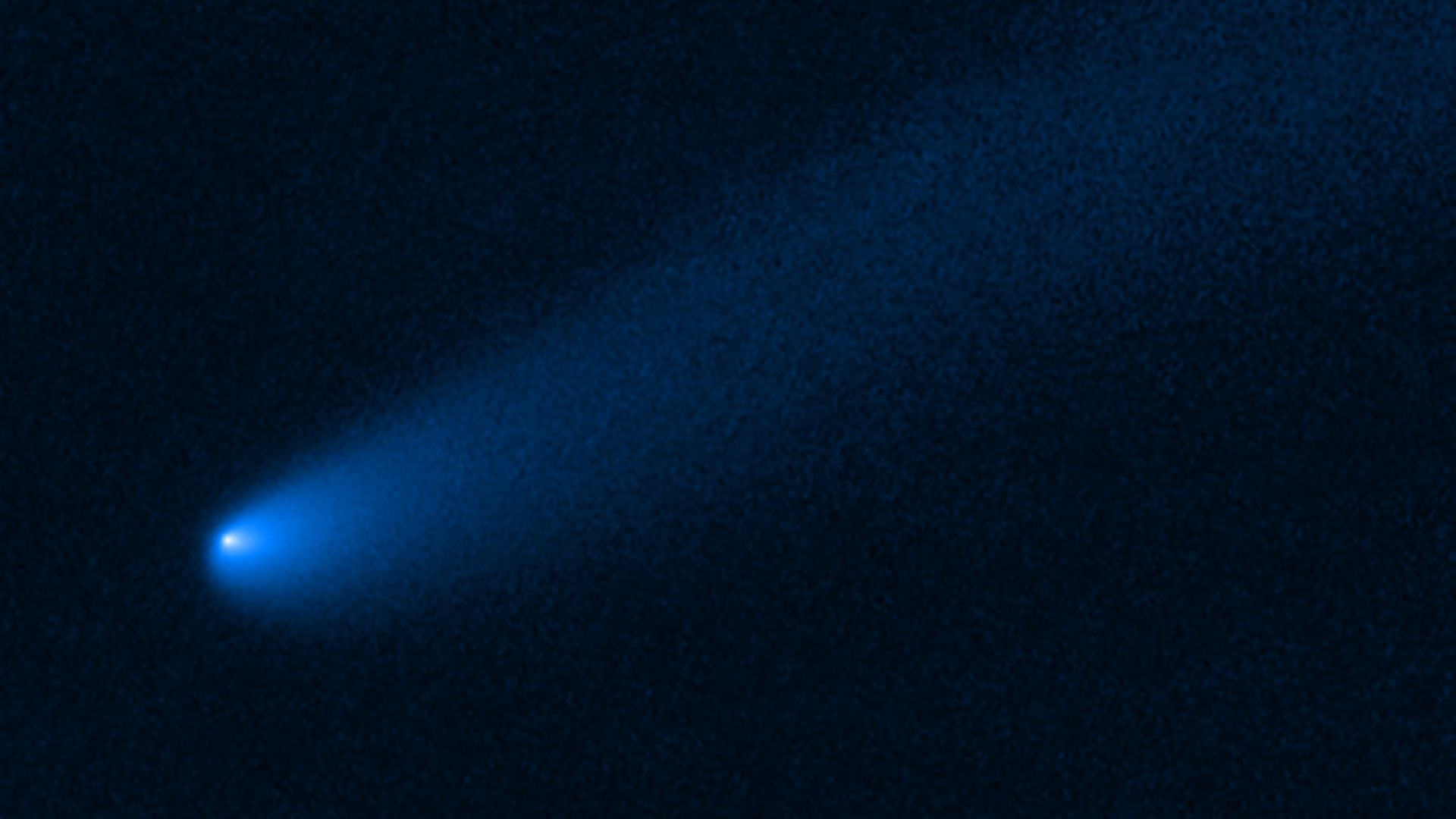
The comet as seen by the Hubble Space Telescope. Photo: NASA/ESA/ B. Bolin
For the first time, scientists have found a comet near a population of asteroids orbiting the Sun alongside Jupiter.
Why it matters: It's possible scientists have found a "pit stop" that other comets may take on their way to the inner solar system from farther afield, according to NASA.
What they found: The comet — named P/2019 LD2 — was discovered not far from a population of asteroids near Jupiter known as Trojans, the new study detailing the finding in the Astronomical Journal says.
- The comet may have originally been kicked out of the Kuiper belt beyond Neptune before orbiting the Sun near the outer, gaseous planets.
- About two years ago, the comet flew near Jupiter, which seems to have pushed the object toward the Trojans, where it was found today.
- "The cool thing is that you're actually catching Jupiter flinging this object around and changing its orbital behavior and bringing it into the inner system," Carey Lisse, one of the authors of the study said in a statement. "Jupiter controls what's going on with comets once they get into the inner system by altering their orbits."
What's next: Scientists think the comet is probably due to leave Jupiter behind in about two years, according to computer simulations.
- The comet is expected to interact with Jupiter again and then continue toward the inner solar system.
- "Simulations show that in about 500,000 years, there's a 90% probability that this object will be ejected from the solar system and become an interstellar comet," Lisse said.
5. Out of this world reading list
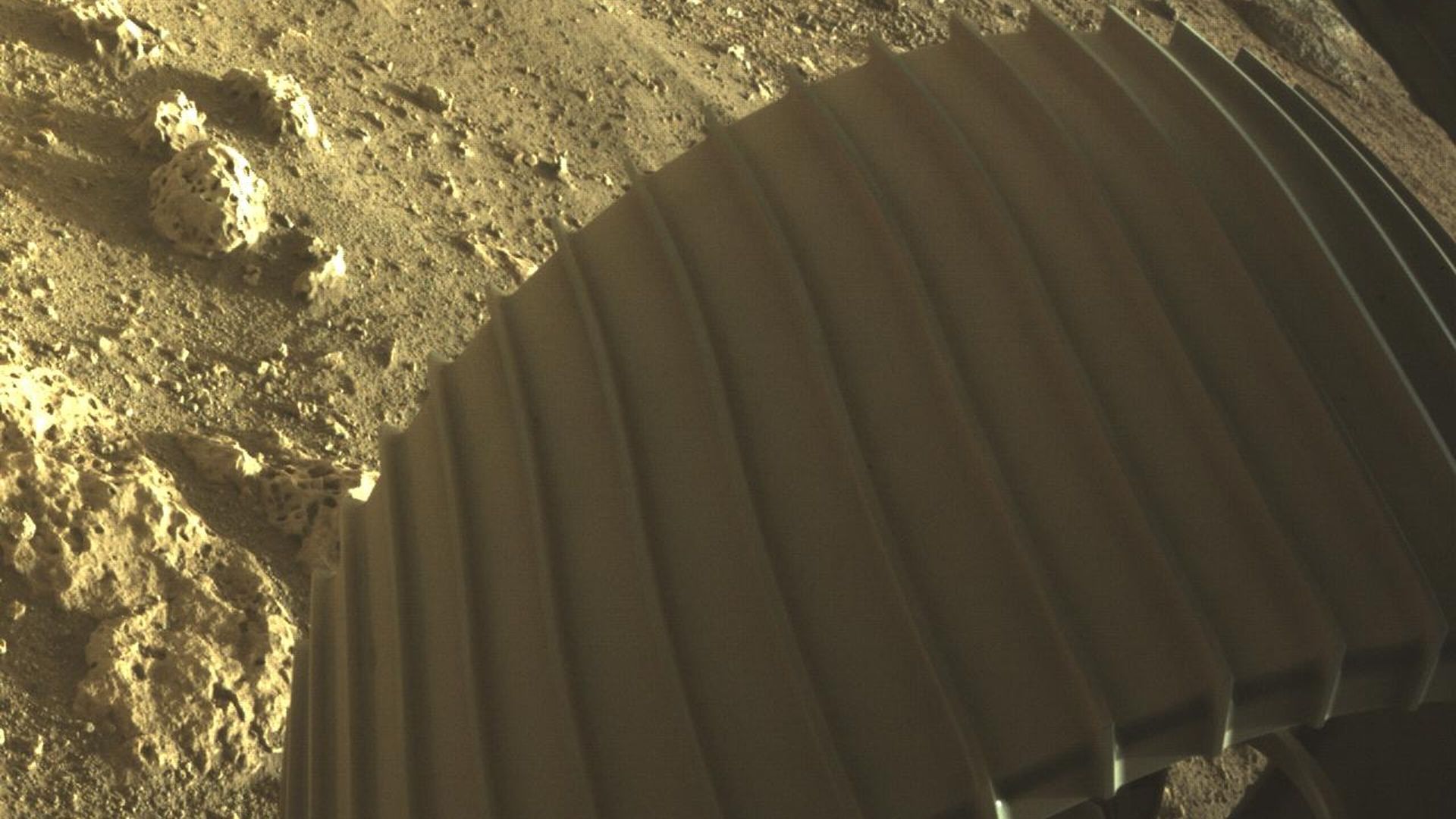
Perseverance's wheel on Mars. Photo: NASA/JPL-Caltech
U.S. to support international effort to set rules of behavior in space (Sandra Erwin, SpaceNews)
SpaceX is ready to launch more astronauts (Chelsea Gohd, Space.com)
Mars is a hellhole (Shannon Stirone, The Atlantic)
Once upon a time on Mars (Dennis Overbye, New York Times)
6. Your weekly dose of awe: Venus in rare form
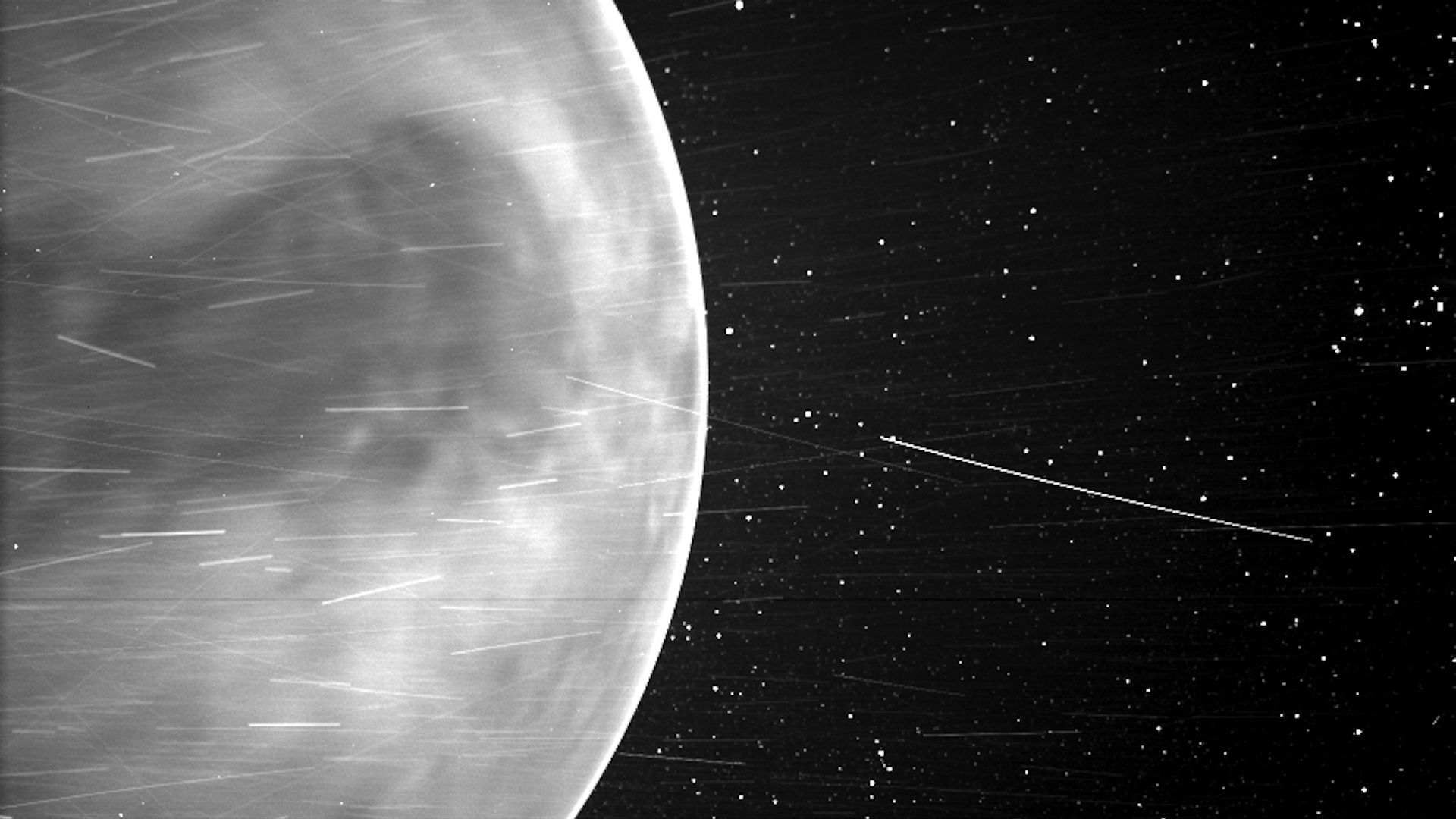
Photo: NASA/Johns Hopkins APL/Naval Research Laboratory/Guillermo Stenborg and Brendan Gallagher
Sometimes a spacecraft needs a gravitational boost from a planet as it passes by, and occasionally those probes can do a little fun science along the way.
- This photo shows Venus as seen by the Parker Solar Probe in July 2020 as the spacecraft flew by on its way toward the Sun.
- The dark patch stretching across the middle of the planet is Aphrodite Terra, a highland region on the surface.
- "We expected to see clouds, but the camera peered right through to the surface," Angelos Vourlidas, a scientist working on the Parker Solar Probe mission, said in a statement.
Big thanks to Alison Snyder, David Nather and Sheryl Miller for editing and Ursula for contributing to this week’s edition. If this email was forwarded to you, subscribe here. ☀️