Axios Space

April 27, 2021

Thanks for reading Axios Space. At 1,500 words, this week's newsletter is about a 6-minute read.
- It's good to be back after a week off and a flurry of space news upon my return.
Please send your tips, questions and videos of cats in weightlessness to [email protected], or if you received this as an email, just hit reply.
1 big thing: A make-or-break moment for cleaning up space junk

Illustration: Annelise Capossela/Axios
Companies and governments around the world are racing to figure out how to clean up human-made junk that is cluttering space.
Why it matters: Trackers are seeing more and more close calls between satellites, as companies work to deploy constellations of hundreds to thousands of small spacecraft, adding to fears that those small satellites could become junk themselves.
- Cleaning up junk requires finding new ways to remove it from orbit — and experts say regulations and policy need to be clarified to prevent more from accumulating.
- At the moment, NASA estimates there are hundreds of thousands of untrackable pieces of junk in orbit around the Earth that threaten operational satellites and even people in space.
What's happening: Companies are starting to prove out the technology needed to actively remove debris and failing satellites from orbit.
- Last month, Astroscale's ELSA-d spacecraft launched on a mission to test its technology designed to latch on to a piece of junk and hurtle it through the atmosphere, burning up harmlessly as it re-enters.
- Northrop Grumman also used its MEV-2 mission this month to dock with a satellite in orbit, in order to extend its life and keeping it from becoming space junk faster.
- "From a technology standpoint and from a market visibility standpoint, the development of satellite servicing and the related ecosystem will contribute to the viability of the active debris removal concepts," Ian Christensen of the Secure World Foundation told Axios.
A major hurdle to cleaning up space junk has been figuring out who is responsible for removing debris and how it is regulated.
- A new study from the Aerospace Corporation shared exclusively with Axios recommends that if a company wants to remove a certain failed satellite or piece of junk from orbit, they should simply ask permission first — a way of avoiding the thorny issue of creating an international framework around the removal of debris, at least for now.
- "Once a debris owner provides permission to somebody to remove a piece of debris, a lot of things can be worked out with the existing regulatory regime," Josef Koller, one of the authors of the new paper, told me.
The big picture: Experts also hope the Biden administration will create new policies that will help limit the creation of space junk as more and more players send their wares to space.
- "The first four years of this Biden administration need to include action on debris," Luc Riesbeck of Astroscale US told me. "The U.S. is licensing a lot satellites to go up, and when you do that as a country, you are accepting that liability for the risk of those systems."
- Reports now suggest that in order to keep certain orbits around Earth safe for new satellites in the coming years, there will need to be active cleanup, with companies and countries removing debris.
- And that becomes even more urgent as companies like SpaceX continue to launch hundreds of satellites to orbit that are threatened by space junk and could contribute to junk themselves.
Yes, but: It's still not clear if there's money to be made for the companies looking to remove debris from orbit.
- Questions around liability and responsibility for cleaning up orbit remain, and the technology still needs to prove effective in real-life scenarios.
- The coming year or two will demonstrate whether or not these companies will be able to make money and who exactly is willing to pay them to remove junk from space.
2. Jill Tarter's search for life

Photo illustration: Annelise Capossela/Axios. Photo: Roger Ressmeyer/CORBIS/VCG via Getty Images
Astronomer Jill Tarter wants the search for extraterrestrial intelligence (SETI) to be taken seriously.
Why it matters: SETI as a scientific field has long played second fiddle to other, well-funded searches for direct and indirect signs of life — like NASA’s Mars program and the hunt for alien planets around distant stars.
What's happening: Instead of generally referring to SETI as a search for smart aliens, Tarter is focusing on the search for "technosignatures" — signs of technology like geoengineering or large structures in orbit from distant civilizations.
- "We can't define intelligence, and we certainly don't know how to find it at a distance, directly," Tarter told me. "What we can do is to look for evidence of somebody else's technology that might be discernible over interstellar distances."
- If scientists on Earth happen to discover those massive signs of intelligent civilizations, however, they were likely created by a more advanced society because anything scientists could pick up from this far away would need to be particularly large for researchers to see it.
Between the lines: By putting technosignatures in the same conversation as biosignatures — biological signs of life on other planets like Mars — Tarter hopes both searches will be able to play off of one another.
- "The exoplanets and extremophiles are pointing out that there is a lot more potentially habitable real estate out there than we ever imagined," Tarter said.
- She also added that "the next obvious question is are they inhabited by intelligent beings?"
The intrigue: In the U.S., SETI efforts have largely been funded through philanthropy.
- Yuri Milner's Breakthrough Listen is the most high-profile example of a philanthropy-funded SETI project in recent years.
- But relatively new, international radio telescopes — like China's FAST and South Africa's MeerKAT — have come online, with the search for alien life built into their DNA, potentially giving a boost to the search for technosignatures globally.
3. A Moon landing in 2024

Photo: NASA
NASA and SpaceX still appear to be pushing to meet the 2024 deadline to land astronauts back on the Moon first set by the Trump administration.
The big picture: In its first 100 days, the Biden administration undid many of the Trump administration's policies but President Biden has largely hewed closely to Trump-era space policies.
Catch up quick: Many in the space industry expected the 2024 deadline for the first Artemis landing would be quickly amended by the Biden administration, but NASA still appears to be working toward that ambitious goal.
- "I think we all have to recognize that space is hard, and it's an ambitious timetable, but that is what has been stated," Bill Nelson, Biden's nominee for NASA administrator said during his confirmation hearing last week.
- NASA also just awarded SpaceX a contract to build a landing system that will take people to the lunar surface as part of the Artemis program.
- "We're going to build a lot of rockets and probably smash a bunch of them, but I think it will happen," SpaceX's Elon Musk said last week. "I think 2024 — it seems likely. We're going to aim for sooner than that, but I think this is actually doable."
Yes, but: While NASA and SpaceX are optimistic, there is plenty of reason to doubt the current timeline.
- The space agency's Space Launch System rocket — designed to bring astronauts to orbit around the Moon — has already been delayed by technical problems, and it's not yet clear it if will fly for the first time before next year, possibly pushing the current timeline.
- NASA's acting administrator Steve Jurczyk has also said 2024 no longer appears to be possible.
- Some are also questioning NASA's decision to only select SpaceX for its human lander, saying the space agency is putting all of its eggs in one basket and landing on the Moon is no easy feat, particularly for a company that has never done it before.
- Blue Origin also filed a protest against the decision to award SpaceX the sole contract, saying the agency "moved the goalposts at the last minute."
4. SpaceX's Starlink wins out

SpaceX Starlink satellites being deployed in Earth orbit. Photo: SpaceX
SpaceX scored a regulatory victory at the FCC today, overcoming opposition from Amazon and other companies on a key change to its plans for Starlink, my colleague Margaret McGill reports.
Why it matters: SpaceX needed FCC approval to move forward with its plan to provide internet access in hard-to-reach areas using its mega-constellation of satellites.
What's happening: SpaceX asked the FCC for permission to lower the orbit of its future Starlink satellites.
- Amazon — which plans to launch its competing Project Kuiper satellite network — objected, arguing that the SpaceX change would interfere with its plans.
- But the FCC unanimously sided with SpaceX, saying it doesn't believe the company's plans will cause significant interference.
- "Based on our review, we agree with SpaceX that the modification will improve the experience for users of the SpaceX service, including in often-underserved polar regions," the FCC said in the order.
My thought bubble: This victory further cements SpaceX as the leader among companies attempting to build mega-constellations of internet-beaming satellites. Whether any others will be able to catch up remains to be seen.
5. Out of this world reading list
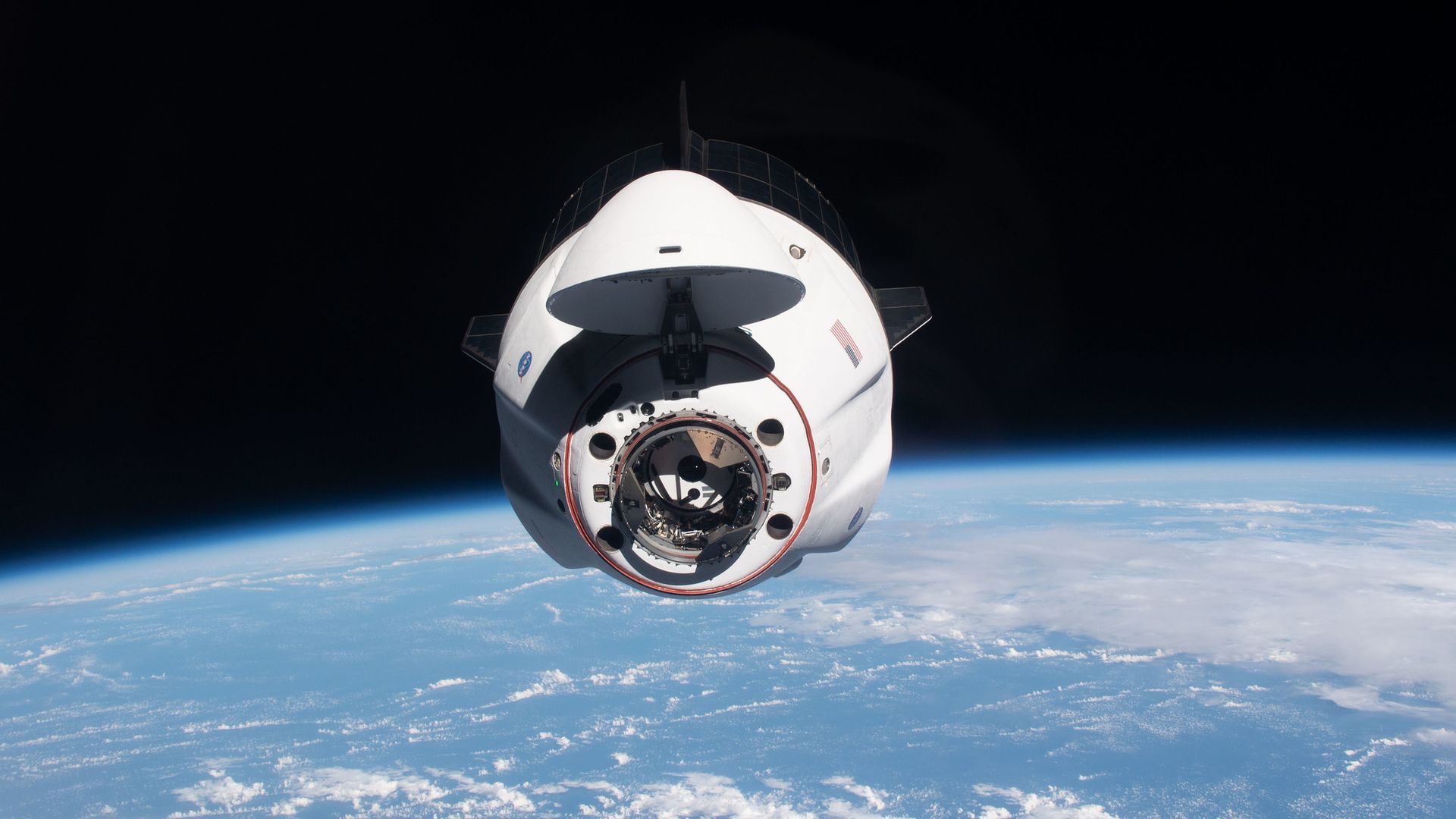
SpaceX's Crew Dragon coming in for a docking. Photo: NASA
Meteorite tracked to its birthplace in the asteroid belt (Nicoletta Lanese, LiveScience)
China, Russia open moon base project to international partners (Andrew Jones, Space News)
Blue Origin protests NASA's Moon lander contract with SpaceX (Axios)
Crewed SpaceX spacecraft docks with International Space Station (Oriana Gonzalez, Axios)
Our Earth in context with other worlds (Axios)
6. Weekly dose of awe: The little helicopter that could
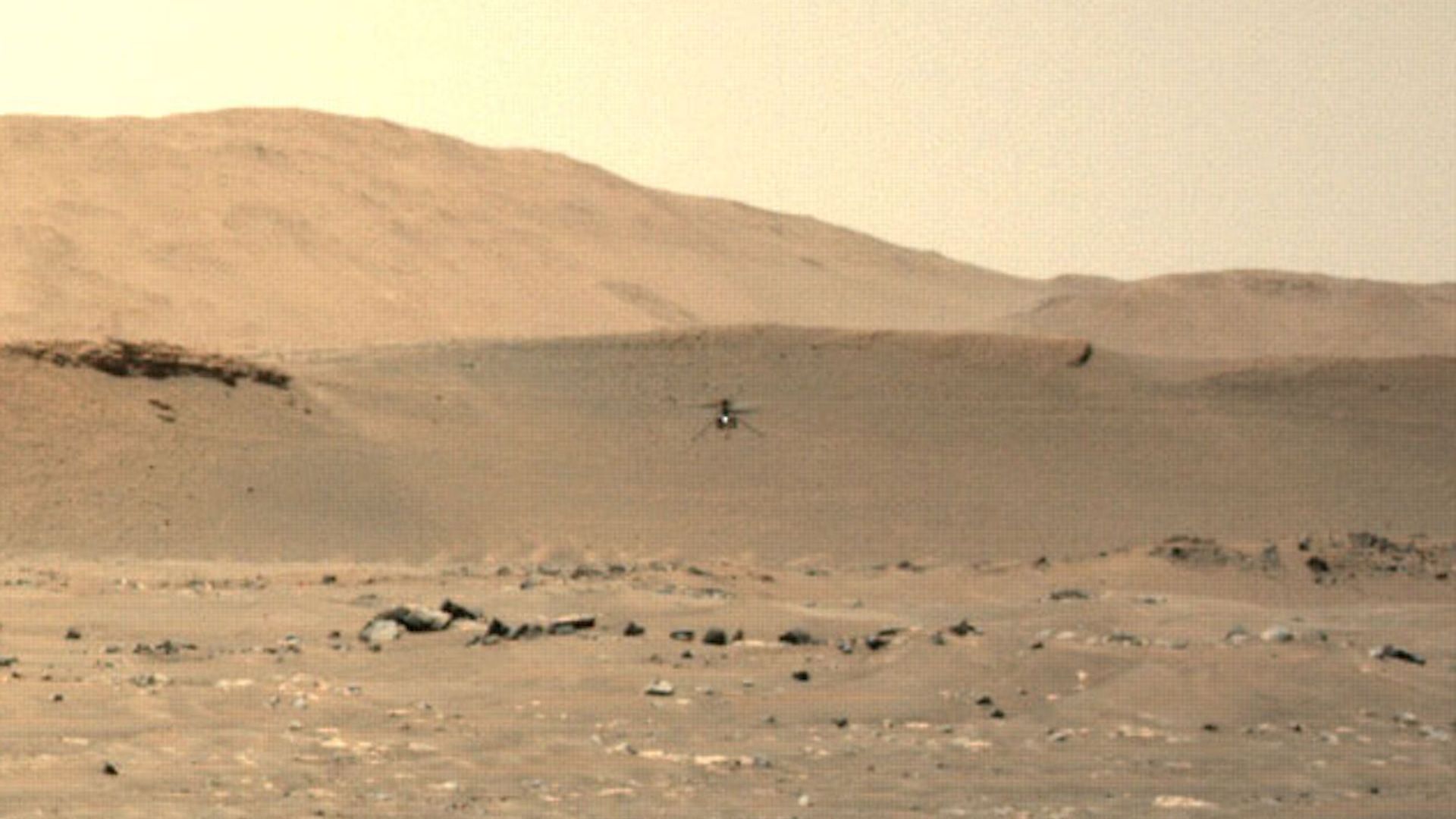
Photo: NASA/JPL-Caltech
It's science fiction made reality.
- The tiny Ingenuity helicopter on Mars took to the skies for the third time on Sunday as the Perseverance rover looked on, snapping photos.
- Ingenuity can be seen against the Martian dunes, just above the surface in the middle of the image.
- NASA is continuing to test Ingenuity's abilities on Mars in hopes that one day the technology will be used for future missions to the Red Planet and beyond.
Big thanks to Alison Snyder, David Nather and Bryan McBournie for editing this week’s edition and to Margaret for contributing. If this newsletter was forwarded to you, subscribe here. 🛰
Sign up for Axios Space

Explore the science and business of space