Axios Space

December 08, 2020

Thanks for reading Axios Space. At 1,338 words, this week's newsletter is about a 5-minute read.
- Please send your tips, questions and Hanukkah wishes to [email protected], or if you received this as an email, just hit reply.
1 big thing: The golden age of space-sample returns

Illustration: Aïda Amer/Axios
Multiple space missions by different countries are bringing rock samples back to Earth from far-off worlds — a trend that could redefine our understanding of the evolution of the solar system.
Driving the news: China’s Chang’e-5 spacecraft is bound for Earth and loaded down with Moon rocks expected to be far younger than those brought back during the Apollo missions. Those samples are expected to arrive in mid-December.
But now, we're getting samples from asteroids, too.
- Japan just returned a sample of an asteroid to Earth collected by the Hayabusa2 mission after launching to space in 2014.
- NASA’s OSIRIS-REx managed to snag what appears to be a large sample of another asteroid thought to represent the leftovers of the planet formation process billions of years ago. That sample is expected to make it back to Earth in 2023.
The big picture: Together, these missions could help fill gaps in scientists' understanding of how the early days of the solar system gave rise to the planets and eventually life.
- By analyzing these samples in labs back on Earth, scientists will have the chance to know exactly how old these cosmic rocks are — and possibly pick out any signs of organic molecules that might act as precursors to life.
- "It is such a puzzle" to figure out how the solar system we know now evolved over billions of years, says Brett Denevi, a planetary geologist at the Johns Hopkins University Applied Physics Laboratory.
Between the lines: Sample return missions allow scientists to use high-powered tools on Earth to analyze material from distant cosmic objects, revealing more than any robotic rover or photos from an orbital mission could.
- While the tech used on spacecraft has progressed rapidly in the last few decades, it will likely never get to the point where a spacecraft can produce analysis as good as what can be done on Earth.
- "It's almost cheaper to just bring a piece back and do it here," the Planetary Society's Casey Dreier told me.
These types of missions also allow scientists to store material for possible future study with tools not yet invented.
- "There will be people who go to those samples 50 years from now with a capability that we can't even conceive of," Dante Lauretta, the principal investigator for OSIRIS-REx, told me.
What's next: These missions are also likely harbingers of things to come. Japan is planning to launch a sample return mission to Mars' moon Phobos in 2024, with an expected return in 2029.
- The sample collected should help scientists figure out the origins of Phobos and Deimos, Mars' other moon.
- NASA also launched the Perseverance rover to Mars this year equipped with tools that will allow it to cache samples for an eventual return to Earth aboard a future mission.
- These current and future missions may eventually open up the possibility of sample return missions to comets, Saturn's moon Enceladus, or other icy, watery bodies in the solar system.
2. Manufacturing in space
Illustration: Aïda Amer/Axios
Varda Space, a Southern California-based startup with plans to manufacture products in orbit, has raised $9 million in seed funding, my colleague Kia Kokalitcheva writes.
Why it matters: Researchers and manufacturers have long dreamed of outsourcing the manufacturing of specialized products to space. Varda Space's funding shows that investors may also be getting on board with that idea.
Details: The company is not sharing much about what it plans to manufacture in space, but says that "super high-value and super sensitive materials" like semiconductors and pharmaceuticals are examples.
- "We're the Foxconn of space," co-founder Delian Asparouhov (and a principal at Founders Fund) tells Axios to describe where in the manufacturing chain Varda aims to be.
- Manufacturing will be mostly automated to avoid the complications that humans add.
- The company declined to share more about what exactly it's building or its timeline, except to say that it's "building things that go into space."
The big picture: The cost of launching payloads to orbit has been dramatically decreasing in recent years, making endeavors like orbital manufacturing seem economically feasible in the future.
- Some companies working on in-space manufacturing right now are focusing on catering to government customers like NASA.
- Varda, however, doesn't plan to rely on space agencies as customers or operational partners, says Asparouhov. "NASA is a research organization and we are a commercial company."
Yes, but: Despite the advances in tech and decreases in costs, this is still a highly speculative bet.
- It's still difficult to launch things into orbit, and it costs tens of millions of dollars, if not more.
- Manufacturing on Earth is also difficult, so bringing it to space could present a number of new challenges.
3. The Geminids are coming
A 2017 Geminid meteor shower composite. Photo: VW Pics/Universal Images Group via Getty Images
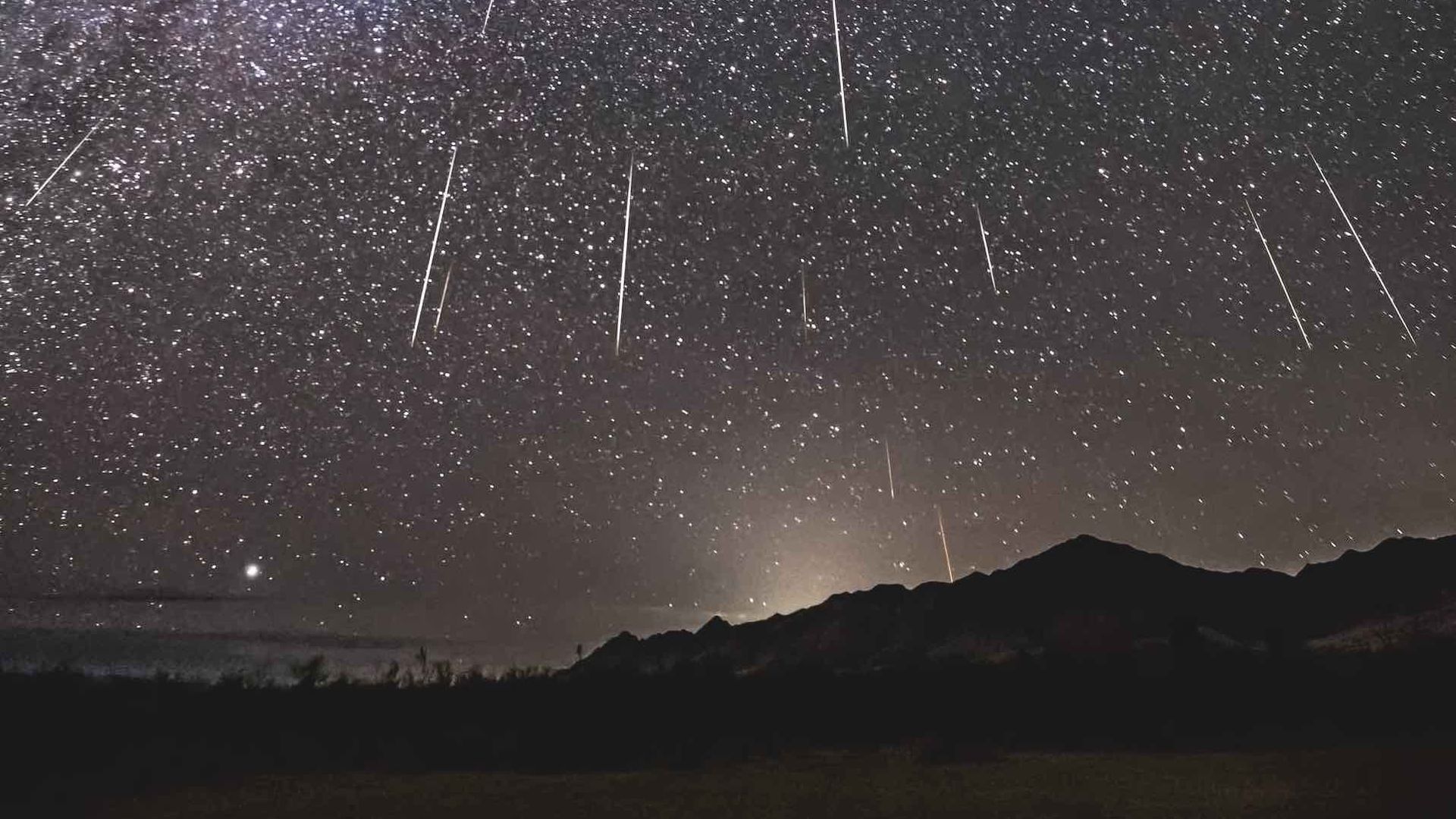
This weekend, be sure to look up to catch the Geminid meteor shower, one of the best of the year.
The big picture: The Geminid meteor shower hits its peak each year in mid-December as Earth passes through the trail of debris left behind by asteroid 3200 Phaethon.
- The shower is expected to be particularly good this year, with very little moonlight interfering with the dark skies needed to spot the streaking shooting stars.
How it works: NASA predicts that the shower will peak overnight on Dec. 13 into the wee hours of Dec. 14.
- You can expect to see meteors all night from the Northern Hemisphere and starting after midnight in the Southern Hemisphere, assuming you have reasonably dark and clear skies above you.
- "For the best viewing, find a safe location away from bright city lights, lie flat on the ground with your feet pointing south and look up," NASA said in a skywatching video. "Meteors can appear in any part of the sky, though they'll appear to radiate from near the constellation Gemini."
- It takes about 30 minutes for eyes to adjust to the dark, so give yourself time, and don't ruin your night vision by looking at a bright phone screen.
What's next: On Dec. 21, Jupiter and Saturn are going to meet up in the night sky thanks to a lucky planetary alignment, appearing closer than they have in about 20 years.
- The two planets will be visible in the same field of view through binoculars or a telescope, according to NASA.
- "This is the 'greatest' great conjunction between Jupiter and Saturn for the next 60 years, with the two planets not appearing this close in the sky until 2080," NASA said.
Bonus: Holiday cheer arrives in space
A Christmas tree above Earth on the ISS in 2015. Photo: NASA
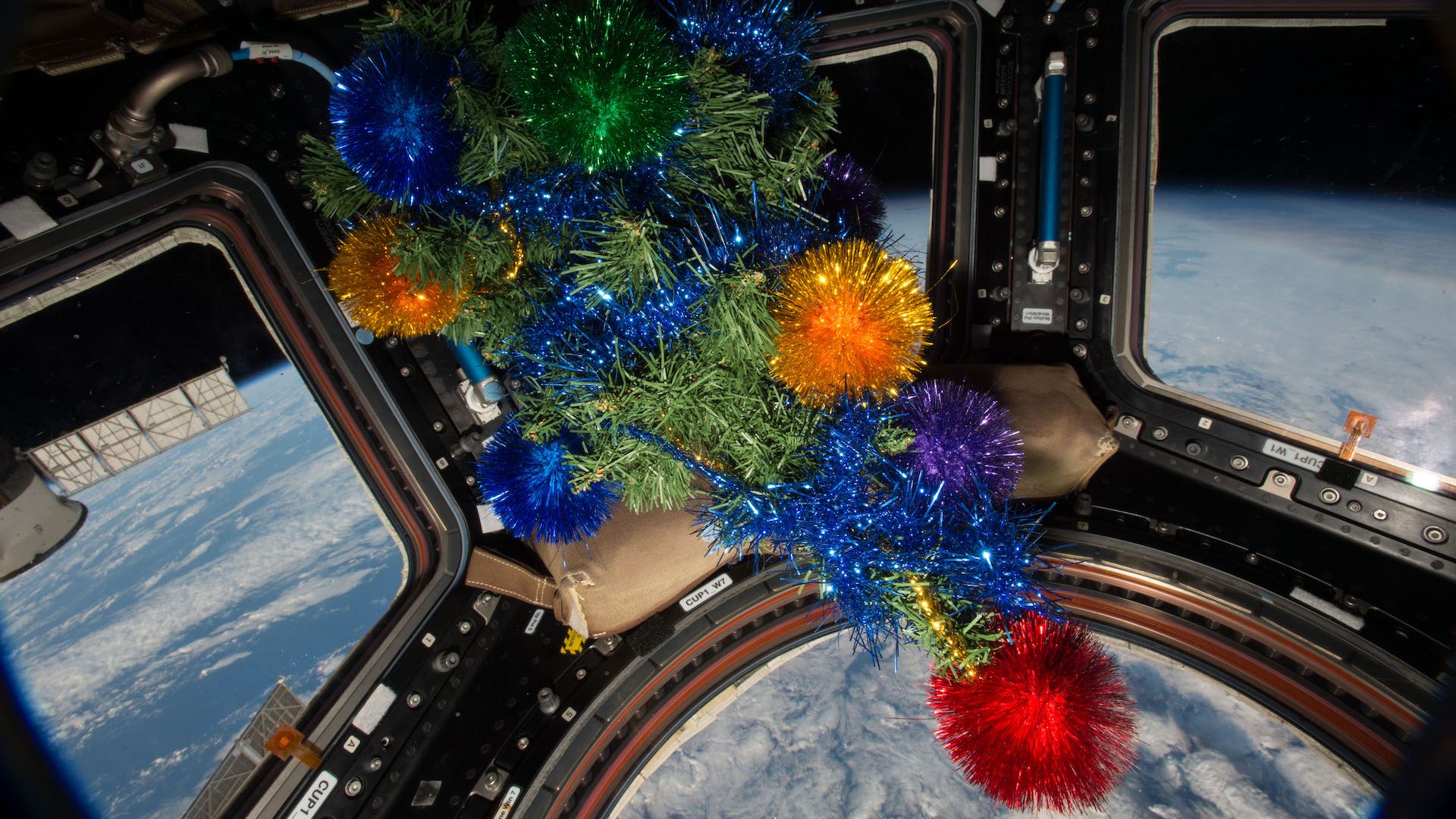
An uncrewed SpaceX Dragon delivered some holiday goodies to the waiting astronauts on the International Space Station Monday.
Details: The Dragon carried plenty of practical gear with it to space, but mission managers also loaded down the capsule with a special holiday feast for the crew members.
- The menu includes cornbread dressing, cranapple dessert, macaroni & cheese, spicy green beans, sparkle gel, roasted turkey and other goodies.
The big picture: There will be seven crew members on the space station for the holidays.
- NASA's Kate Rubins, Victor Glover, Michael Hopkins and Shannon Walker, Japan's Soichi Noguchi, and Russian cosmonauts Sergey Ryzhikov and Sergey Kud-Sverchkov will spend the holidays together 250 miles above Earth this year.
1 fun thing: NASA's cornbread dressing has been a mainstay at the holidays for crew members in orbit for a number of years.
- In 2015, the space agency published its recipe for the seasonal favorite.
4. Out of this world reading list
The collapsed Arecibo Observatory seen from space. Photo: Planet Labs Inc.
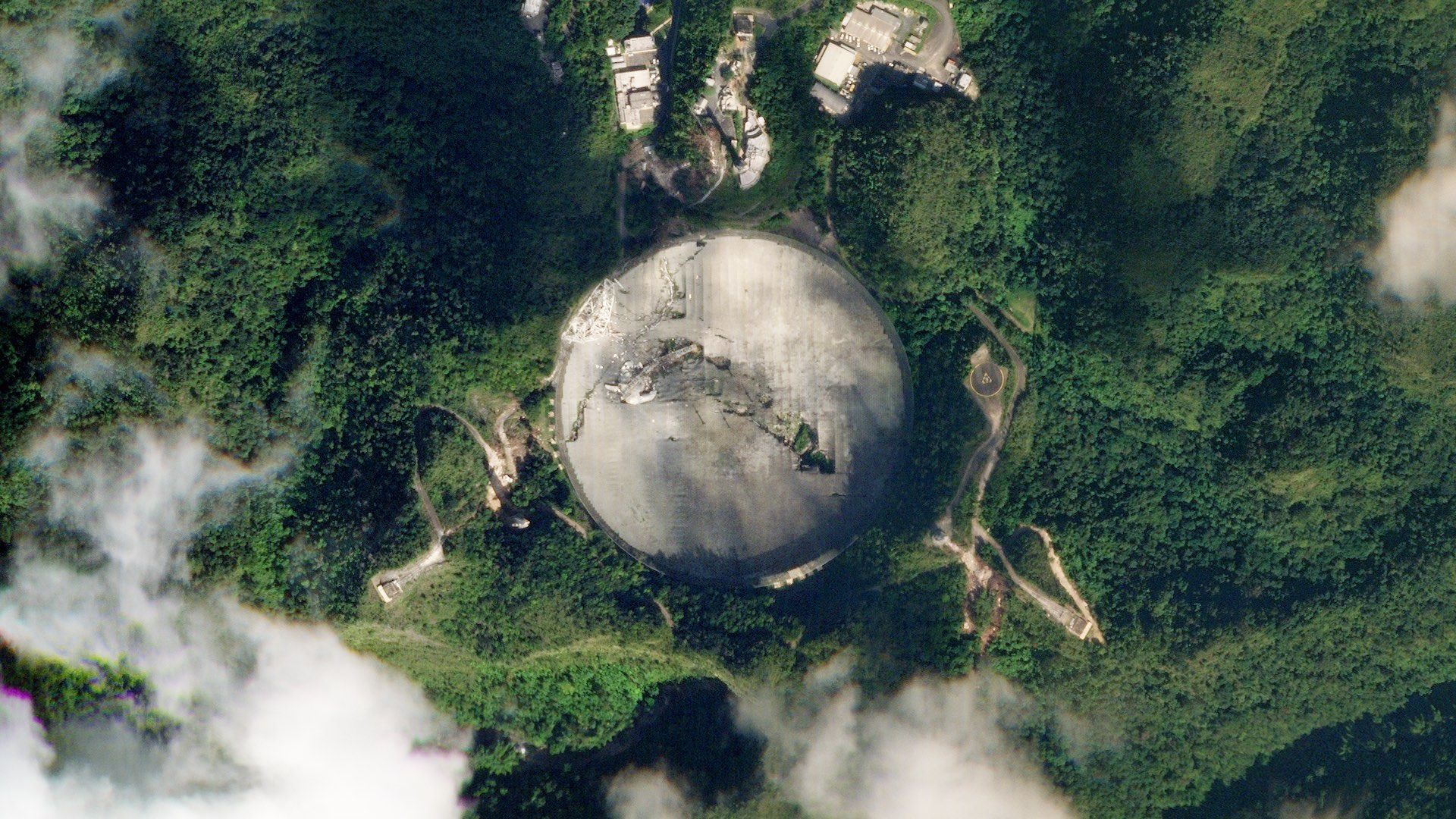
NSF says it’s too early to decide whether to replace Arecibo (Jeff Foust, SpaceNews)
Asteroid dust from Hayabusa2 could solve a mystery of planet creation (Jonathan O'Callaghan, Scientific American)
The Voyagers found a small surprise in interstellar space (Marina Koren, The Atlantic)
SpaceX capsules parked side-by-side at station for 1st time (Marcia Dunn, AP)
5. Your weekly dose of awe: Close-up sunspot
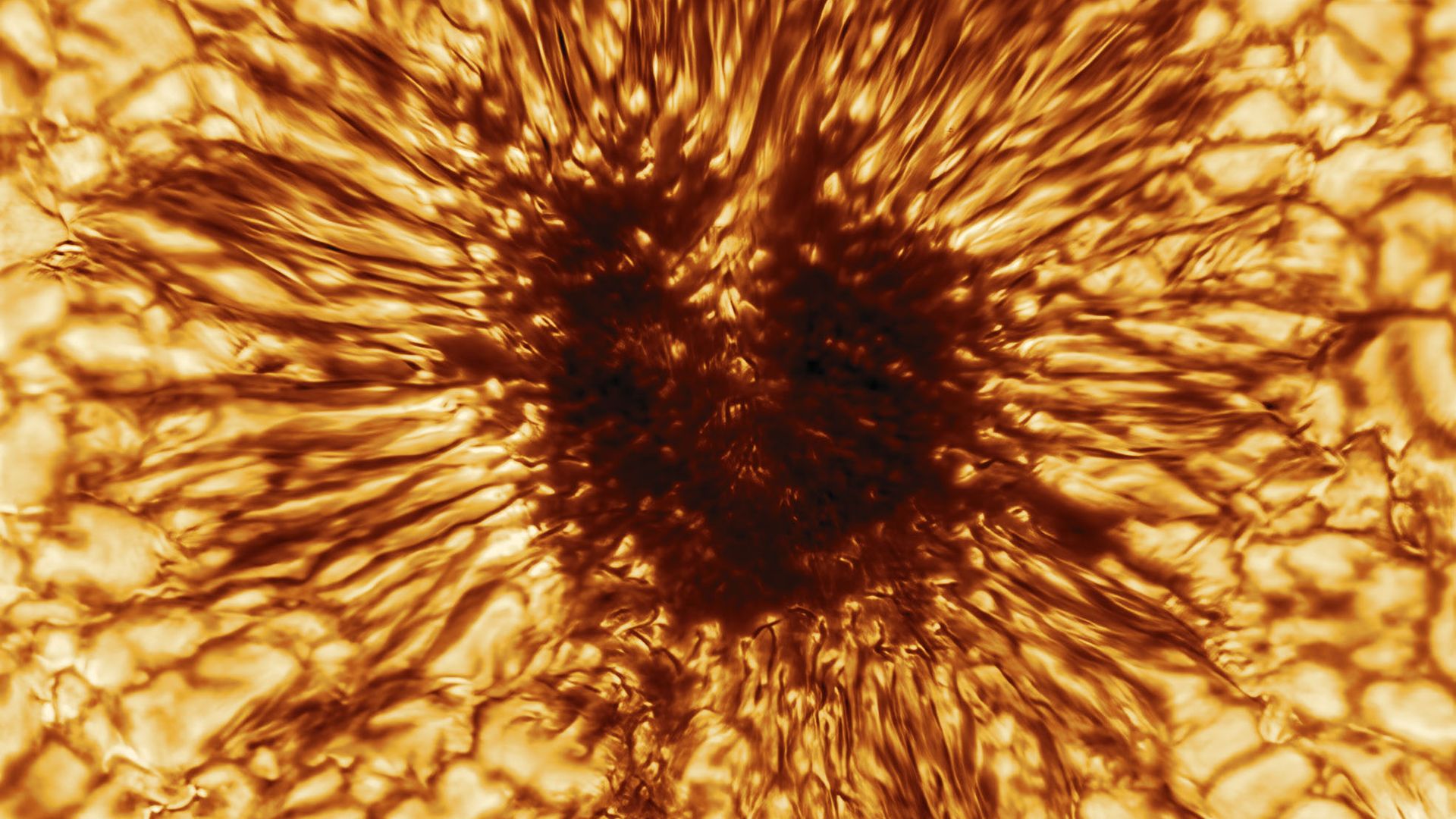
Photo: NSO/AURA/NSF
No, it's not the eye of Sauron. This newly released photo shows the up-close details of a sunspot photographed by the Inouye Solar Telescope in January.
- Sunspots are active areas of the Sun where solar flares can erupt, making them particularly interesting targets for scientific study.
- "This sunspot image, measuring about 10,000 miles across, is just a tiny part of the Sun. However, the sunspot is large enough that Earth could comfortably fit inside," the National Solar Observatory wrote in a press release.
The big picture: Scientists want to use telescopes like the Inouye Solar Telescope to learn as much as they can about our nearest star in order to one day predict space weather that could threaten satellites and power grids on Earth.
Big thanks to Alison Snyder, David Nather and Sheryl Miller for editing this week’s edition and Kia for contributing. If this email was forwarded to you, subscribe here. 🕎