Axios Space

July 18, 2023

Thanks for reading Axios Space. At 1,250 words, this newsletter is a 5-minute read.
- Programming note: This newsletter is going to be taking a couple of weeks off while I'm on a trip with the family. See you all again on Aug. 8.
Please send your tips, questions and coronal mass ejections to [email protected], or if you received this as an email, just hit reply.
1 big thing: Understanding the Sun
Illustration: Sarah Grillo/Axios
The Sun's activity is defying forecasts and highlighting how difficult it is to predict the machinations of Earth's nearest star.
Why it matters: Space weather, which is largely driven by the Sun, can shorten the lifespans of satellites, cause radio blackouts and, in extreme solar storms, bring down power grids.
- Predicting and understanding the inner workings of the Sun is key to figuring out how it might behave in the short and long term.
Driving the news: Predictions from 2020 suggested the Sun would reach the peak of its 11-year solar cycle in 2025, and its intensity would be on par with the last cycle.
- But current observations show its activity could now peak as early as 2024.
- The current cycle is also on track to be more extreme, with more solar flares, sunspots and activity than the previous one, though not as big as others on record.
How it works: The National Oceanic and Atmospheric Administration's Space Weather Prediction Center (SWPC) is responsible for predicting and forecasting space weather on any given day.
- The SWPC uses instruments in space and on Earth to gather data about the electrically charged solar plasma constantly emitted by the Sun.
- Sunspots — dark areas on the face of the Sun — can spit out major solar flares that sometimes come with coronal mass ejections (CMEs), bursts of electrically charged plasma that can interfere with satellites, electrical grids and supercharge the auroras.
- If coronal holes — cooler spots in the Sun's atmosphere — rotate into the view of Earth, they can send extremely fast solar winds into our part of space, warping Earth's magnetic fields in the process.
Yes, but: The Sun is extremely complicated and even after decades of study, researchers don't understand exactly how it works.
- "When you see a big sunspot, what's the chance that it's going to erupt and give us a big solar flare and coronal mass ejection?" NASA scientist Alex Young tells me. "We don't understand the factors that go into what makes it release its energy."
The intrigue: Forecasters also have trouble predicting what the basic impacts of any given solar storm could be.
- Scientists know the magnetic orientation of a CME determines whether it will strongly interact with Earth's magnetic field, causing potential problems. However, when a CME erupts, scientists aren't able to figure out its magnetic orientation immediately.
- It typically takes a day or so for a CME to travel the 93 million miles to Earth, and scientists today don't have the technology to predict a CME's impact until it reaches the satellites stationed about 1 million miles from our planet.
- "It can take somewhere between 20 minutes to an hour" for a CME to reach Earth from 1 million miles away, Young said, adding that it's enough time for power companies to make some adjustments to protect the grid if needed, but it's not ideal.
What to watch: NOAA is planning to fly two new instruments to space that should help them keep an eye on the Sun in the coming years.
- A Sun-focused instrument is slated to launch on the GOES-U weather satellite next year and another instrument will fly in 2025.
- Eventually, private companies could have a role in providing the data needed to forecast space weather.
- "Maybe the private sector can fly the spacecraft and sell the data to the government in a more cost-efficient way to do business," William Murtagh, the program coordinator for the SWPC, tells me.
2. A rebound for the space industry
Illustration: Sarah Grillo/Axios
Space industry startup investment is beginning to show signs of evening out after a turbulent start to the year.
Why it matters: The space industry isn't immune to broader market headwinds, and space startups are essential to the growth of the industry.
What's happening: A new report from Space Capital shows 91 companies received a total of $6 billion in the second quarter of 2023, marking a slight comeback after the first quarter of the year.
- Hiring in the space economy also went back up to 2020 levels, according to the report, and investment rose 72% from last quarter.
- Yes, but: If you exclude a major transaction involving the satellite company Maxar, "Q2 was the lowest quarter for private market investment in the Space Economy since 2015 due to a lack of large late-stage rounds — just six companies raised more than $100M," the report reads.
The big picture: For years, it was relatively easy for companies just starting out to find funding in the space industry, but those days appear to have ended.
- "2021 was the 'peak of inflated expectations' with large financings in Launch, speculative investments in Emerging Industries, mega rounds by crossover investors in Location-based Services, and a crescendo of disappointing SPACs," the report reads.
- Now, the industry is in leaner times, which will likely mean only the strongest companies survive, positioning the industry at large for growth.
3. Dark stars seen by JWST
The three dark star candidates. Photo: NASA/ESA
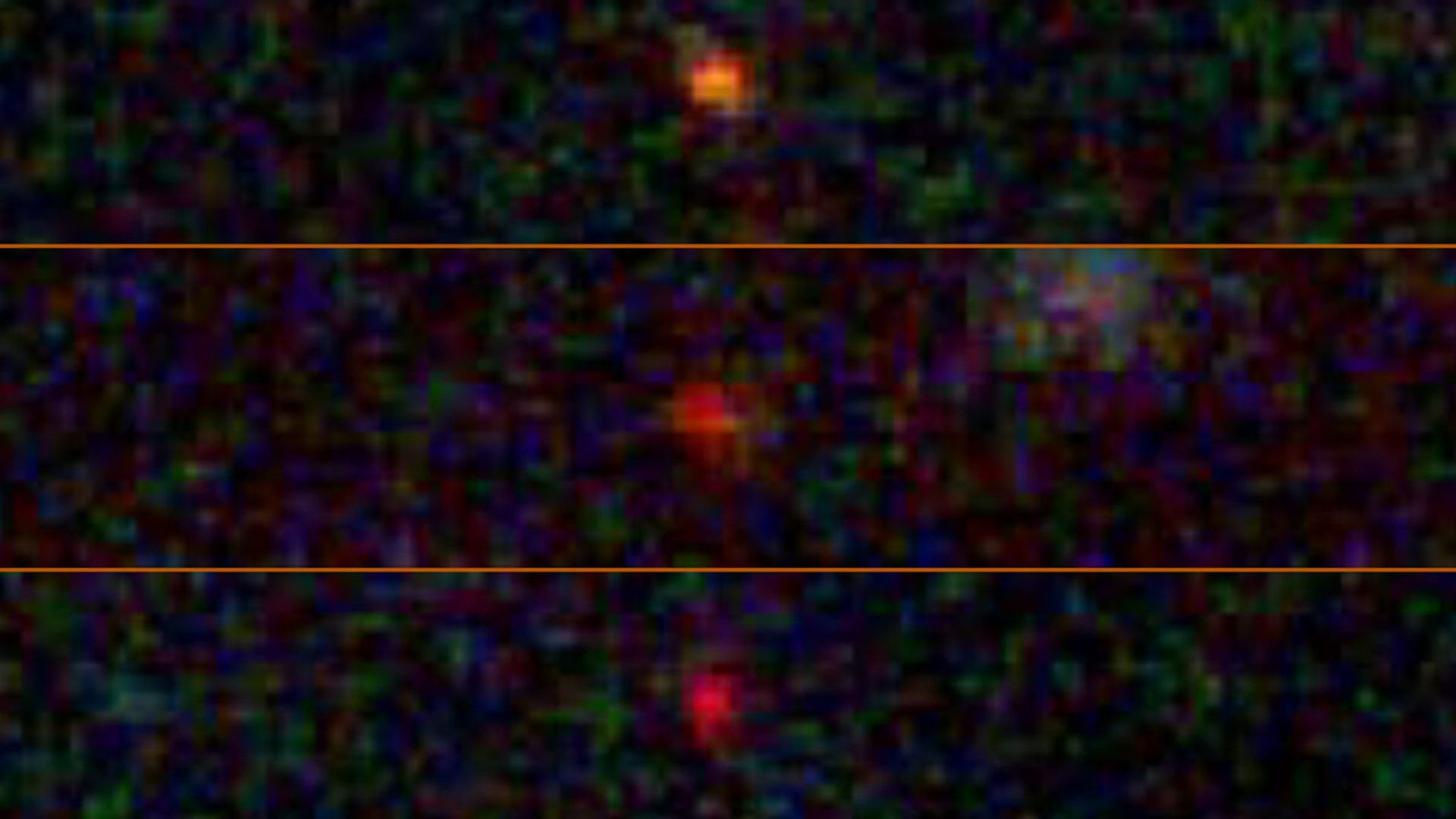
Scientists using NASA's James Webb Space Telescope may have spotted three large stars that might be powered by annihilating dark matter.
Why it matters: Dark matter is thought to make up 25% of the universe, but scientists still don't understand it.
- If these objects are "dark stars," it could help scientists better understand the nature of dark matter.
What they found: The three objects were found in 2022 and initially thought to be galaxies with millions of luminous stars that existed just 320 million to 400 million years after the Big Bang.
- But there is another possibility: They could be dark stars.
- These theoretical objects — which have never been observed — can be as bright as a galaxy, making the possibility that these objects are dark stars worth looking into, according to the researchers behind a new study in the Proceedings of the National Academy of Sciences.
- "And believe it or not, one dark star has enough light to compete with an entire galaxy of stars," Katherine Freese, of the University of Texas at Austin and co-author of the study, said in a statement.
How it works: Theoretically, dark stars can form when dark matter particles collide, destroying themselves and heating clouds of collapsing hydrogen.
- After the dark matter is depleted, causing the supermassive dark star to die, it's possible it could collapse into a black hole, acting as "seeds for the supermassive black holes observed throughout the universe and at early times," the study says.
The big picture: If these objects are dark stars, it could also help explain why the JWST has discovered more galaxies in the early universe than initially expected.
- "[I]f some of these objects that look like early galaxies are actually dark stars, the simulations of galaxy formation agree better with observations," Freese added.
What's next: Future observations from the JWST could help scientists learn more about what exactly these objects are.
4. Out of this world reading list
Rho Ophiuchi seen by the JWST. Photo: NASA/ESA/CSA/STScI/Klaus Pontoppidan and Alyssa Pagan (STScI)
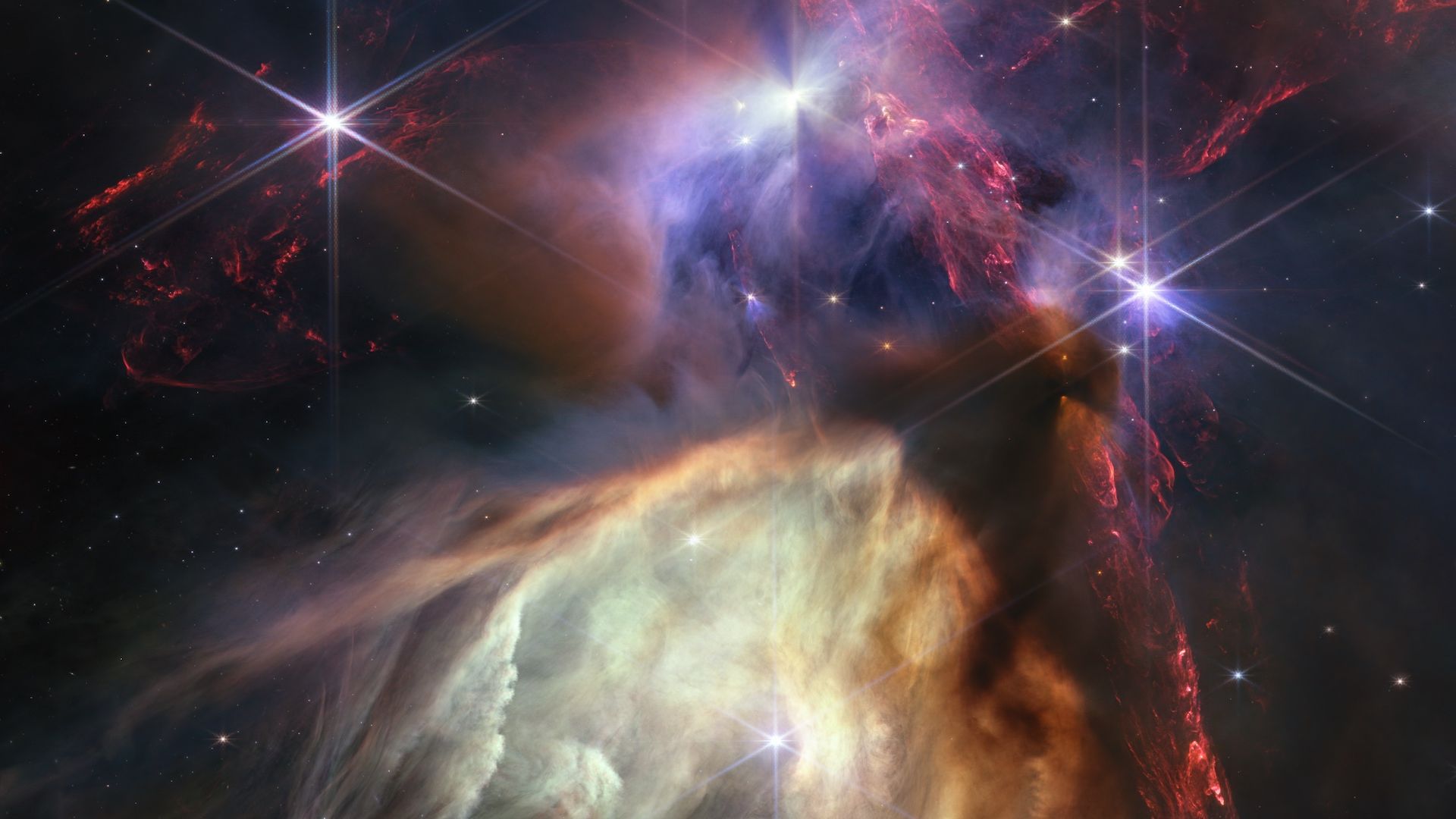
✨ NASA's JWST reveals shining baby stars in new photo (Axios)
💰 Young space firms are driving acquisition activity (Jason Rainbow, SpaceNews)
✈️ Virgin Galactic reveals three passengers for its first space tourism flight (Ashley Strickland, CNN)
🌕 For the first time in 51 years, NASA is training astronauts to fly to the Moon (Stephen Clark, Ars Technica)
5. Weekly dose of awe: Purple, pink skies
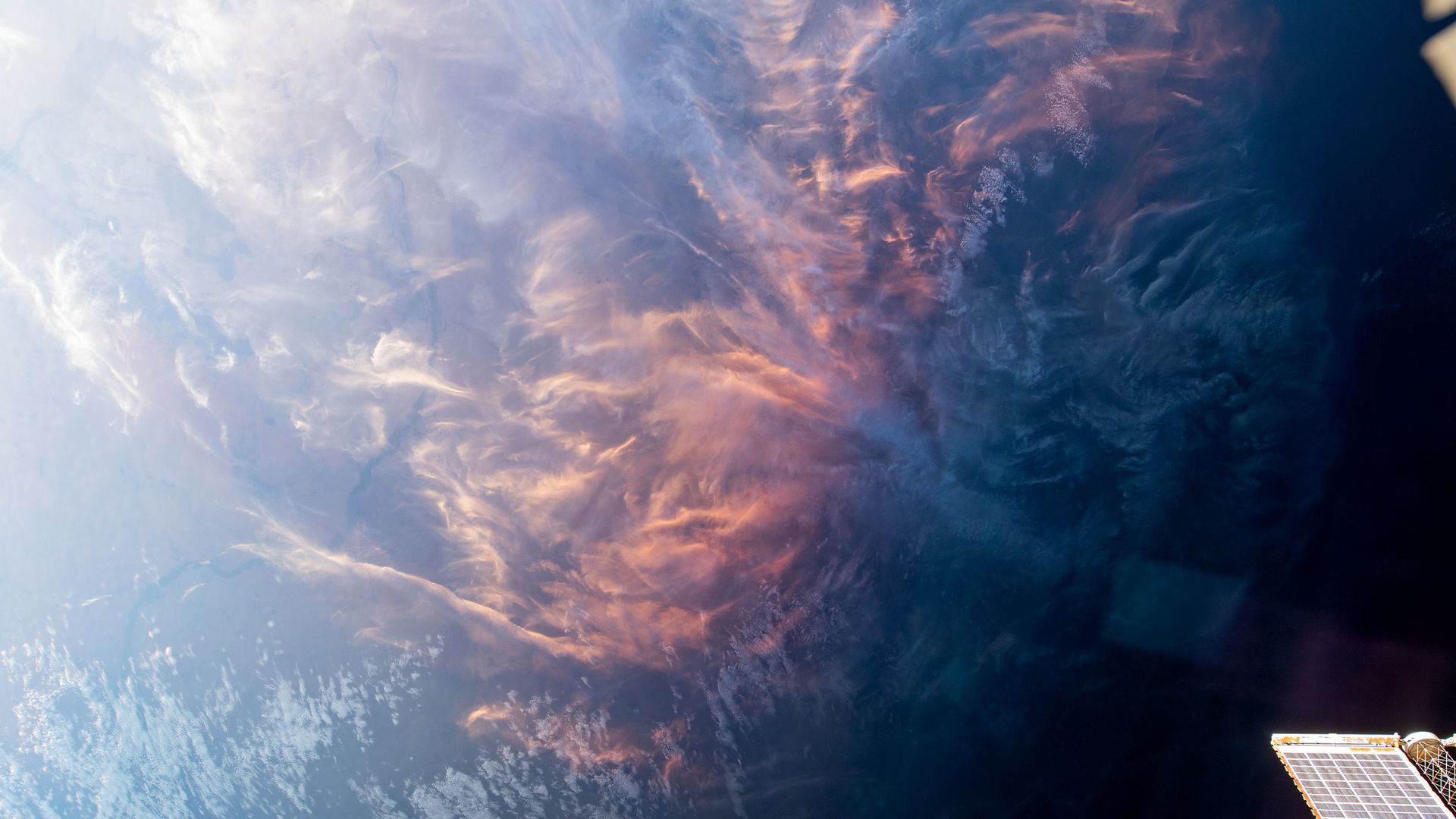
Photo: NASA
These are the photos that make me understand just how special having humans in space can be.
- Wisps of pink clouds stand out 259 miles above the Red Sea as seen from the International Space Station.
- It's a perfectly normal space photo, but somehow having this perspective on our planet makes it seem absolutely extraordinary.
🕶 Big thanks to Alison Snyder for editing, Sheryl Miller for copy editing and the Axios visuals team. If this newsletter was forwarded to you, subscribe.
Sign up for Axios Space

Explore the science and business of space