Axios Sneak Peek

November 17, 2021
Welcome back to Sneak. The president hit the road — to sell his roads-and-bridges law.
Smart Brevityâ„¢ count: 1,021 words ... 4 minutes. Edited by Glen Johnson.
1 big thing: A first - Mandatory draft registration for women

Illustration: Annelise Capossela/Axios
America's young women are on the cusp of a rite of passage that's been reserved for men until now: registering with the Selective Service when they turn 18, write Axios' Sophia Cai and Alayna Treene.
Driving the news: Whether allowing women to serve in combat also means they should have to sign up for the military draft has been a debate for decades. Now, an unlikely coalition of feminists, veterans and conservatives could make it law as part of the Senate's expected passage of the National Defense Authorization Act.
- The House included the change when it passed its version of the NDAA in September. The Senate could act as early as this week.
- A majority on the Senate Armed Services Committee backed the change in a markup over the summer. One group of Republicans now is renewing an effort to block it as the Senate considers amendments before a final vote, but it's not clear they have the numbers to stop it.
- Senate Minority Leader Mitch McConnell has said for years the draft also should apply to women.
The change is in line with the recommendation of a March 2020 study by the National Commission on Military, National and Public Service.
- Earlier this year, President Biden, through his female acting solicitor general, asked the Supreme Court to let Congress rather than the courts decide.
How it works: The change would require Americans ages 18-26 to sign up — regardless of their gender identification.
- That would ensure their information is available in case there were ever another draft.
Why it matters: It would certainly represent a major cultural milestone as women take on greater non-traditional and leadership roles across all facets of American life, from politics to industry to the military.
- It also could solve for shifting definitions around gender in society today.
But, but, but: The impact seems more symbolic than substantive for now. Today's military is comprised of volunteers — both men and women.
2. Congress fights for war power
Illustration: Sarah Grillo/Axios
Congress is about to repeal a president's authorization to use military force for the first time in about half a century, kicking off a debate about restoring its role in authorizing future wars, write Alayna and Axios' Zachary Basu.
Why it matters: Democrats are eager to declare they've succeeded in facilitating an official end to America's "endless wars." The 2002 AUMF that justified the Iraq war was cited as recently as the January 2020 assassination of Iranian Gen. Qassem Soleimani, who was killed in a drone strike in Baghdad.
- Critics say the authorization was never intended for such an operation and letting it linger could trigger misuse by future presidents.
- Some Republicans fear repealing it could embolden Iranian-backed militias in Iraq, which have carried out attacks against U.S. troops stationed there.
- Biden, who supports repealing it, has acknowledged the U.S. has "no ongoing military activities that rely solely on the 2002 AUMF as a domestic legal basis."
- The repeal of another resolution passed in 2001, which also has been exploited, would be a heavier lift.
Between the lines: The 2002 authorization gave President George W. Bush the domestic authority to invade Iraq and topple the government of Saddam Hussein.
- Nearly 20 years later, the number of U.S. troops in Iraq is down to 2,500 from a peak of about 170,000, and the Iraqi government is an ally of the United States.
- The Senate — on a rare bipartisan basis — is expected to vote as early as this week to repeal it as a component of approving the National Defense Authorization Act.
- Senate Minority Leader McConnell concedes it will be repealed but is expected to speak out against the move, aides told Alayna.
3. Charted: Rarity of repeal

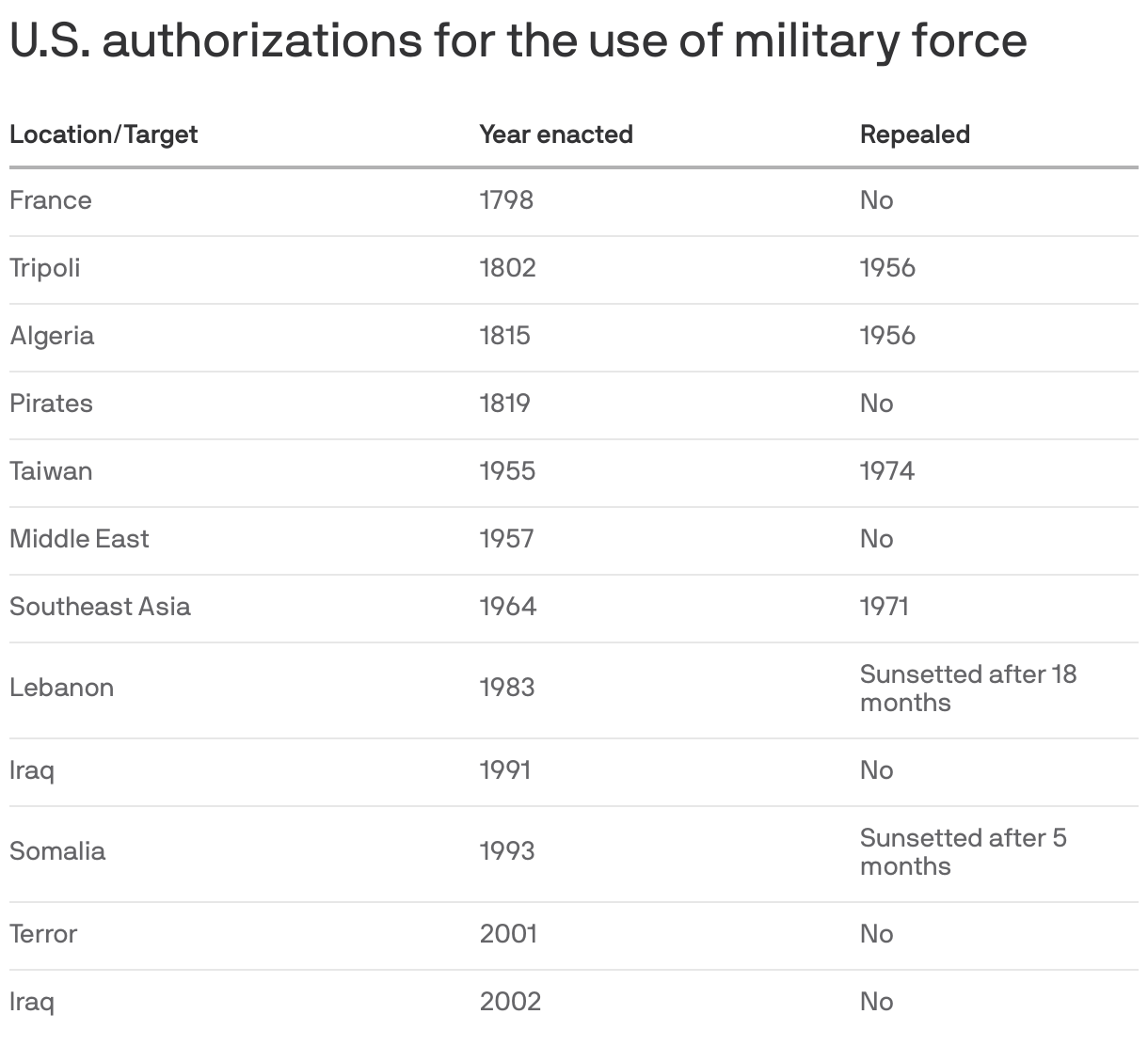
The last time an authorization of military force was repealed was in 1974, and some ancient authorizations remain on the books, Axios' Andrew Solender reports based on data from the Congressional Research Service and House Historian.
Why it matters: Lawmakers in both parties have framed repeals as a rare instance of the legislative branch wresting some control back from the executive branch. That's especially true in the post-9/11 era, when Congress’ authority on war powers is often overlooked.
- The longest-standing authorizations include a 1798 one on targeting French vessels.
- Another is an 1819 law to address piracy in the Caribbean Sea.
- Other authorizations passed in the early 19th century were repealed only in the 1950s.
What they're saying: "I think it's incredibly significant," Rep. Peter Meijer (R-Mich.) said of Congress taking steps to repeal AUMFs.
- He's introduced bills to repeal AUMFs from 1957 and 1991.
- "This is not a partisan issue; this is about institutional prerogatives," said Meijer, an Army veteran.
4. Sullivan outlines four China "buckets"
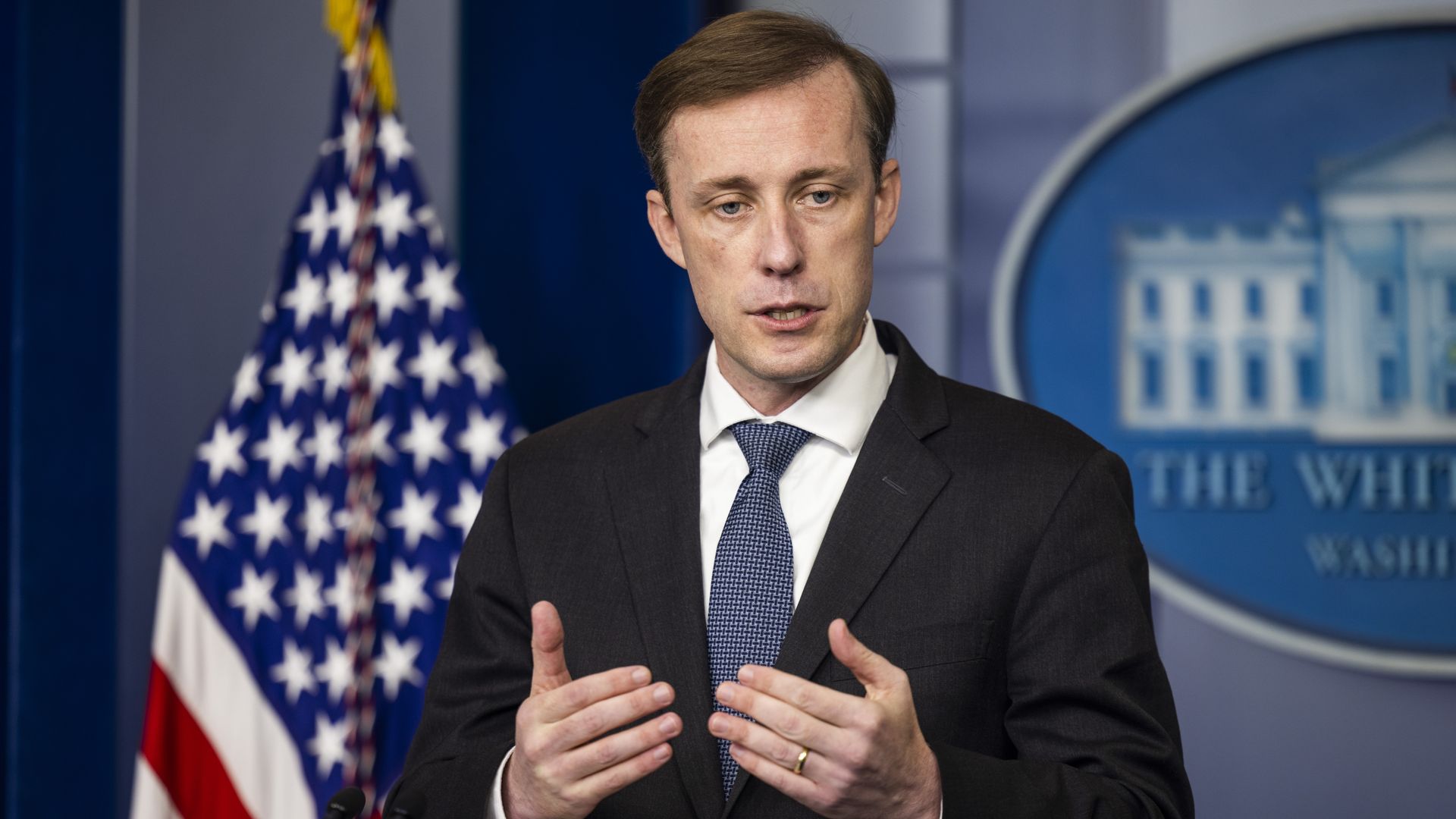
National security adviser Jake Sullivan. Photo: Jim Lo Scalzo/EPA/Bloomberg via Getty Images
National security adviser Jake Sullivan said today the future of the U.S.-China relationship can best be categorized by placing future bilateral engagement into four "buckets," Zachary also reports.
Why it matters: Biden held a 3.5-hour, late-night virtual meeting with Chinese President Xi Jinping last night. Sullivan helped fill in the blanks with a public readout on the talks at the Brookings Institution this morning.
- Bucket No. 1: Working together on "urgent" issues in which U.S. and Chinese interests align, such as implementing the COP26 climate deal and vaccinating the world to end the COVID-19 pandemic.
- Bucket No. 2: Addressing challenges in which the U.S. and China have historically worked together and now face important tests, including Iran nuclear talks and North Korea's escalating missile tests.
- Bucket No. 3: Improving direct communication to effectively "manage differences," including over Taiwan. Sullivan said Biden reminded Xi he voted for the Taiwan Relations Act as a senator in 1979 and deeply understands what U.S. law says about support for the island's self-defense.
- Bucket No. 4: Resolving outstanding issues in the Phase One trade deal, while continuing to use "the full range of tools available to us" to confront China's unfair economic practices.
Sullivan also revealed Biden asked Xi to launch talks on "strategic stability," following growing concerns about China's rapid expansion of its nuclear arsenal.
5. Pic du jour: Swords into ploughshares

Photo: Win McNamee/Getty Images
Rep. Rosa DeLauro (D-Conn.) protected her eyes before working with molten metal.
- She was attending an event near the Capitol to convert firearms into garden tools.
📬 Thanks for reading. A reminder your family, friends and colleagues can subscribe to Sneak or any of Axios’ other free local and national newsletters through this link.
Sign up for Axios Sneak Peek

Take a look at both ends of Penn Ave — and our best scoops