Axios San Francisco

June 14, 2026

💼 Hello, it's Sunday.
- In today's special Business Brief, we dive deep into how AI is changing work.
🌤️ Today's weather: Mostly sunny, with a highs around 70, lows near 60.
Today's newsletter is 1,052 words — a 4-minute read.
1 big thing: 🤖 AI workforce disruptions
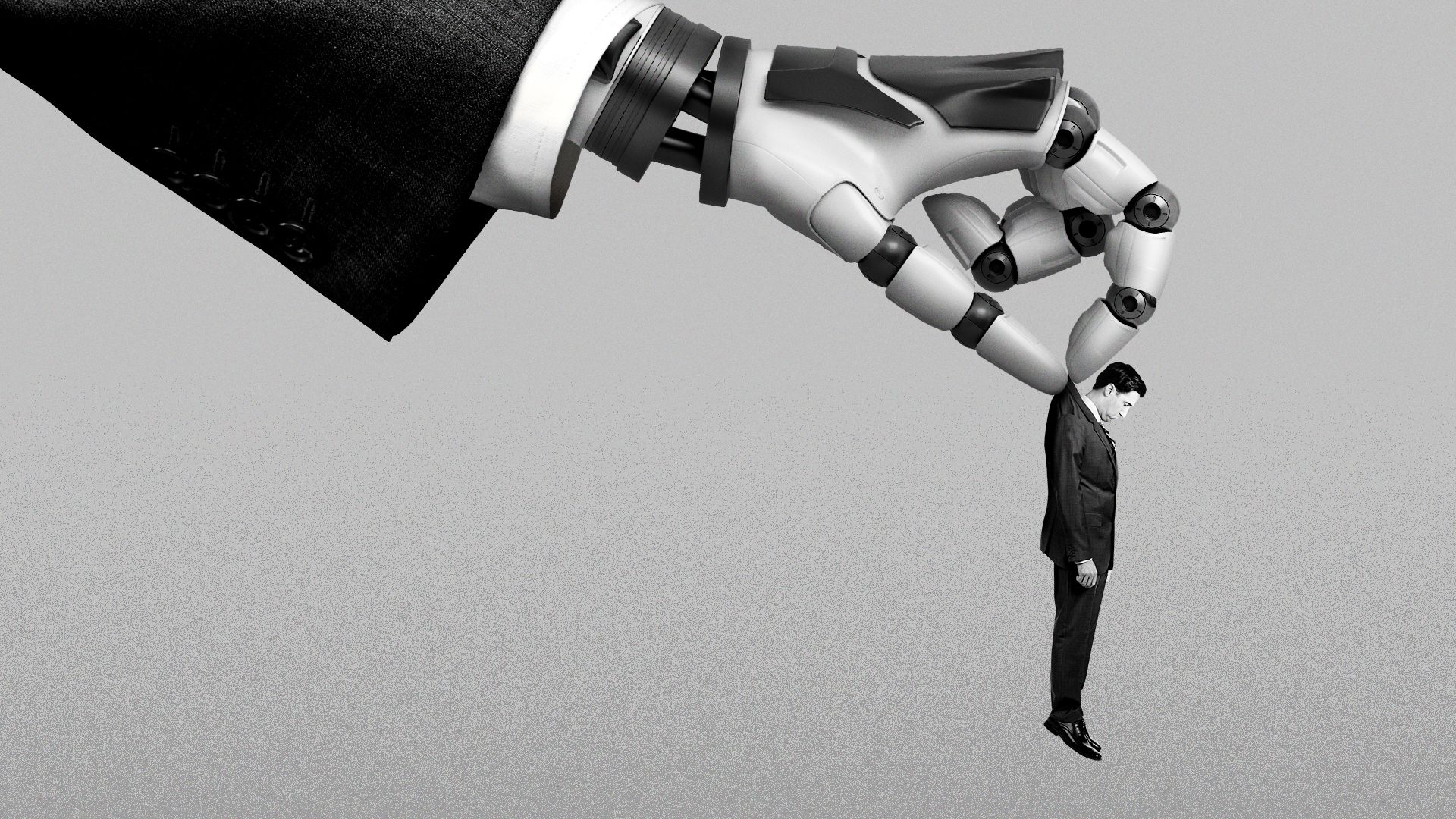
Gov. Gavin Newsom's executive order last month directing state agencies to study how AI is reshaping work reflects a growing challenge for policymakers: preparing workers for labor market changes as the technology accelerates and anxiety about job losses grow.
Why it matters: California is home to many of the world's leading AI companies, making it both a driver of rapid growth and a potential ground zero for any workforce disruption that follows.
State of play: Newsom has billed the order as a first-in-the-nation effort to help California get ahead of AI-driven workforce disruption through data collection, employment trend monitoring and worker safeguards like retraining programs and severance pay.
The big picture: AI adoption is rapidly spreading, but what it ultimately means for workers remains an open question.
- Though there have been high-profile layoffs linked to AI, labor market data has yet to show widespread job losses directly attributable to it, Michael Bernick, former director of California's Employment Development Department (EDD) and an employment and labor lawyer at Duane Morris LLP, told Axios.
- "We just don't know" AI's effects on jobs yet, he said. "We need a far broader understanding of what's really going on."
The EDD has begun collecting and analyzing workforce data to identify whether losses are emerging and which occupations could be most exposed.
- "It's largely at this stage studying it, which I think is the right approach," Bernick added.
Between the lines: Newsom's order arrives amid growing public concerns over AI's economic consequences.
- Stanford's 2026 AI Index shows that nearly two-thirds of Americans believe AI will lead to fewer jobs in the coming decades.
- "There isn't any policymaker that we're talking to that isn't thinking about this issue," Drew Spence, a policy program manager at Stanford's Institute for Human-Centered Artificial Intelligence, told Axios. "What we need more of is data to understand where some of the workforce changes are going to be the most profound."
Occupations that could be affected include software development, manufacturing, healthcare, customer service and certain administrative roles.
- But Spence cautioned that the evidence remains preliminary and often points to a more complicated reality.
The intrigue: While some employers may eventually need fewer workers for certain tasks, others are using AI to make employees more productive, rather than replace them altogether.
- That distinction — augmentation versus replacement — is becoming central to discussions about AI and the future of work, Spence said.
2. 💼 AI becomes easy culprit for layoffs
San Francisco-based Coinbase is one of the latest companies to pair layoffs with announcements that AI is changing the way the company operates.
Why it matters: Companies are increasingly blaming AI for job cuts, but a messier mix of automation, cost-cutting and market pressure are also factors.
Driving the news: Coinbase CEO Brian Armstrong told employees last month the firm will lay off about 700 workers and rebuild around "AI-native" pods.
Zoom out: Coinbase joins Block, Pinterest and Shopify in tying workforce cuts or restructurings to AI, though it is often hard to tell whether automation drove the layoffs or helped justify them.
- None of the companies appear to have offered concrete AI productivity metrics on earnings calls before the announcements.
What they're saying: Goldman Sachs economist Joseph Briggs said labor market data can help separate real AI-related job losses from corporate AI hype.
- Briggs expects AI adoption to push unemployment modestly higher over time — by about half a percentage point. He also expects AI to create new jobs that offset some of those losses.
- Still, he cautioned that unemployment could rise more sharply in the short term if companies adopt AI faster than workers can transition into new roles.
Reality check: So far, the number of jobs eliminated by AI at companies like Meta, Cloudflare and Coinbase "has been minimal," Michael Bernick, an employment and labor law attorney at Duane Morris LLP, told Axios.
- "For the most part, the rush to AI by employers has been to examine potential uses for their existing workforce in utilizing AI, and train for these uses," he added.
Follow the money: Developer and founder Mo Bitar said fears of AI-driven job losses can discourage workers from seeking raises or switching jobs.
3. ✂️ Workplace benefits get cut
The era of ever-expanding workplace perks may be coming to an end.
Why it matters: High health-care costs, shrinking worker leverage and an AI reckoning are leading some employers to roll back generous workplace benefits.
The big picture: Standard benefits during COVID and workforce shortages — from fertility subsidies to 401(k) matches — appear on shakier ground, with several companies recently scaling back benefits.
- Deloitte has reduced family leave, vacation time and some health-related perks, saying the changes better align with the market.
- TTEC, a customer experience technology company, paused its U.S. 401(k) match this year, citing investments in AI, automation and employee training.
By the numbers: More than half of business leaders surveyed by ResumeBuilder.com said they are cutting benefits (53%), raises (53%) or bonuses (61%) to help fund AI investments.
Between the lines: Workers now have less leverage than they did during the hiring boom, marking a sharp turn from the tech industry's perks race when free meals, wellness programs and other extras became recruiting tools.
4. 📉 Young workers discouraged


Young Americans are far less confident about their job prospects than older workers — an optimism gap that is larger in the U.S. than anywhere else Gallup surveyed.
The big picture: In most countries, younger people are either more optimistic about finding work or share a similar outlook with older generations.
By the numbers: Just 43% of Americans ages 15 to 34 said 2025 is a good time to find a job where they live, compared with 64% of adults 55 and older.
- That 21-point gap is the widest among 141 countries surveyed.
Zoom in: The steepest drop in optimism came from young Americans with higher education who haven't yet landed full-time jobs, said Benedict Vigers, a senior news writer at Gallup who analyzed the data.
- Concerns about AI are a driver as workers increasingly question the future of entry-level opportunities.
🧠 Nadia is reading about personalized AI agents and how they are being used to automate work.
🗓️ Shawna is out.
This newsletter was edited by Geoff Ziezulewicz.
Sign up for Axios San Francisco