Axios San Francisco

May 26, 2026

💊 Good morning, it's Tuesday.
☀️ As summer arrives and we zero in further on our health, today's newsletter pulls back the curtain on supplements promising optimal health and longevity.
⛅ Today's weather: Partly sunny with highs around 60, lows near 50.
🎧 Sounds like: "Medication" by Garbage.
Today's newsletter is 1,047 words, a 4-minute read.
1 big thing: 👀 Not your grandfather's horse pills

New supplements aren't just boasting vitamins and minerals; they also promise to be beautiful, delicious and vegan.
Why it matters: People are relying on marketing messages instead of their personal health needs to pick and choose what to take.
Threat level: Most people aren't regularly talking with their primary care physician about supplements, and even if they did, doctors and many health care professionals "have no clue here," Taylor Wallace, CEO of Think Healthy Group and editor of the Journal of Dietary Supplements, told Axios.
- "I always suggest consulting with a registered dietitian nutritionist (RDN) about supplement regimens to make sure you aren't getting too much," Wallace says.
What they're saying: Glossy marketing messages can also be a red flag, says Pieter Cohen, associate professor at Harvard Medical.
- Cohen, who has been researching the industry for decades, warns against the dangers of supplements and how labels can be wrong about ingredients and amounts.
- "If the supplement label suggests it will have some immediate or really any health benefit, I recommend not taking it," he said.
Many consumers imagine supplements as something closer to "farm to capsule," wellness author Colleen Derkatch said on a recent podcast — products harvested from idyllic fields and naturally transformed into health boosters.
- But in reality, she noted, supplements often look far more like pharmaceuticals than people assume: manufactured in labs, packaged in pill bottles and produced through highly industrialized processes.
One way consumers can vet the latest supplement trending on TikTok is through third-party verification.
- Organizations like NSF and USP maintain directories of products that have been independently tested to confirm they contain what their labels claim.
- Always tell doctors prescribing you medication what supplements you're taking to make sure they don't react poorly to one another.
The bottom line: Supplements are processed pills with a business behind them.
2. 📈 Supplement sales surge

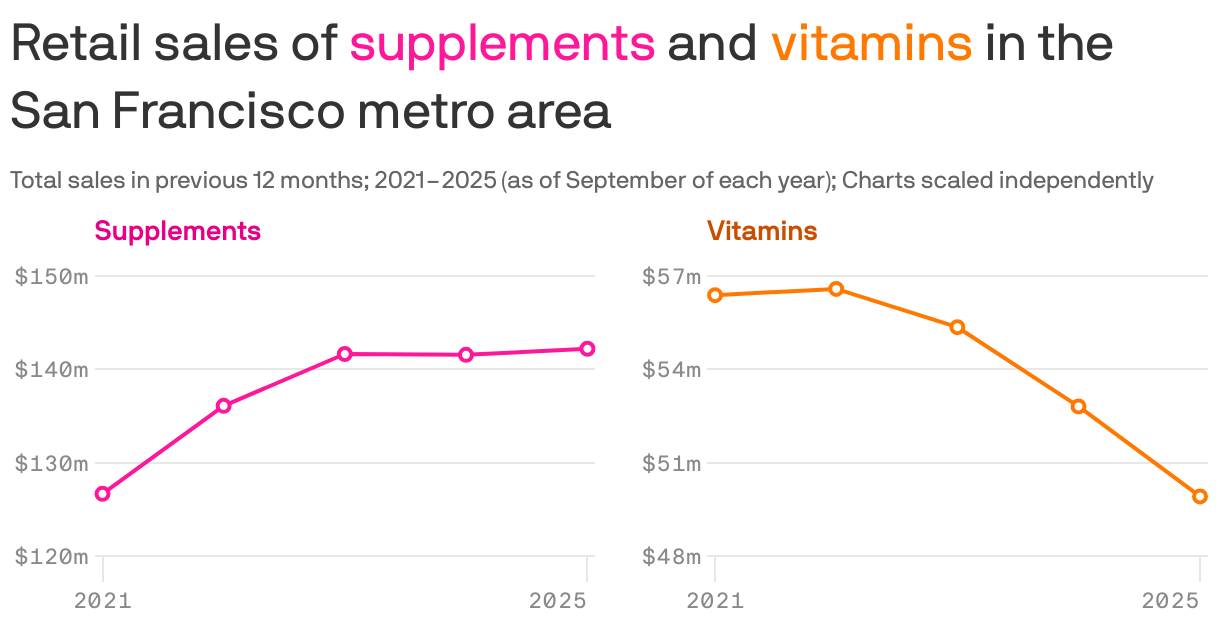
Multi-ingredient supplements are outselling single-ingredient vitamins such as vitamin C or vitamin D capsules, data from NielsenIQ shows.
Why it matters: Consumers are pouring more money into products promising weight loss, sleep and stress relief — part of a bigger global shift toward spending on wellness.
Zoom out: Globally, 82% of consumers say health product labels need to be more transparent and a quarter cite lack of trust in effectiveness as a barrier to healthier choices, per NIQ's Global Health & Wellness Trends report.
3. The Wiggle: ✨ Carnaval weekend shines

💃🏽 The city's annual Carnaval celebration brought thousands to the Mission over the weekend for a parade filled with colorful costumes, dancing and music. (KQED)
Japanese punk band Peelander-Z canceled its San Francisco show at Bottom of the Hill after a semitruck crash seriously injured all three members. (SF Chronicle)
💰 Supervisors Alan Wong and Stephen Sherrill are receiving support from a PAC funded by fast-food franchise owners who opposed California's $20 fast-food minimum wage law. (Mission Local)
4. 🏛️ The politics of vitamin pills
HSS Secretary Robert F. Kennedy Jr. has been portrayed as supplements' savior, but his FDA plans may not go down easy.
Why it matters: Millions of Americans take supplements, and how the federal government treats them affects everything from individual health to a booming business' bottom line.
Catch up quick: The FDA regulates supplements — a $60 billion industry — but unlike prescription drugs, companies don't need pre-approval to sell them. The agency usually only steps in after a product is flagged as unsafe or misleading.
What we're hearing: Kennedy, known for taking multiple vitamins himself and touting some supplements as treatments, is directing the FDA to require review of all Generally Recognized as Safe (GRAS) affirmations — the process companies use to show a substance is safe to eat without needing full agency approval.
Between the lines: That proposal might be "well intentioned," Natural Products Association CEO Daniel Fabricant told Axios, but could drive up supplement prices and limit consumer choice.
- Fabricant, a former FDA director, said the food and supplement industries could face "one standard federally, and then 50 other standards state-wise. How is that workable for anybody?"
Reality check: Kennedy is weighing in on everything from childhood vaccinations to pushing for autism cures and fighting food additives.
What they're saying: "We encourage individuals to consult a healthcare provider when choosing a dietary supplement and we will continue working to strike the right balance between protecting public health and respecting personal choice," HHS spokesperson Andrew Nixon told Axios in an emailed statement.
The bottom line: While Kennedy's nutritional tilt energizes supplement makers, his FDA proposals could still introduce new regulatory hurdles that the industry may not fully welcome.
5. 🔍 The truth about multivitamins
Multivitamins aren't magical substitutes for a healthy lifestyle, but they could be a part of one.
The big picture: A multivitamin can feel like an easy health insurance policy, but most health professionals say healthy, whole foods are still the best bet.
Most research on multivitamins shows they're low-risk and low-reward. For older adults, there are some documented benefits.
- "When we've seen actually quite consistent findings for potential benefits of a multivitamin on cognition, I would say that applies to men over 60 and women over 65," says Howard Sesso, an associate epidemiologist at Brigham and Women's Hospital and Harvard Medical School associate professor of medicine, who has led multivitamin clinical trials.
- In a study of men 50 and older, daily multivitamin use had a "very modest" reduction in cancer as well as forms of eye disease, Sesso says.
Between the lines: Research on multivitamins, and really everything, has been conducted on more men than women.
- Avoid products with botanicals and a long list of additives, Sesso says. Those don't always mix well with other medications such as GLP-1s or hypertensive meds.
Fun fact: While Sesso agrees that benefits are minimal, he decided to start taking a multivitamin at age 50 ("once I hit the eligibility criteria for the studies that I've been conducting") even though he eats a healthy diet and stays active.
- His advice for multivitamin shoppers: Skip the pricier "specialized formulations" and go with a major brand.
😬 Nadia is not planning on taking supplements anytime soon...
Thanks to Ashley Mays' editor Shane Savitsky.
Sign up for Axios San Francisco